Bidspirit auction | An early WW2 Distinguished Flying
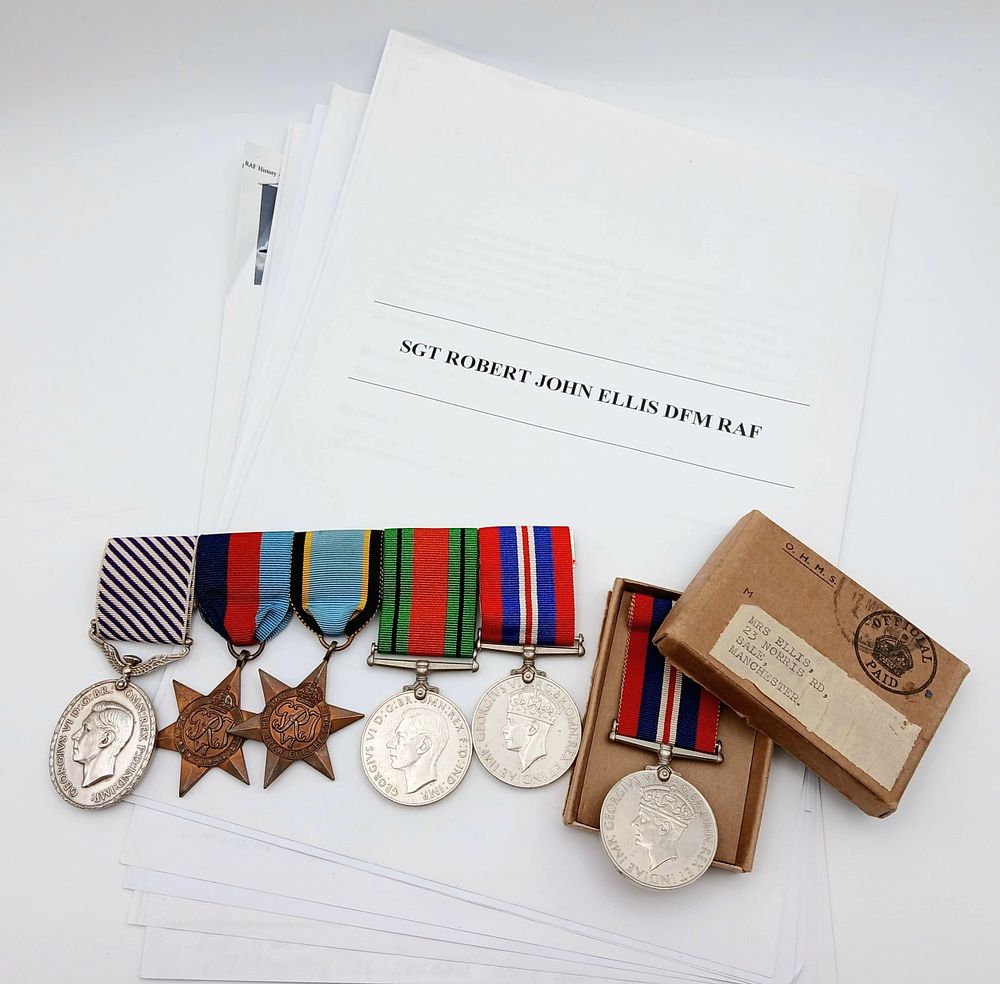
An early WW2 Distinguished Flying Medal (DFM) award to a Navigator/Bomb Aimer on the legendary 75 (New Zealand) Squadron. The DFM named to: 519433 Sgt R J Ellis RAF. Robert John Ellis is a somewhat enigmatic figure as it has not been possible so far to positively confirm his date and place of birth, or his family background. His RAF service number (519433) dates his enlistment into the RAF as October 1925, and so his dob would probably have been c 1908-10; Ancestry lists several Robert John Ellis’s born in his period, none of whom appear to have served in the RAF in WW2. Be that as it may, Robert John Ellis enlisted in the RAF in 1925 and, following the outbreak of WW2, had volunteered for operational aircrew service. Relatively ‘old’ by RAF aircrew standards (aged around thirty years old), he served as a Navigator and Bomb Aimer with 75 (New Zealand) Squadron and, by September 1940, had completed thirty-one operational sorties for which he was recommended for the DFM, the award of which was published in the London Gazette on 22 November 1940. No 75 Squadron was equipped at that time with the Vickers Wellington bomber and it is probable that all thirty-one sorties would have been carried out in that type of aircraft. As a temporary Warrant Officer, he was later commissioned as a Pilot Officer (LG dated 2 June 1942). 75 (New Zealand) Squadron, with Squadron Codes AA and JN, was re-formed in April 1940 (from the former 75 Squadron RAF, which had been disbanded) and equipped with 30 Vickers Wellington Mk ICs, which had previously been ordered by the NZ government, but were gifted to Great Britain following the outbreak of WW2. The majority of the aircrew personnel were from the RNZAF but, where necessary, crews were completed with RAF personnel. Ellis would have been one of these. The Squadron was later equipped with Stirlings and Lancasters, was based at Feltwell, Mildenhall, Newmarket and Mepal and served in 3 Group until the end of the war. The Squadron carried out a total of 8,017 sorties (739 raids) and lost 193 aircraft (2.4%). It carried out the fourth highest number of bombing raids in Bomber Command heavy Squadrons, flew the most sorties in 3 Group and in the whole of Bomber Command, suffered the second highest casualties in Bomber Command and is believed to have dropped the third greatest tonnage of bombs (c 21,600 tons) and the second highest number of mines (2,344). Sergeant J A Ward was awarded the Victoria Cross for climbing out onto the wing of a Wellington of which he was second pilot during the raid on Munster on 7/8 July 1941 in an attempt to put out an engine fire. Although badly damaged by enemy fighters' cannon shells, the aircraft managed to return to its base. Sgt Ward was later KIA during the raid on Hamburg on 15/16 September 1941 With transcript of the citation for the DFM, copy extracts from the LG for the DFM and appointment to a commission and campaign medal award slip. The DFM mounted together with Sgt Ellis’s WW2 campaign medals (1939-45 Star, Air Crew Europe Star, Defence and War Medals) and accompanied by a War Medal 1939-1945 in box of issue addressed to Mrs Ellis at an address in Manchester. Extremely Fine (EF) condition.