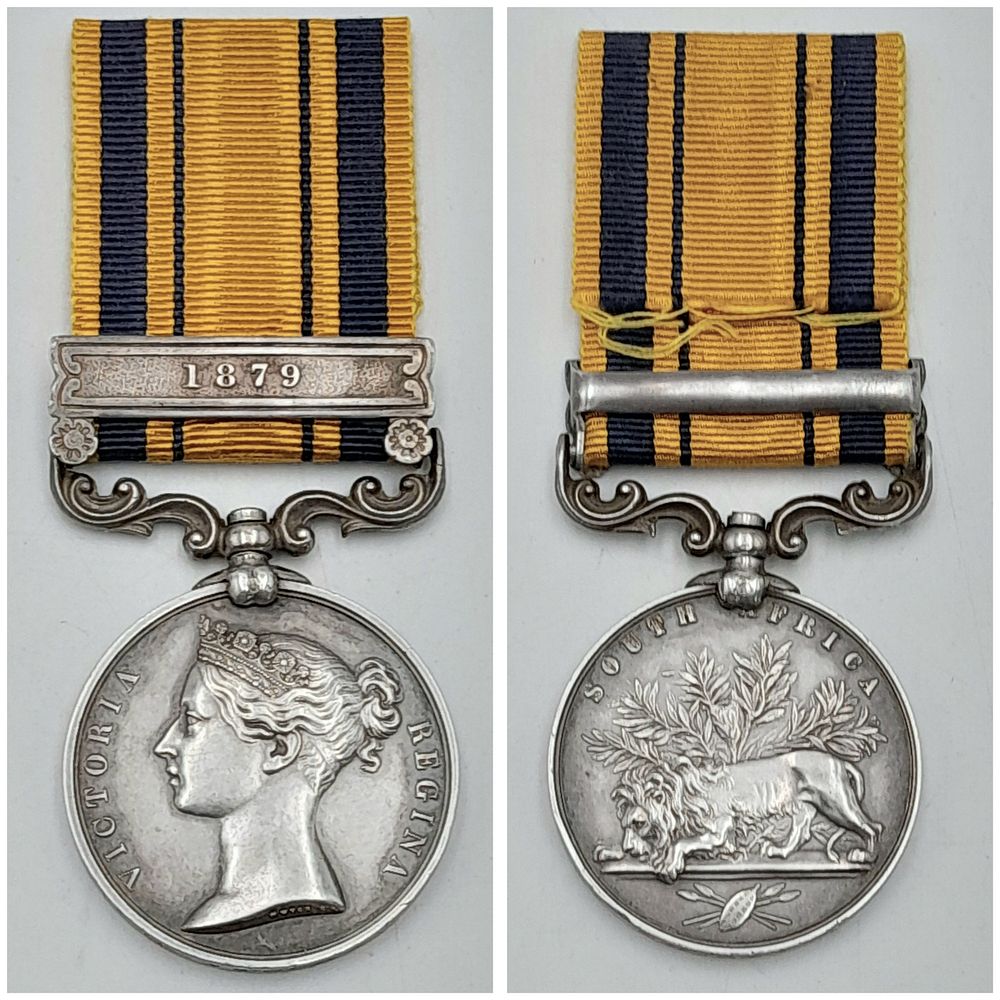
Bidspirit auction | A South Africa Medal 1877-79,
A South Africa Medal 1877-79, with clasp ‘1879’, named to: 1079 Pte W Stocks 99th Foot. The 1879 campaign against the Zulus in Natal is comprehensively documented. The 99th Duke of Edinburgh’s (Lanarkshire) Regiment of Foot served throughout the campaign but did not take part in the final decisive battle of Ulundi. Lord Chelmsford originally had eight British battalions at his disposal forming the backbone of his three invading columns; five were veterans of South Africa - 1/24th , 2/24th , and 90th had recently fought in the Eastern Cape and the 13th and 80th had served against Sekhukhunes’s rebels in the Transvaal – and the 2/3rd had seen no action but had been stationed in Natal for some time. Only the two battalions sent out from Britain as reinforcements in 1878 – the 4th and 99th – were new to South Africa. Six companies of the 99th formed part of Colonel Pearson’s No 1 column which crossed the Tugela River on 11 January 1879; two companies under command of Lt Col Welman took part in the Battle of Nyezane on 22 January and the battalion was later part of the garrison of Eshowe, where it suffered a number of casualties from enemy action and disease. Several companies of the 99th were included in the Eshowe relief column which set out under Lord Chelmsford on 29 March, and formed the west face of the lager (square) at the subsequent Battle of Gingindlovu on 2 April, where Lieut George Johnson was mortally wounded and a further six privates of the 99th were killed or wounded. Pte William Stocks would either have been part of the original No 1 Column, possibly fighting at Nyezane and then forming part of the garrison at Eshowe, or alternatively would have taken part in the second invasion of Zululand, being present at the Battle of Gingindlovu and the subsequent relief of Eshowe. The facing colour of the 99th was yellow, with the regimental badge being the Duke of Edinburgh’s cypher, two ‘A’s on either side of a coronet. The battalion apparently wore the earlier pattern frock, without cuff facing colours, and the older pattern black leather ammunition pouches rather than buff – see attached illustration. With copy extract from medal roll confirming medal and clasp. One small EK on reverse at 8 o’clock and with light toning; otherwise Good Very Fine (GVF) condition.