Bidspirit auction | WW2 Von Braun Rocket Scientist
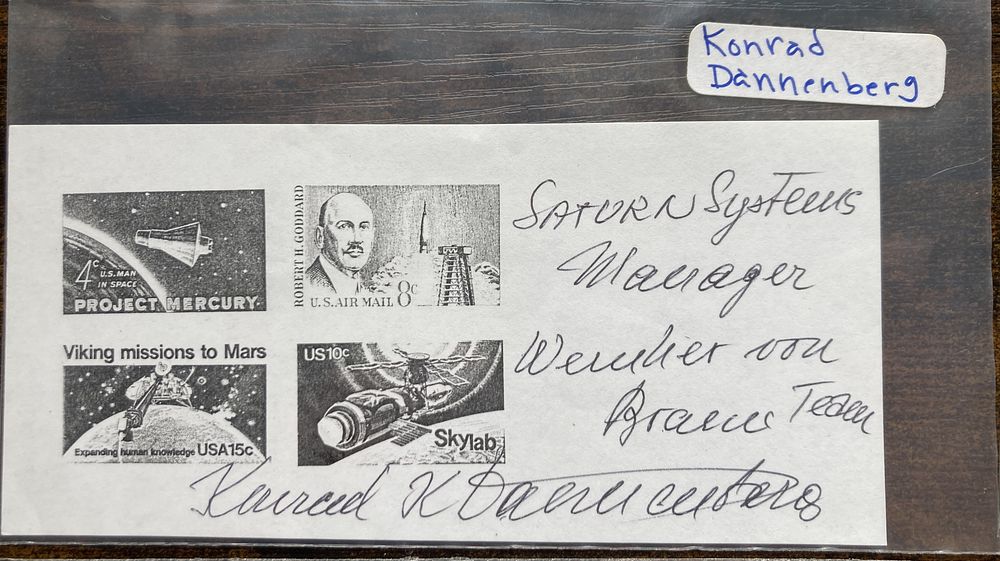
WW2 Von Braun Rocket Scientist Konrad Dannenberg signed page Op Paperclip NASA. Approx 5 x 3 inch piece with Space images hand signed. Konrad Dannenberg (August 5, 1912 - February 16, 2009) was a German-American rocket pioneer and member of the German rocket team brought to the United States after World War II. After the end of World War II, Dannenberg was brought to the United States with 117 other German specialists under Operation Paperclip to Fort Bliss, Texas. Most members of the group performed calculations and designs of future advanced launch vehicles with longer ranges and greater payloads. About 30 members trained the U. S. Army and the support contractor General Electric to launch V-2s at the White Sands Proving Ground. Due to range limitations, all rockets were launched vertically, to limit their range. Robert H. Goddard's idea of upper atmosphere research could now be conducted on a large scale. When the Korean War started, the group was required to leave their quarters in an Annex to the Wm. Beaumont Hospital, and were eventually transferred to the Redstone Arsenal near Huntsville, Alabama, where development of the PGM-11 Redstone Missile was their first assignment. At that time, rocket pioneer Wernher von Braun decided not to start their own rocket engine development, but to purchase an engine from North American Aviation (NAA) that was being developed by Dannenberg's former boss, Riedel, who had previously left the team to join NAA. Due to these circumstances, Dannenberg became Liaison Engineer at NAA's Rocketdyne Division and procured rocket engines for the Redstone and the Jupiter IRBM for the U. S. Army. He also became responsible for production of the Redstone and Jupiter missile systems for the Army Ballistic Missile Agency at the Chrysler plant in Detroit, Michigan. In 1960, Dannenberg joined NASA's newly established Marshall Space Flight Center as Deputy Manager of the Saturn program. He received the NASA Exceptional Service Medal in 1973 for successfully initiating development of the largest rocket ever built, the Saturn V, which took the first human beings to the moon. When Arthur Rudolph came back from the Army's development of the Pershing missile system, von Braun assigned the management of the Saturn system to him. Dannenberg then started to work on Saturn-based space stations, which were eventually replaced by the Space Shuttle-based ISS. . Good condition Est.