Bidspirit auction | WW2 Victoria Cross winner Norman
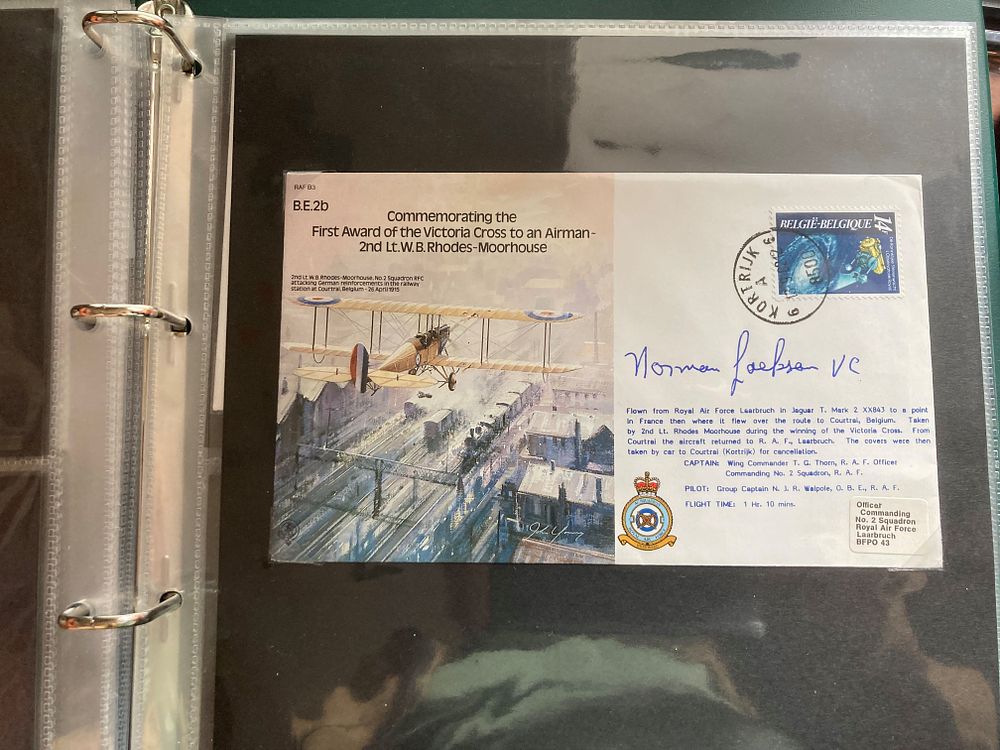
WW2 Victoria Cross winner Norman Jackson VC signed RAF BE2b flown bomber cover B3c. Norman Cyril Jackson VC (8 April 1919 - 26 March 1994) was a sergeant in the Royal Air Force (RAF) who earned the Victoria Cross during a Second World War bombing raid on Schweinfurt, Germany in April 1944. On 28 July 1943, he joined No. 106 Squadron which operated Avro Lancaster bombers. Jackson completed his tour of 30 missions on 24 April 1944, but, as he had flown one sortie with a different crew, he chose to fly once more so that he and his original aircrew could finish their tour together.[1] Jackson's 31st mission was a raid on the German ball bearing factories at Schweinfurt on the night of 26-27 April. Having bombed the target, Jackson's Lancaster (serial ME669) was attacked by a German night fighter and a fuel tank in the starboard wing caught fire. Jackson, already wounded from shell splinters, strapped on a parachute and equipped himself with a fire extinguisher before climbing out of the aircraft and onto the wing, whilst the aeroplane was flying at 140 miles per hour (230 km/h), in order to put out the fire. He gripped the air intake on the leading edge of the wing with one hand, and fought the fire with the other. The flames seared his hands, face, and clothes. The fighter returned and hit the bomber with a burst of gunfire that sent two bullets into his legs. The burst also swept him off the wing. He fell 20,000 feet (6,100 m), but his smouldering and holed parachute worked well enough to save his life. He suffered further injuries upon landing, including a broken ankle, but managed to crawl to a nearby German village the next morning, where he was paraded through the street. He spent 10 months recovering in hospital before being transferred to Stalag IX-C prisoner-of-war camp. He made two escape attempts, the second of which was successful as he made contact with a unit of the US Third Army. Jackson's exploit became known when the surviving crewmen of his bomber were released from German captivity at the end of the war. He was promoted to warrant officer and his Victoria Cross (VC) award was gazetted on 26 October 1945. When he went to Buckingham Palace to receive his VC from King George VI, he was accompanied by Leonard Cheshire, who was also due to receive his on that day. Group Captain Cheshire insisted that, despite the difference in rank, they should approach the King together. Jackson remembers that Cheshire said to the King, ”This chap stuck his neck out more than I did - he should get his VC first! Of course the King had to keep to protocol but I will never forget what Cheshire said. Good condition Est.