Bidspirit auction | WW2 Pathfinder CO AVM Don
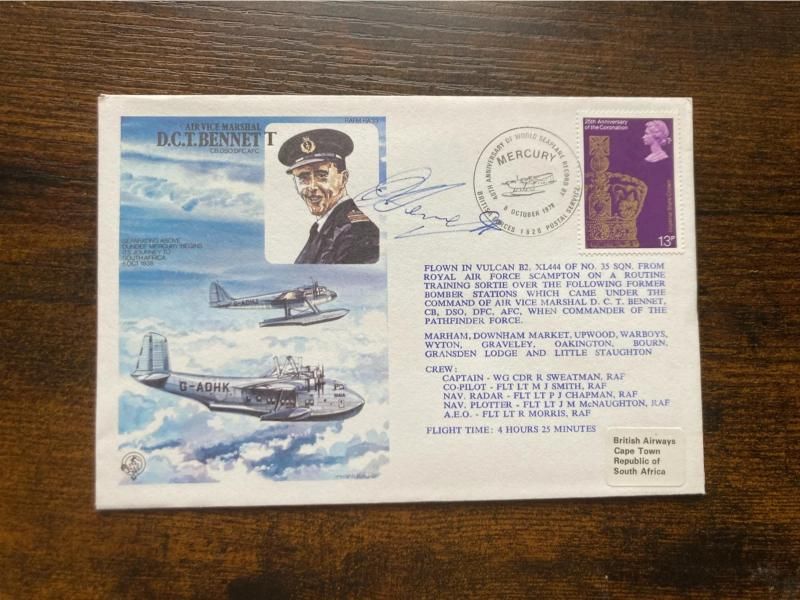
WW2 Pathfinder CO AVM Don Bennett DSO DFC signed on his own Historic aviators cover. Bennett was recommissioned in 1941 in the Royal Air Force Volunteer Reserve as a squadron leader. His first task was to oversee the formation of the Elementary Air Navigation School, Eastbourne, for the initial training of observers (later navigators). However, he was promoted to wing commander, and appointed to the command of No. 77 Squadron, based at RAF Leeming and flying Whitleys in 4 Group, Bomber Command, on 7 December 1941. In April 1942, No. 77 Squadron was transferred to Coastal Command and Bennett was given command of No. 10 Squadron (Handley Page Halifax) and shortly afterwards led a raid on the German battleship Tirpitz. Shot down during that raid, he evaded capture and escaped to Sweden, from where he was able to return to Britain; he and his copilot were awarded the Distinguished Service Order (DSO) on 16 June 1942. Pathfinder Force In July 1942, Bennett was appointed to command the new Pathfinder Force (PFF), an elite unit tasked with improving RAF Bomber Command's navigation. At this stage of the war, Bomber Command had begun to make night-time raids deep into Germany, but had not yet been able to cause significant damage, largely because only about a quarter of the bomb loads were delivered ”on target” - and this at a time when ”on target” was defined as within three miles of the aim point. Pathfinder Force was set up to lead the bomber stream to the target areas and drop markers for the remainder of the force to aim at. Later in the war, the Pathfinder Force would be equipped with a range of newly developed and often highly effective electronic aids, but the initial object was to simply take experienced crews with standard equipment and hone their navigation skills. Having already demonstrated that he could pass on his meticulous navigational ability to others, Bennett was an obvious choice for the role, yet nevertheless a surprising one. The Air Ministry's Directorate of Bomber Operations had for some time been pushing to establish an elite precision bombing force, but Bomber Command AOC-in-C Air Chief Marshal Arthur Harris was implacably opposed to the idea on the grounds that it would ”lower the morale” of the other squadrons. When Harris learned that Vice-Chief of the Air Staff (VCAS) Air Chief Marshal Sir Wilfrid Freeman planned to order the change, and that the strong-willed Basil Embry would probably be given command of the new force, Harris bowed to the inevitable, but was given a ”more or less free hand” in selection of the force commander. He chose to appoint Bennett without considering other candidates. Harris described Bennett as ”the most efficient airman I have ever met”.[6] Bennett was called to Bomber Command HQ when he was on the point of leaving with his squadron for the Middle East. There he was informed by Harris that he was to lead a special force to make use of the new bombing and navigational aids then available and the more sophisticated ones that would follow. With effect from 5 July he was promoted to group captain. In 1943 Bennett was promoted with the upgrading of PFF to group status to air commodore, and then in December to acting air vice marshal[8] - the youngest ever to hold that rank - giving him a rank similar to those of the other commanders of groups. He remained in command of the Pathfinder Force until the end of the war, overseeing its growth to an eventual 19 squadrons, a training flight and a meteorological flight, working relentlessly to improve its standards, and tirelessly campaigning for better equipment, in particular for more Mosquitos and Lancasters to replace the diverse assortment of often obsolete aircraft with which the force started. Bennett was not a popular leader: a personally difficult and naturally aloof man, he earned a great deal of respect from his crews but little affection. As Harris wrote, ”he could not suffer fools gladly, and by his own high standards there were many fools”. Nor did Bennett get on well with the other RAF group commanders: not only was he 20 years younger, he was an Australian. Indeed, Bennett saw his own appointment in those terms: it was, he believed, a victory for the ”players” over the ”gentlemen”. There was antagonism between Bennett and Air Vice-Marshal Ralph Cochrane of No. 5 Group. In 5 Group's 617 Squadron, Cochrane had his own specialist squadron pursuing high levels of accuracy. Good condition Est.