Bidspirit auction | Joseph Hume Scottish surgeon and
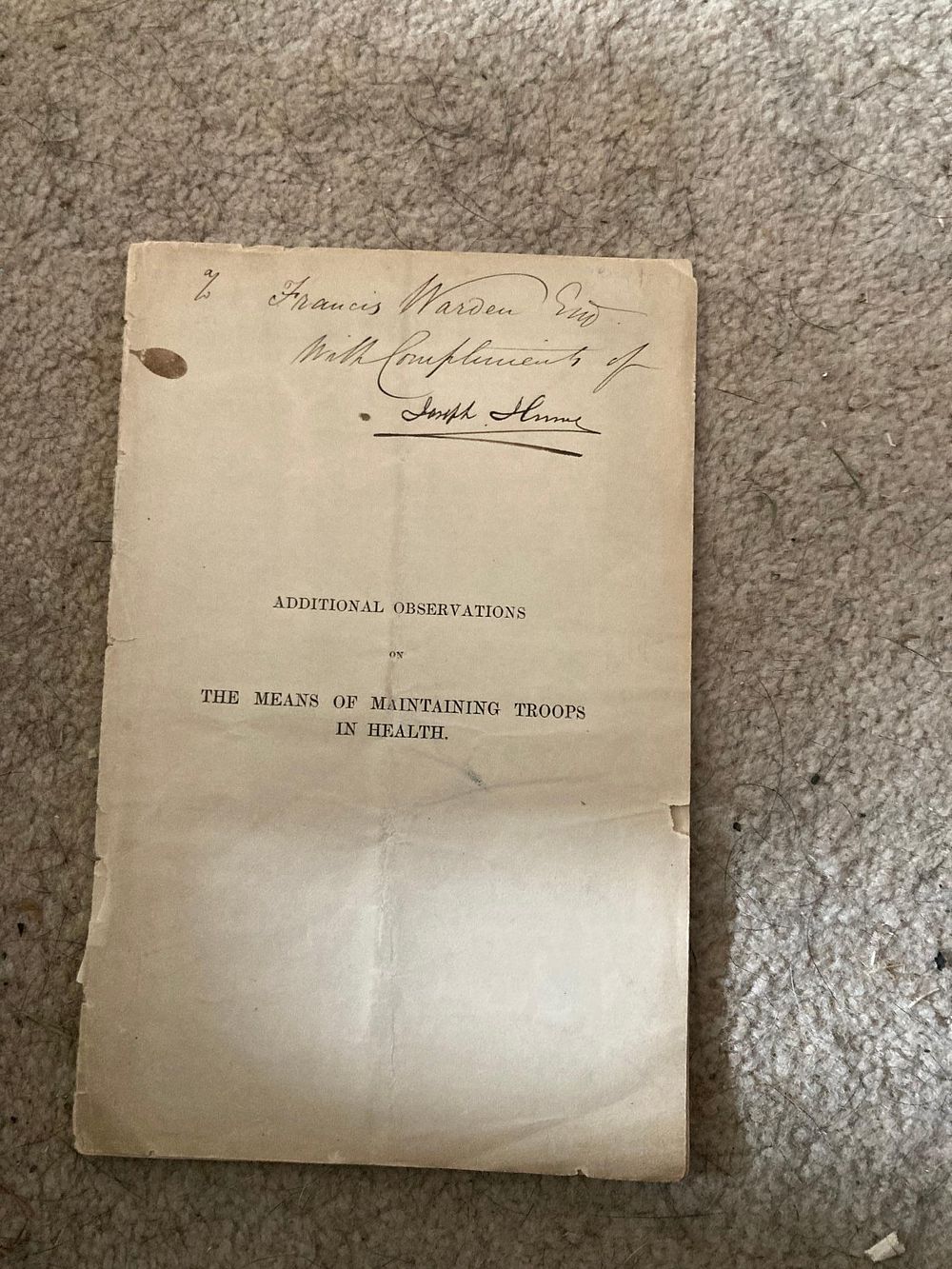
Joseph Hume Scottish surgeon and Radical MP signed 1800 booklet The Means of Maintaining Troops in Health. In 1848, Edward Thornhill Luscombe published Practical Observations on the Means of Preserving the Health of Soldiers, an influential text that outlined strict guidelines regarding diet, clothing, hygiene, and ventilation to prevent rampant disease in military camps. It remains a hallmark of 19th-century military medical literature. Inscribed to Frances Warden ( we assume Late East India Director, and formerly Chief Secretary at Bombay) with compliments of Joseph Hume. 12 pages the front is loose. Some signs of age. Hume studied medicine at the University of Aberdeen and then the University of Edinburgh. He had as patron David Scott MP. Before he qualified, he saw wartime service as surgeon-mate on the Hoy (boat) HMS Hawke; and then was on the East Indiaman Hope for 18 months. In 1799 Hume sailed to India, nominated to the Bengal service by Jacob Bosanquet of the British East India Company. He worked his passage as medical officer on the Houghton.[5] Once there, he was commissioned as a surgeon to the 7th Sepoy Regiment. Gaining fluency in Hindustani and Persian, he worked also as an interpreter and on commissariat. On the eve of the Second Anglo-Maratha War, Hume came to the attention of Lord Lake with a method to recover damp gunpowder. On the outbreak of war, he was with General Peregrine Powell who marched from Allahabad into Bundelkhand. He took on again a variety of roles during the campaign. In 1808, Hume resigned from the army and returned to the United Kingdom with a fortune of about £40,000. Between 1808 and 1811, he travelled around England and Europe. In 1818 Hume was elected a Fellow of the Royal Society, being, according to his nomination, ”well versed in various branches of Useful knowledge and particularly in Chemistry, in various branches of oriental literature and Antiquities”. In 1812, Hume obtained through Spencer Perceval a seat in Parliament for Weymouth, Dorset, England, vacant by the death of Sir John Johnstone, 6th Baronet. He was allowed it by Masterton Ure, was elected unopposed and voted as a Tory supporter of the Perceval administration. Hume was present at Perceval's assassination in the House of Commons in May that year, when he helped detain Perceval's assailant John Bellingham and testified that he was ”perfectly sane” from Bellingham's composed behaviour immediately following. Good condition Est.