Bidspirit auction | Poet Playwright Christopher Fry 3
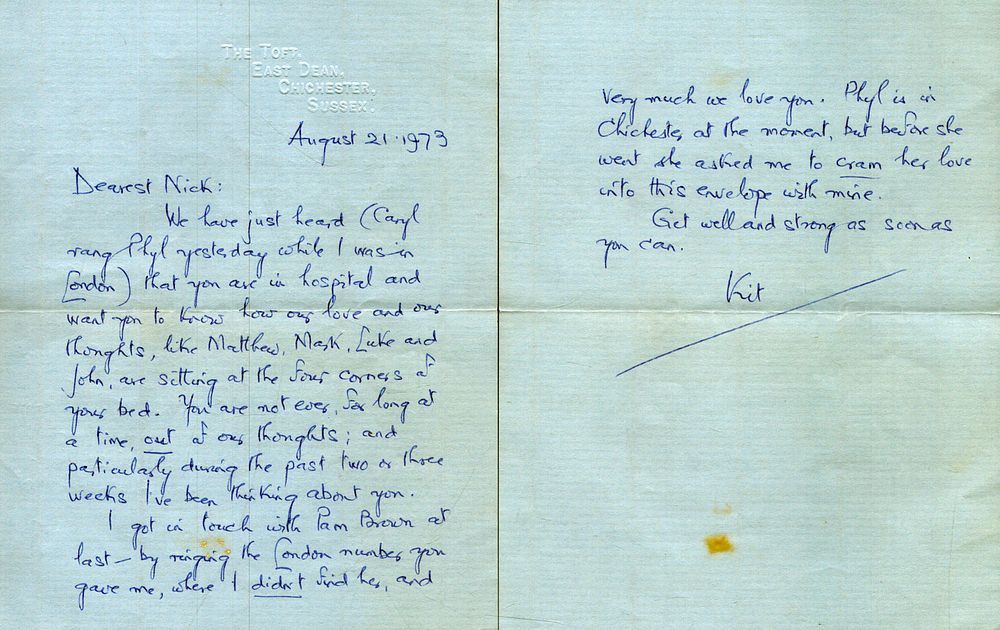
Poet Playwright Christopher Fry 3 page touching hand written letter to Nick. 1973 with kind words to Nick who is in hospital, ”want you to know how our love and our thoughts like Matthew, Mark, Luke and John are sitting at the four corners for your bed”. Also references to the BBC and The Dark is light enough and Radio show. Signed with his nickname Kit. Christopher Fry (18 December 1907 - 30 June 2005) was an English poet and playwright. He is best known for his verse dramas, especially The Lady's Not for Burning (1948), which made him a major force in theatre in the 1940s and 1950s. Fry was then commissioned to write a play by Alec Clunes, manager of the Arts Theatre in London. The result, The Lady's Not for Burning, was first performed there in 1948, directed by the actor Jack Hawkins. Due to its success, it transferred to the West End for a nine-month run, starring John Gielgud and featuring Richard Burton and Claire Bloom among the cast. It was presented on Broadway in 1950, again with Burton. The play marked a revival in popularity for poetic drama, most notably espoused by T. S. Eliot. It is the most performed of all his plays and inspired British Prime Minister Margaret Thatcher to declaim, ”You turn if you want to - the lady's not for turning,” at the Conservative Party conference in 1980. In 1950, Fry adapted a translation of Jean Anouilh's Invitation to the Castle as Ring Round the Moon for director Peter Brook. He also wrote Venus Observed, which was produced at the St James's Theatre by Laurence Olivier. A Sleep of Prisoners followed in 1951, first performed at St Thomas' church in Regent Street, London, in 1951 and later touring with Denholm Elliott and Stanley Baker. The Dark is Light Enough, a winter play starring Katharine Cornell and Edith Evans in 1954, was third in a quartet of ”seasonal” plays, featured incidental music written by Leonard Bernstein.[9] The production also featured Tyrone Power, Lorne Greene and Marian Winters. Christopher Plummer had an understudy role that he wrote about in his memoir. This play followed the springtime of The Lady's Not For Burning and the autumnal Venus Observed. The quartet was completed in 1970 with A Yard Of Sun, representing summer, presented at the Nottingham Playhouse in 1970. His next plays were translations from French dramatists: The Lark, an adaptation of Jean Anouilh's L'Alouette (”The Lark”), in 1955; Tiger At The Gates, based on Jean Giraudoux's La guerre de Troie n'aura pas lieu, also in 1955; Duel of Angels, adapted from Giraudoux's Pour Lucrèce, in 1960; and Judith, also by Giraudoux, in 1962. Although Fry lived until 2005, his poetic style of drama began to fall out of fashion with the advent of the Angry Young Men of British theatre in the mid-1950s. Despite working mainly for the cinema in the 1960s, including scripts for Ben Hur, Barabbas, and The Bible: In the Beginning...,[10] he continued to write plays, including Curtmantle for the Royal Shakespeare Company (1961). Good condition Est.