Bidspirit auction | Lt Cdr Sir Peter Scott
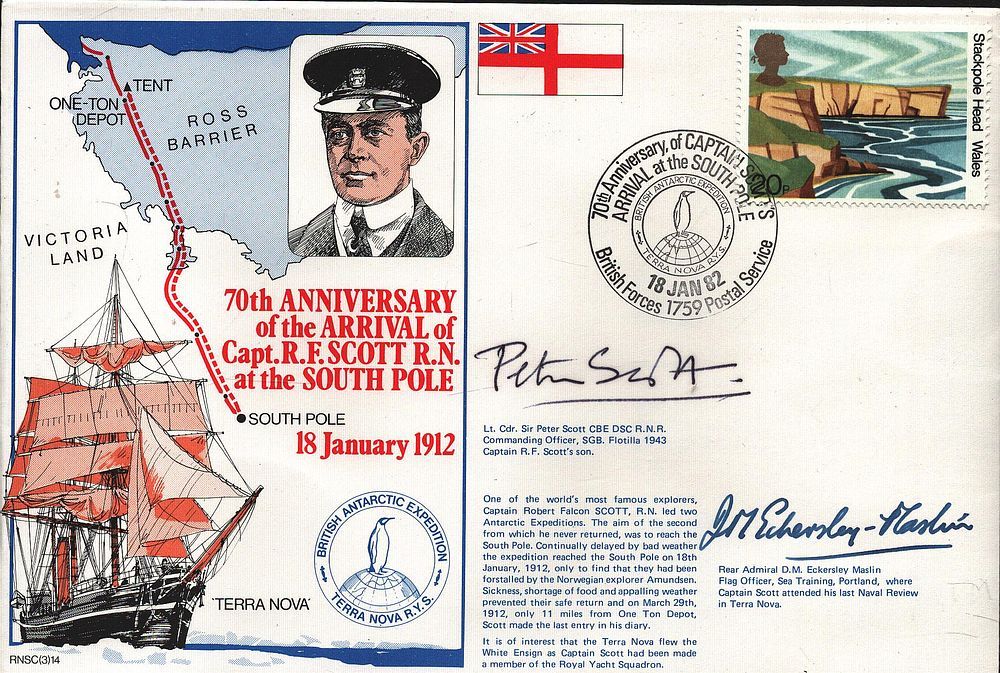
Lt Cdr Sir Peter Scott DSC 70th Ann Arrival Capt. Scott at S. Pole signed cover. 70th Anniversary of the Arrival of Capt. R.F. Scott R.N. at the South Pole 18 Jan 1912. Single Stamp plus Single post marked 18 Jan 82. Personally Signed by Rear Admiral D M Eckersley Maslin. Flag officer sea training Portland. Capt Scott attended his last naval review in Terra Nova, and also signed by Lt Cdr Sir Peter Scott CBE DSC Commanding Officer, SGB Flotilla 1943 Captain R F Scott's son. RN Yeovilton Official FDC Ref no 3RN14c. Sir Peter Markham Scott CH, CBE, DSC, FRS, FZS (1909-1989) was the son of Scott of the Antarctic and his artist wife Kathleen, Lady Kennet. Educated at Oundle and Trinity College, Cambridge, he studied art at the State Academy, Munich and at the Royal Academy Schools, London. He was a yachting enthusiast and won a sailing bronze at the 1936 Berlin Olympics. By the time war broke in 1939, he was already an established author, broadcaster, artist and conservationist with ornithology at the heart of his interests. On 11 June 1940 he went ashore at Saint-Valery-en-Caux as an RNVR sub-lieutenant to help in the evacuate wounded from the 51st Highland Division prior to its surrender en masse to Erwin Rommel next day. He served in the Shakespeare class destroyer HMS Broke supporting the North Atlantic convoys, and in April 1941 was mentioned in despatches for rescuing crewmen from the burning armed merchant cruiser Comorin. He was further credited with designing a ship camouflage scheme for the Western Approaches (MBE, military division, 1942). In the summer of 1942 he was appointed commanding officer of a new type of Coastal forces vessel, steam gun boat HM SGB 9, later named HMS Grey Goose. Steam gun boats were large enough to withstand rough weather and combined the functions of the motor gunboat (MGB) and motor torpedo boat (MTB) in order to hunt down German E-boats. In August 1942 Scott and SGB 9 gave early proof of the buccaneering spirit for which SGB crews were known when he was again mentioned in despatches 'for gallantry, daring and skill in the combined attack on Dieppe' (Operation Jubilee). He subsequently led a number of actions in Grey Goose in the spring and summer of 1943 as Senior Officer, 1st SGB Flotilla operating from HMS Aggressive (the Coastal Forces base at Newhaven). On 1 June 1943 he was awarded the Distinguished Service Cross (DSC) 'for skill and gallantry in action with enemy light forces', when he engaged 3 armed enemy trawlers about 20 miles west of Le Havre. 'Many hits were scored on the rear enemy ship, and although she was not seen to sink she was left stopped and silenced and burning. All our ships returned safely to harbour. They suffered casualties, one being killed and 4 wounded. He was further mentioned in despatches for an action in the English Channel on 26 July 1943, and awarded a Bar to the DSC for actions on 4 and 27 September 1943. By early 1944, the E-boat threat had reduced and he was appointed staff officer operations, coastal forces to help prepare the role of coastal forces in Operation Neptune, the naval element of Operation Overlord, the invasion of France. He was subsequently detached as Staff Officer, Coastal Forces, British Assault Area (Courseulles) and later as Liaison Officer, PT Boats (Cherbourg). After the war he stood for Parliament but was narrowly defeated. He famously established the Wildfowl and Wetlands Trust in Slimbridge in 1946 and helped found the World Wide Fund for Nature, the logo of which he designed. He was knighted in 1973 for his work in conservation of wild animals and in 1987 he was made a Companion of Honour for services to conservation. Good condition Est.