Bidspirit auction | WW2 Rare Variety Escape Belgium
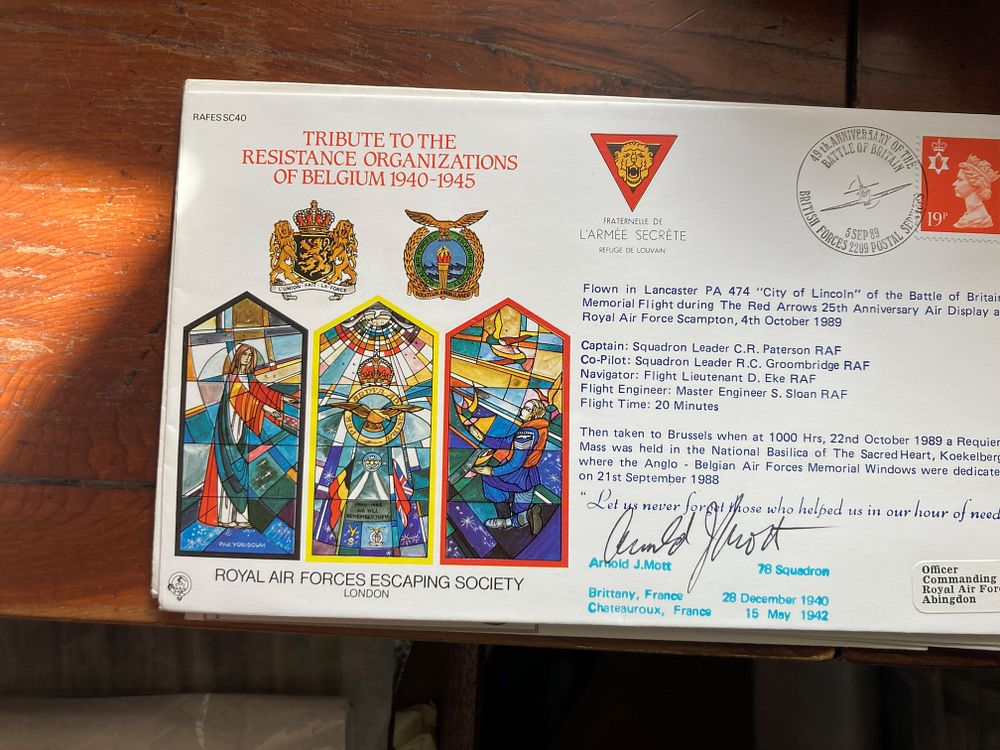
WW2 Rare Variety Escape Belgium cover signed escaper TWICE Arnold Mott 78 sqn. In December 1940, Sergeant John Mott (first name Arnold) was the pilot of a Whitley bomber from RAF 78 Squadron which took off from Dishforth to bomb the dockyard at Lorient Brittany. He was forced to jump from the burning aircraft, landing on the North West edge of Lanvallon. The rest of the crew baled out, but all were captured apart from the rear gunner Sgt A J McMillan. Mott was able to hide and lie low before initially receiving assistance from a chain of helpers. In early January 1941, he was taken to the home of Monsieur and Madame Delavigne in Nantes, Brittany who managed to shelter him up until September of the same year. In mid-August Sgt Macmillan had arrived and been located in a safe house with a Madame Flavet and her family. In late September, security in the network was compromised and arrests were made by the Gestapo. Amongst those taken were Madame Flavet and her family and Macmillan and Mott's conveyer Monsieur Hevin. The latter was executed just under a month later. Once the cell had been penetrated, Mott was shuttled around a series of safe houses by the Delavignes, whilst a plan was formed to get him out. Madame Delavigne recalled: 'The leader of the organisation Claude Lamirault (MI6 agent) was to ensure the escape of the two airmen. Unfortunately the Flavet family and MacMillan were arrested. Having been informed immediately and not knowing the leaders address, we decided to do all we could to save Mott' For a price, the Delavignes negotiated a passage for Mott into the unoccupied Vichy zone of France. He would be accompanied by an agent codenamed 'Rips' operating in the area and vaguely known to them through the trafficking of letters into the Vichy area. On 26 September, Mott and the agent left Nantes on bicycles and taking the fast train to Bordeaux arrived at an address of a Pole called Selk. Mott was helped to reach Toulouse on 4 October and he recalled what happened next: 'On the 12th I crossed over the frontier of Spain. Once there I kept walking to the British Consul who passed me on the Embassy in Madrid. On 14 November 1941, I arrived in Gibraltar and left in a Sunderland flying boat on 13 December, arriving at Pembroke Dock on the 14th.' The Delavigne family were arrested on 5 March 1942. After a spell in a Bordeaux civil prison which took the life of their nephew, they were finally released in July 1943. To continue sheltering evaders after arrest and imprisonment was almost suicidal, but Monsieur and Madame Delavigne started up where they left off. Their luck ran out in January 1944. Monsieur eventually died of exhaustion in Camp No 1 at Gouzen in January 1945 and Madame after a succession of prisons was liberated at Mauthausen concentration camp by the International Red Cross on 22 April 1945 weighing only four and half stone. John Mott had attained the rank of Flight Lieutenant with RAF 161 Special Duties Squadron when on the night of 28/29 May 1942 he was involved with a second Lysander aircraft in a double operation around delivery and pick up of agents from France. He was delivering Alex Nitelet, scheduled to be the Pat O'Leary Escape Line's new operator. The aircraft landed at Chateauroux, but became bogged down and failed to take off. Mott was captured and held in various French prisons until being transferred to Italian Prisoner of War Gavi Camp No 5. In September 1943 after the Italian armistice the Germans made plans to transfer the prisoners in the camp by train to Austria. Housed in cattle wagons the opportunity for escape presented itself to the men. During the journey Mott managed to cut a hole in his wagon near to the buffers, and followed by other officers the men lowered themselves down and dropped off the train. This operation was extremely dangerous as attempts by this method in previous unrelated escapes had sometimes resulted in limbs being severed, escapers falling under the train or being shot by the guards. Mott himself sustained a head injury but managed to get away. He joined a fellow POW officer who had also escaped and they travelled to Tarcento with other POWs and joined up with some Partisans who took them over the border to Ziri in Yugoslavia. The group came under fierce attack from the Germans and they decided to break away in pairs from the Partisans and try to reach Italy again as they were close to the border. Flight Lieutenant Carmichael who had also escaped from the train travelled south with Mott, and the pair crossed the border reaching Calla in the extreme north of the country. By this point the weather was too bad for any sustained travel, so they took refuge and did not set out again until 3 December 1943. The plan was to travel south, then cut across to the east coast of Italy and sail a boat out of the country. Allied sympathisers gave them shelter as they travelled and a Lance Corporal who Mott does not name joined them,