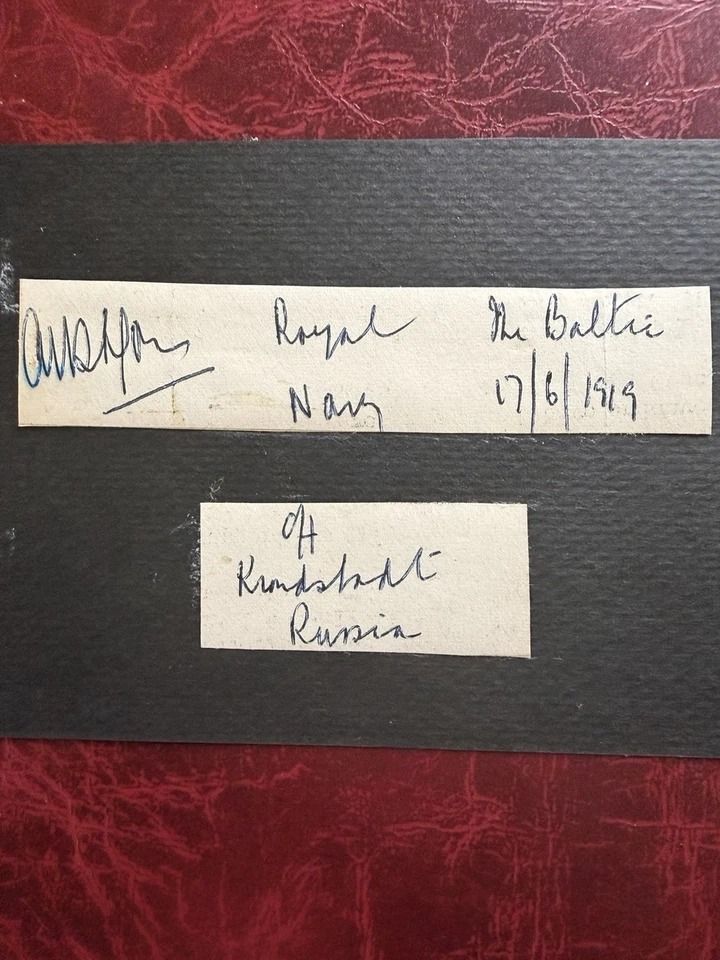
Bidspirit auction | Rare Victoria Cross winner Augustus
Rare Victoria Cross winner Augustus Agar VC signed piece and biography. Augustus Willington Shelton Agar, VC, DSO (4 January 1890 - 30 December 1968) was a Royal Navy officer in both the First and the Second World Wars. He was a recipient of the Victoria Cross, the highest award for gallantry in the face of the enemy that can be awarded to British and Commonwealth forces, for sinking a Soviet cruiser during the Russian Civil War. 1913 - appointed to HMS HIBERNIA, one of the last pre-DREADNOUGHT battleships, known as the Wobbly Eight, where he served for three years, mainly in the Home Fleet, but with a visit to the Dardanelles at the time of the evacuation of Gallipoli: this was his first time under fire. He next went to Archangel in the depot ship for the minesweeping trawlers that were keeping that port open for the supplies we were sending to Russia. Then after a short course at the Torpedo school he joined the Coastal Motor Boat (CMB) base at Osea Island in the river Blackwater as Torpedo and Mining Officer. After some time there, he was called to the Admiralty and seconded to the Secret Service. This launched him on the events that led to his VC. His instructions, received from the Head of MI6 - known simply as 'C' - were that together with 2 CMBs plus crews he would be transported to the Baltic (under the guise of 'civilian salesmen') where he and his crews would set up a courier service between the Finnish coast and a British agent in Petrograd (St Petersburg), 'ST25', (identified by Agar as Paul - later Sir Paul - Dukes): Agar himself was 'ST34'. His team consisted of three Sub-Lieutenants of the Royal Naval Reserve (the tape refers to them as Midshipmen but, in the photographs, they are dressed as Sub-Lieutenants) and two Chief Motor Mechanics: his own boat being crewed by Sub-Lieutenant Hampsheir and Chief MM Beeley - referred to as 'Faithful Beeley' throughout. The boats were unarmed, though each could carry one torpedo: the crews wore plain clothes but carried minimal uniform and a white ensign in case of need. He was given £1000 in cash to cover expenses. Agar felt that his small force should be doing more than acting as a shuttle service. The Bolsheviks had seized much of the Russian fleet at Kronstadt, and Agar considered these vessels a menace to British operations and took it upon himself to attack the enemy battleships./He set out with his two boats, HM Coastal Motor Boat 4 and another, on 17th June 1919. One had to turn back before completing its mission, but Agar continued into the bay. The battleships were not in the harbour though. CMB4 penetrated a destroyer screen and was closing on a larger warship further inshore when CMB4, whose hull had been damaged by gunfire, broke down. She had to be taken alongside a breakwater for repairs and for twenty minutes was in full view of the enemy. The attack was then resumed and a Russian cruiser, the 6,645 ton Oleg was sunk, after which Lieutenant Agar retired to the safety of the open bay under heavy fire. For this he was awarded the Victoria Cross and was promoted to Lieutenant Commander on 30th June 1919. Good condition Est.