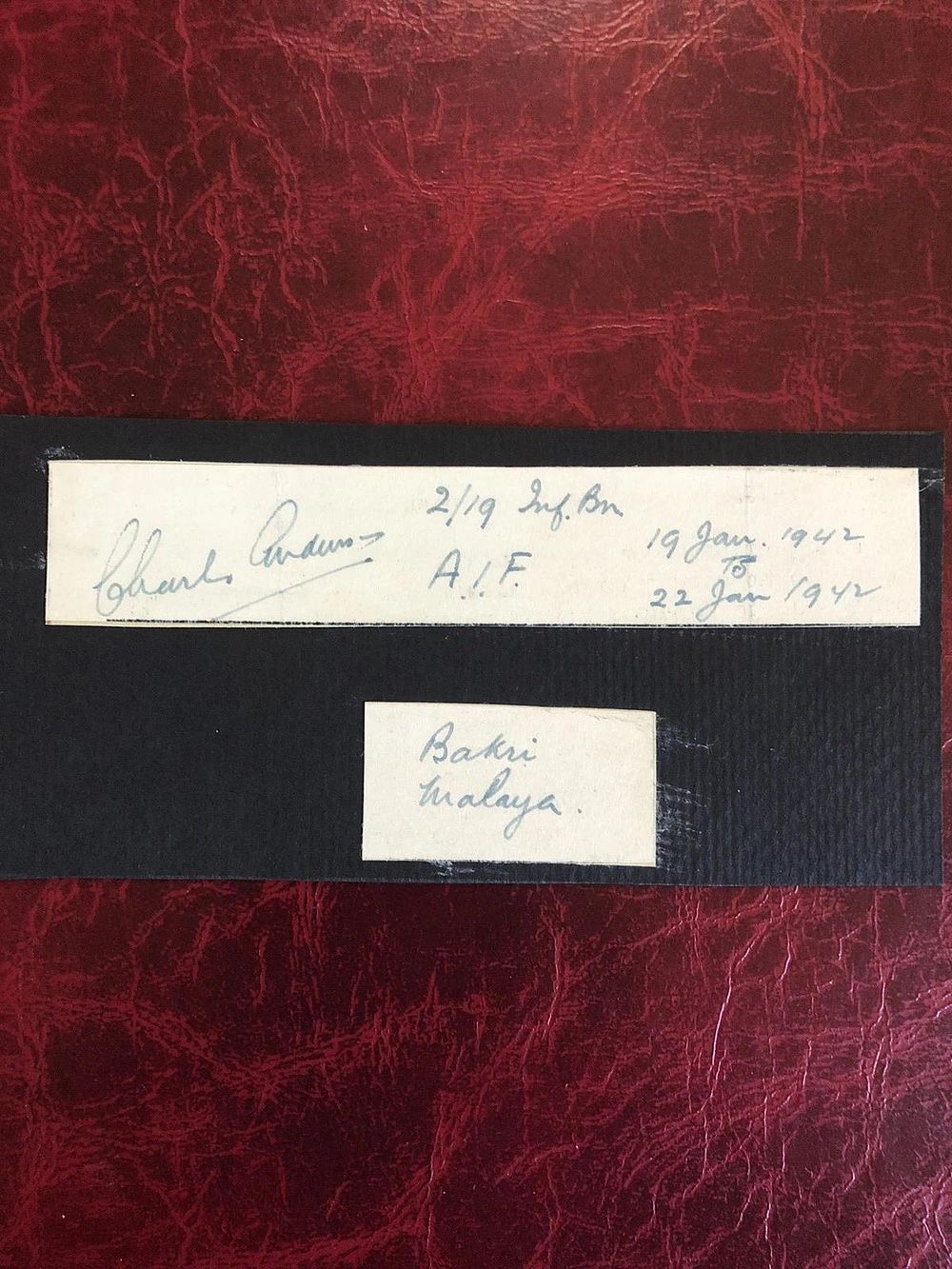
Bidspirit auction | Rare Victoria Cross winner Lieutenant
Rare Victoria Cross winner Lieutenant Colonel Charles G.W.Anderson VC signed piece and biography. During the period of 18-22 January 1942 in the Battle of Muar near the Muar River, the 44-year-old Anderson was in command of a small force which destroyed ten enemy tanks. When they were later cut off, Anderson led his force through fifteen miles (24 km) of enemy-occupied territory, being attacked by air and ground forces all the way. Many times in the journey from Muar to Parit Sulong, Anderson had to lead bayonet charges and hand-to-hand combat against the Japanese. Anderson is famous for leading the Allied attack in Parit Sulong against the Japanese when the Allies were retreating to Yong Peng to meet up with the main force heading for Singapore. Upon reaching the small town of Parit Sulong on the way, they discovered their way blocked because the main bridge was already in Japanese hands with a Japanese machine gun defending the bridge. They were surrounded and a heavy battle ensued for several days in Parit Sulong. The Allied troops at Yong Peng under Gordon Bennett unsuccessfully attempted to break through the Japanese lines to reinforce Anderson's men, but without reinforcements, Anderson and his troops had to try many times to recapture the bridge but was unable to do so. Heavily outnumbered, Anderson's Australian and Indian troops were attacked and harassed continuously by Japanese tanks, machine gun, mortar and air attacks and suffered heavy casualties. Yet they held their position for several days and refused to surrender. During the battle, Anderson had tried to evacuate the wounded by using an ambulance, but the Japanese would not let the vehicles pass the bridge. Although the detachment attempted to fight its way through another eight miles (13 km) of enemy-occupied territory to Yong Peng, this proved impossible, and Anderson had to destroy his equipment and attempted to work his way around the enemy. Anderson then ordered every able man to escape through the jungle to link up with the retreating main force in Yong Peng heading for Singapore. They had no choice but to leave the wounded to be cared for by the enemy, assuming the Japanese would take care of the wounded. But unfortunately, the Japanese unit at Parit Sulong later executed the approximately 150 wounded Australian and Indian soldiers next to the bridge of Parit Sulong, in the Parit Sulong Massacre. For his brave actions and leadership in Muar and the difficult retreat from Muar to Parit Sulong and the subsequent difficult battle at Parit Sulong led by Anderson, he was awarded the highest and most prestigious decoration for gallantry in the face of the enemy that could be awarded to British Commonwealth forces. His VC citation, as listed in the London Gazette on 13 February 1942, states: ”...for setting a magnificent example of brave leadership, determination and outstanding courage. He not only showed fighting qualities of very high order but throughout exposed himself to danger without any regard for his own personal safety”. Following the action around Muar and Parit Sulong, Anderson went to Singapore, as the Allies withdrew across the Causeway to prepare a line of defence. Shortly afterwards he was hospitalised and, as a result, missed the majority of the fighting following the Japanese landings on 8 February 1942. As the situation became desperate, on 13 February, Anderson discharged himself and returned to the heavily mauled 2/19th, by then down to just 180 men from its authorised strength of 900. He led them until the surrender was announced two days later. Anderson was captured and for the next three years was held as a prisoner of war. He was the chief staff officer under Brigadier Arthur Varley of the 22nd Brigade in A Force - the first contingent of POWs at Changi to voluntarily avail themselves of a Japanese ”offer” to move to a new location where they were told there would be abundant food and a healthy climate. In reality the group of 3,000 were shipped to Burma and were used as slave labour to build the 415 km railway link between Nong Pladuk in Thailand and Thanbyuzayat in Burma. Throughout his time in captivity, Anderson worked to mitigate the hardships of other prisoners, leading by personal example and maintaining morale. At the end of the war, Anderson was repatriated back to Australia. His appointment in the army was terminated on 21 December 1945 and he returned to his property in New South Wales. Good condition Est.