Bidspirit auction | Scott of the Antarctic signed
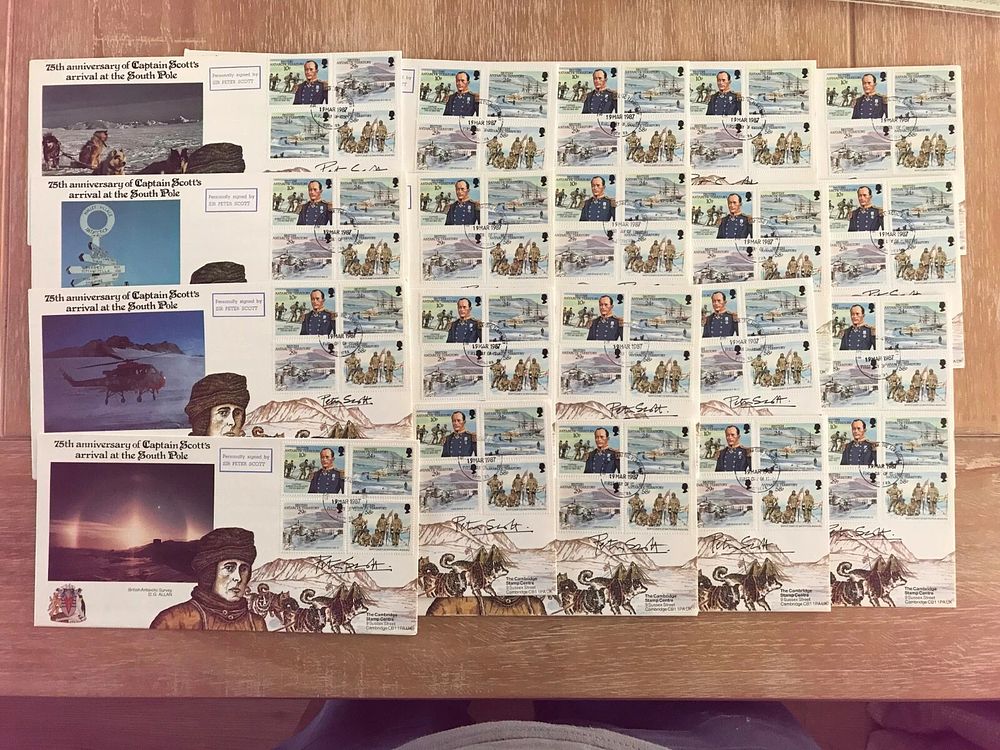
Scott of the Antarctic signed collection, a complete set of 20 BAT FDCs all signed by Sir Peter Scott DSC. Only 35 of each were signed and many sets would have been broken up so this might be one of the only sets complete. Stunning images on each cover which comm. 40th ann of Scotts arrival at the South Pole. British Antarctic Territory stamps and postmarks. These retail for £30/40 each. Sir Peter Markham Scott (14 September 1909 - 29 August 1989) was a British ornithologist, conservationist, painter, naval officer, broadcaster and sportsman. The only child of Antarctic explorer Robert Falcon Scott, he took an interest in observing and shooting wildfowl at a young age and later took to their breeding. He established the Wildfowl & Wetlands Trust in Slimbridge in 1946 and helped found the World Wide Fund for Nature, the logo of which he designed. He was a yachting enthusiast from an early age and took up gliding in mid-life. He was part of the UK team for the 1936 Summer Olympics and won a bronze medal in sailing a one-man dinghy. He was knighted in 1973 for his work in conservation of wild animals and was also a recipient of the WWF Gold Medal and the J. Paul Getty Wildlife Conservation Prize. During the Second World War, Scott served in the Royal Navy Volunteer Reserve. As a sub-lieutenant, during the failed evacuation of the 51st Highland Division he was the British naval officer sent ashore at Saint-Valery-en-Caux in the early hours of 11 June 1940 to evacuate some of the wounded. This was the last evacuation of British troops from the port area of St Valery that was not disrupted by enemy fire. At a light coastal forces base, HMS Vernon, Operational Officer Lieutenant Commander Scott, briefs motor torpedo boat officers before they set off on anti-E-Boat patrols, June 1944. Then he served in destroyers in the North Atlantic but later moved to commanding the First (and only) Squadron of Steam Gun Boats against German E-boats in the English Channel. Scott is credited with designing the Western Approaches ship camouflage scheme, which disguised ship superstructures. In July 1940, he managed to get the destroyer HMS Broke, in which he was serving, experimentally camouflaged, differently on the two sides. To starboard, the ship was painted blue-grey all over, but with white in naturally shadowed areas as countershading, following the ideas of Abbott Handerson Thayer from the First World War. To port, the ship was painted in ”bright pale colours” to combine some disruption of shape with the ability to fade out during the night, again with shadowed areas painted white. However, he later wrote that compromise was fatal to camouflage, and that invisibility at night (by painting ships in white or other pale colours) had to be the sole objective. By May 1941, all ships in the Western Approaches (the North Atlantic) were ordered to be painted in Scott's camouflage scheme. The scheme was said to be so effective that several British ships including HMS Broke collided with each other. The effectiveness of Scott's and Thayer's ideas was demonstrated experimentally by the Leamington Camouflage Centre in 1941. Under a cloudy overcast sky, the tests showed that a white ship could approach six miles (9.6 km) closer than a black-painted ship before being seen. On 8 July 1941, it was announced that Scott had been mentioned in despatches ”for good services in rescuing survivors from a burning Vessel” in April 1941 while serving on HMS Broke. On 2 October 1942, it was announced that he had again been mentioned in despatches ”for gallantry, daring and skill in the combined attack on Dieppe”.[15] He was further mentioned in despatches on 28 September 1943 for an action in the English Channel on 26 July 1943. On 1 June 1943, he was awarded the Distinguished Service Cross (DSC) ”for skill and gallantry in action with enemy light forces”[16] for an action in the English Channel on 15 April 1943 while commanding H.M. Steam Gunboat ”Grey Goose”. In the London Gazette of 9 November 1943, he was awarded a Bar to the DSC for actions in the English Channel on the 4th and 27 September 1943 while commanding the First SGB Flotilla. He was appointed Member of the Order of the British Empire in the Military Division (MBE) in the 1942 Birthday Honours. Good condition Est.