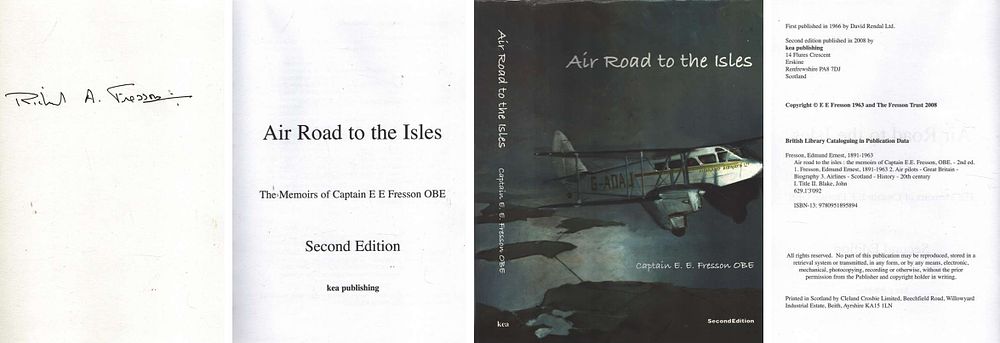
Bidspirit auction | Richard A. Fresson signed. Air
Richard A. Fresson signed. Air Road to the Isles The Memoirs of Captain E.E. Fresson, OBE Hardback Book. Author: Edmund Ernest Fresson. Second Edition. Publisher: Kea Publishing. Richard Fresson is the son of the legendary aviation pioneer Captain Ernest Edmund ”Ted” Fresson If you ever find yourself in the Orkney Islands, on the Mainland driving from Kirkwall to the airport, or perhaps, to the Mullhead Nature Reserve on Deerness, look out for an imposing stone memorial to ‘Capt. Ted Fresson’, intrepid pilot, airline entrepreneur and the man who single-handedly built the first air link between northern Scotland and the Orkneys. The memorial celebrates the ‘first scheduled air service’ by Fresson's airline, Highland Airways, and has a metal sculpture of a DH-84 Dragon bi-plane perched on top of the stonework, although the aircraft which actually landed at Kirkwall on that first day in May 1933 was a smaller, single-winged Monospar. Edmund Fresson, who died in 1963, belonged to that group of pioneer aviators who established the world's first air transport routes in the years between the two world wars. Many of these services were developed over inhospitable terrain where surface transport was poor, particularly over mountains and where stretches of water had to be crossed. In Britain this meant services to Scottish islands such as the Orkneys, Shetlands and Hebrides as well as to the Isle of Man and the Channel Islands, all of which had hitherto relied on slow ferry connections, often delayed or made intolerable for passengers by rough seas. Domestic airlines in Britain began later than flag-carriers like Imperial Airways (1924), but from the early 1930s a rash of independents sprang up, flying different routes from Cornwall to northern Scotland. These new airlines flew unsubsidised, in open competition with one another, free to decide their frequencies and fares. They rarely made a profit and they did not survive beyond the Second World War, but they did lay the foundations of Britain's internal air transport network. Scotland, with its mountains, islands and circuitous surface communications, was a promising field for air transport and Fresson took up the challenge in 1931 when he flew across the Pentland Firth and saw the potential of an air link to the Orkneys. From 1933 his Highland Airways flew a regular service from Inverness via Wick to Kirkwall, cutting the nine-hour train and ferry journey to one-and-a-half hours. In 1934 and 1935, using the reliable six-seater de Havilland DH.84, Highland extended its network to include other Scottish islands as well as Aberdeen. It flew paying passengers, medical emergencies as an air ambulance service, newspapers and the all-important Royal Mail. Financially however, Highland Airways never really got above the clouds and lacking access to capital for expansion, Fresson was forced to surrender his independence to United Airways in 1935 although the airline continued to operate under its own name until United was absorbed by the pre-war British Airways group in 1938. During the war, with commercial airline operations suspended, Fresson organised air communications for the Air Ministry in the north of Scotland and to Scapa Flow. With the end of the war Fresson's enterprise passed, along with the other independent British airlines, into the hands of BEA's Domestic Division. This take-over by one of the new Labour government's state-owned corporations was clearly acrimonious and a painful experience for a free marketeer like Fresson. He left the country shortly afterwards and spent much of the remainder of his career in Africa. This entertaining autobiography paints an absorbing picture of the early airline business, when men like Fresson flew air services for far-flung but highly appreciative communities, in fairly primitive aircraft, ‘by the seat of their pants’. It has been said of aviators that ‘virtue gathers where technology fails’ and this certainly seems to apply to Edmund Fresson. A second edition is available from Edinburgh University Press for £25. There are no signed copies of the first edition on Abebooks.