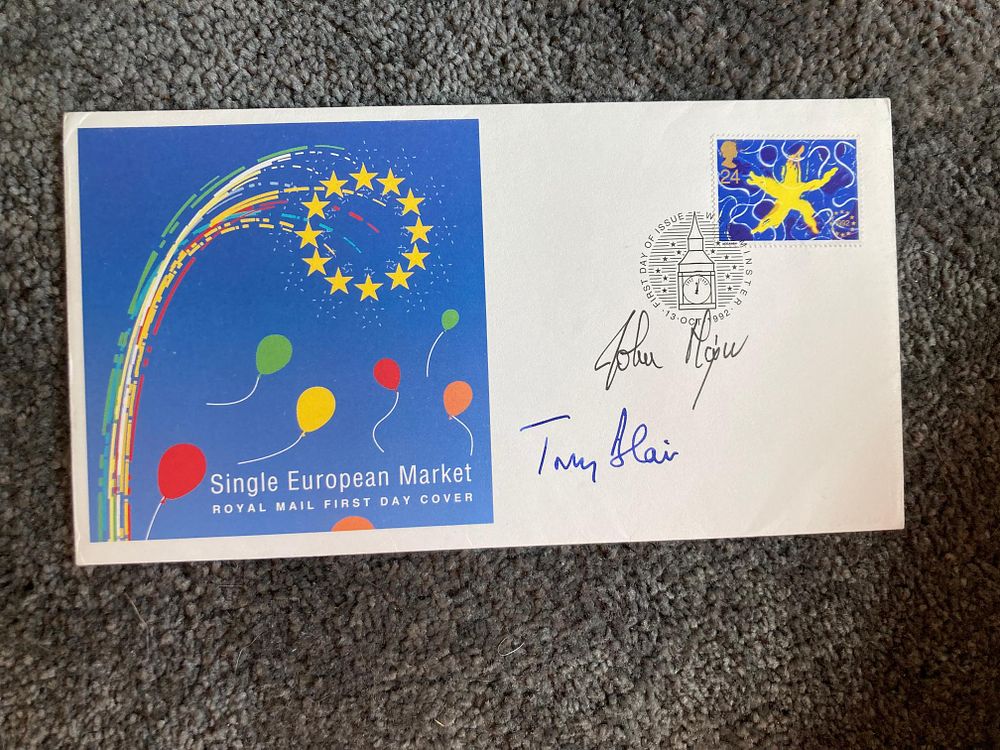
Bidspirit auction | Prime Minister John Major and
Prime Minister John Major and Tony Blair signed 1992 EEC Single Market FDC. Sir John Major (born 29 March 1943) is a British statesman and former politician who served as Prime Minister of the United Kingdom and Leader of the Conservative Party from 1990 to 1997. He previously held various Cabinet positions under Margaret Thatcher. Major was the Member of Parliament (MP) for Huntingdon, formerly Huntingdonshire, from 1979 to 2001. Since stepping down, Major has focused on writing and his business, sporting, and charity work, and commentating on political developments. Major left school before 16, worked as an insurance clerk, joined the Young Conservatives in 1959, and became a highly active member. He was elected to Lambeth London Borough Council in 1968 and, a decade later, to parliament as a Conservative MP at the 1979 general election. Major held junior government positions under Thatcher from 1984 to 1987, including parliamentary private secretary and assistant whip. He served as Chief Secretary to the Treasury from 1987 to 1989, Foreign Secretary in 1989, and Chancellor from 1989 to 1990. Following Thatcher's resignation in 1990, Major stood in the 1990 Conservative leadership election and emerged victorious, becoming prime minister. Major's mild-mannered style and moderate political stance contrasted with Thatcher. Major created the Citizen's Charter, replaced the Poll Tax with the Council Tax, committed British troops to the Gulf War, took charge of the UK's negotiations over the Maastricht Treaty, led the country during the early 1990s economic crisis, withdrew the pound from the European Exchange Rate Mechanism on Black Wednesday, promoted the socially conservative back to basics campaign, privatised the railways and coal industry, and played a pivotal role in creating peace in Northern Ireland. Two years into his premiership, Major led the Conservatives to a fourth consecutive electoral victory, winning more than 14 million votes, which remains the highest won by a British political party. In 1995, Major resigned as party leader, amid internal divisions over UK membership of the EU, parliamentary scandals and questions over his economic credibility. Despite winning the 1995 leadership election, his government remained unpopular, and lost its majority. The Labour Party pulled ahead of the Conservatives in every local election during Major's premiership, which increased after Tony Blair became Labour leader in 1994. The Conservatives were defeated by Labour in a landslide in the 1997 general election, ending 18 years of Conservative government. After Blair became prime minister, Major served as Leader of the Opposition while the leadership election to replace him took place, won by William Hague. Major remained in the House of Commons as a backbencher, regularly attending and contributing in debates, until he stood down at the 2001 election, to focus on writing and his business, sporting and charity work. Major has maintained a low profile, occasionally making political interventions. He supported the unsuccessful Britain Stronger in Europe campaign for the UK to remain in the European Union, and has often criticised Brexit since the 2016 referendum. Major was appointed a Knight Companion of the Order of the Garter (KG) in 2005 for services to politics and charity, and became a member of the Order of the Companions of Honour in 1999 for his work on the Northern Ireland peace process. Though public favourability of Major has improved since he left office, his premiership is viewed as average in historical rankings and public opinion of British prime ministers. Since Thatcher's death in 2013, he has been the oldest living former British prime minister. Sir Anthony Charles Lynton Blair (born 6 May 1953) is a British politician who served as Prime Minister of the United Kingdom from 1997 to 2007 and Leader of the Labour Party from 1994 to 2007. He was Leader of the Opposition from 1994 to 1997, held shadow cabinet posts from 1987 to 1994, and was Member of Parliament (MP) for Sedgefield from 1983 to 2007. He is the longest-serving Labour prime minister and only person to lead Labour to three consecutive general election victories. Blair founded the Tony Blair Institute for Global Change in 2016 and serves as its Executive Chairman. Blair attended the independent school Fettes College, studied law at St John's College, Oxford, and worked as a barrister. He became involved in the Labour Party and was elected to the House of Commons in 1983 for Sedgefield. Blair supported moving Labour to the political centre of British politics. He was appointed to Neil Kinnock's shadow cabinet in 1988 and as shadow home secretary by John Smith in 1992. Following Smith's death in 1994, Blair won the Labour leadership election, and went on to rebrand the party as ”New Labour”. He became the youngest prime minister of the 20th century after Labour won a landslide of 418 seats in the 1997 general election,