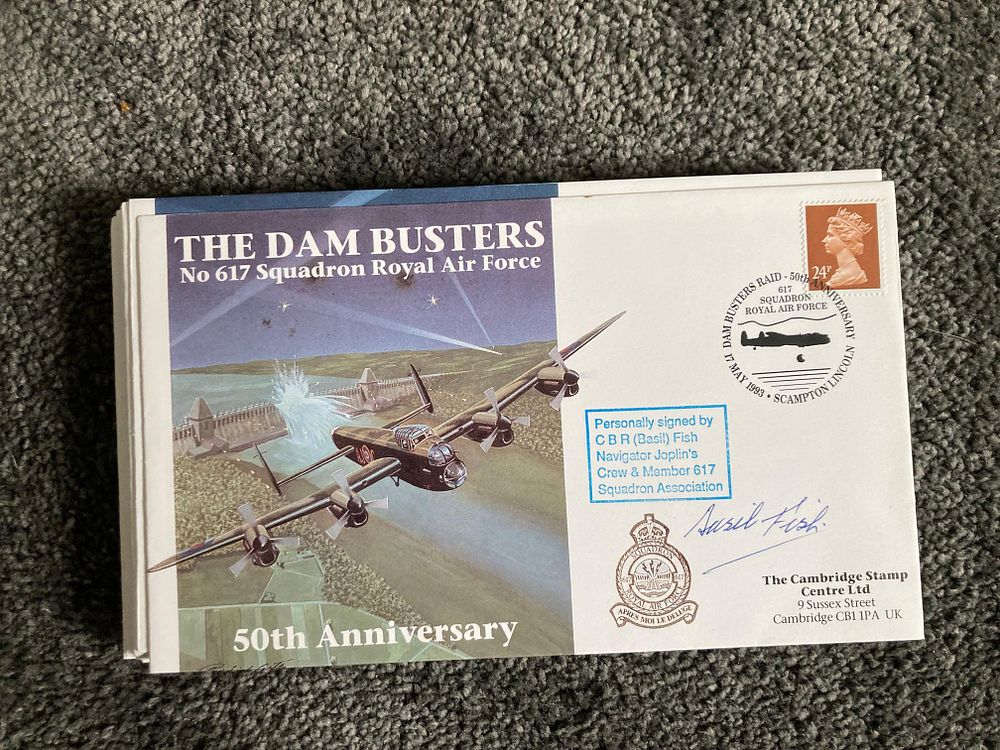
Bidspirit auction | Basil Fish 617 sqn Tirpitz
Basil Fish 617 sqn Tirpitz raid signed WW2 RAF Dambusters 50th ann Cover Rare. Flown by Lancaster PA474 over the Derwent Dam, numbered on the back with flight details on cachet. Special Scampton 50th ann Dambusters Raid postmark. In October 1940, at the age of eighteen, Basil Fish went up to Manchester University from Queen Elizabeth's Grammar School, Blackburn, Lancashire, to read civil engineering. In early 1941, he joined the first Air Squadron to be formed at the university and, on 3 November 1941, when just nineteen, he enlisted in the Royal Air Force Volunteer Reserve at Padgate. He was accepted for pilot/observer training, but was returned to university to continue combined studies for his BSc degree and Initial Training Wing for the Royal Air Force. In the summer of 1942 he obtained the first part of his degree. He also passed the Initial Training Wing examination and entered the RAF full-time. He was directed to navigator training and sent to South Africa to follow this course. On 21 August 1943 he qualified as an Air Navigator at No 42 Air School, Port Elizabeth. He returned to the United Kingdom and was posted on a course at No 8 Advanced Flying Unit, RAF Mona, Anglesey and in April 1944 he was posted to No 17 Operational Training Unit at RAF Silverstone, Northamptonshire, where he crewed with a New Zealand pilot, Flying Officer Arthur Joplin from Auckland. The crew continued through the bomber training schedule via No 1660 Heavy Conversion Unit, RAF Swinderby and then to No 5 Lancaster Finishing School at RAF Syerston, to be posted in mid-August 1944 direct to join 617 Squadron at Woodhall Spa. There was much to learn and absorb, especially the proper use and demands of the Stabilized Automatic Bomb Sight and the dominant role that accurate bombing played in the lives of all 617 aircrew. At the end of August their bombing results on the Wainfleet Bombing Range reached the standard required of crews operating with 617. On 27 August 1944, the crew carried out their very first bomber operation, a daylight raid in the 'gaggle' formation favoured by 617, against the U-Boat pens at Brest. Their operations were to include two of the Tirpitz raids, the Kembs Barrage across the Rhine near Basle, the E-Boat pens at Ijmuiden, Holland and two operations against the Urft Dam in Germany before the crash on their ninth operational sortie left Basil the only member of the crew able to continue his operational career. After a very brief spell in hospital, Basil was back on 617 and flew further operations with Flying Officer Bill Carey, Flight Lieutenant 'Stew' Anning and Squadron Leader Ward, his last and twenty-fourth operation being the Berchtesgarten raid on 25 April 1945. He had been recommended for commissioning by Group Captain Johnny Fauquier, the 617 commanding officer, and duly became a Pilot Officer on 21 April 1945. He moved to RAF Waddington with 617, to commence training for Tiger Force - the scheduled Bomber Command contribution to the war against Japan. For a while he was also employed on assistant Squadron Adjutant duties. With the Japanese surrender in August 1945, the Tiger Force concept was abandoned. Basil had been under considerable strain since the crash of December 1944 and after the cessation of hostilities, was given a short spell of hospitalization and a period of leave during which his promotion to the rank of Flying Officer was gazetted. Towards the end of 1945 Basil decided to apply for accelerated demobilization, in order to prepare for the resumption of his studies at Manchester University. This was subsequently granted and his official demobilization was notified to him on 19 April 1946. In October that year, Basil commenced his third and final year at University, obtaining a BSc in Municipal Engineering in June 1947. Good condition. Part of Single Vendor collection. We combine postage on multiple winning lots and can ship worldwide.