Bidspirit auction | WW2 Gen Brian Horrocks, John
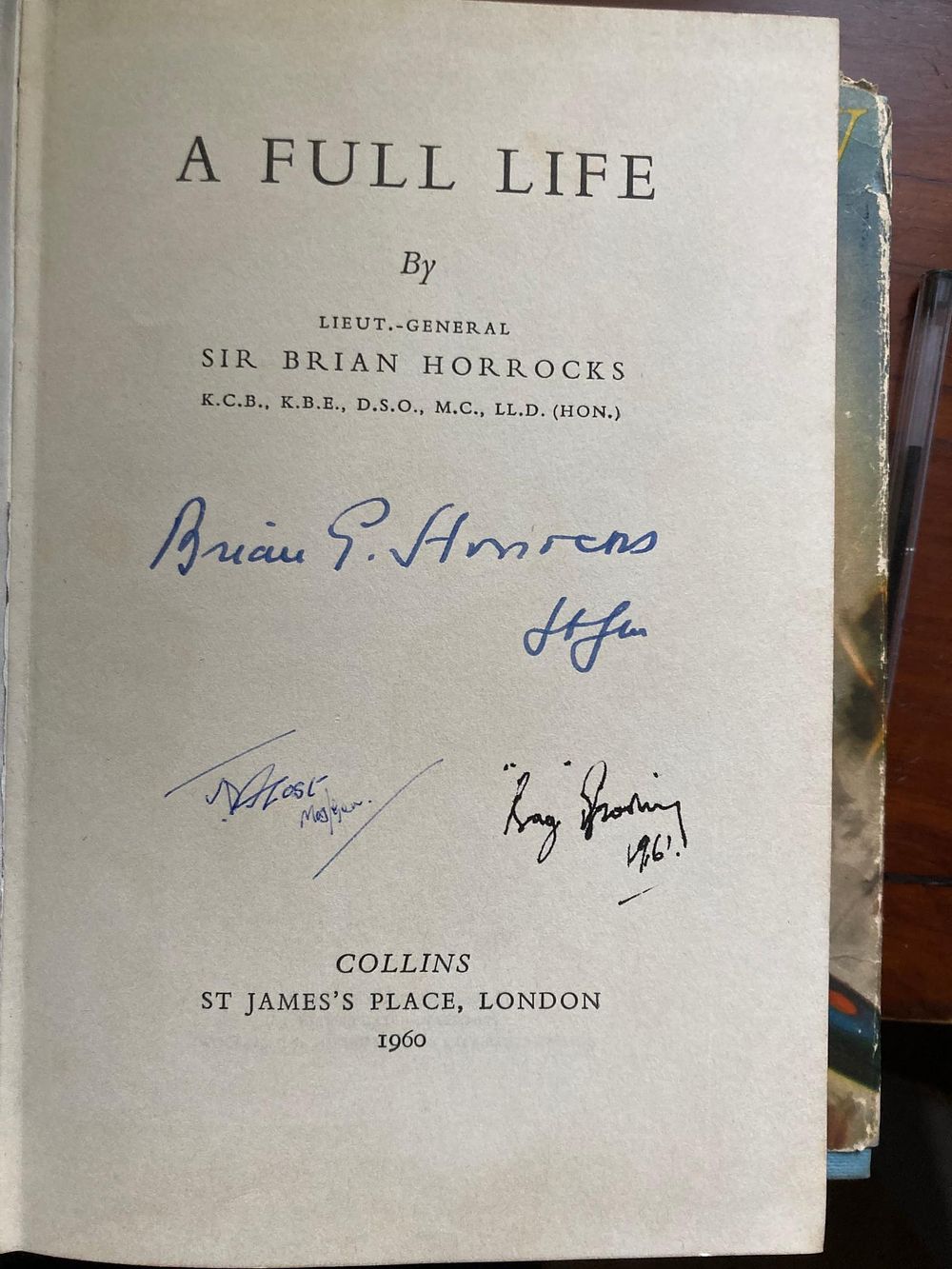
WW2 Gen Brian Horrocks, John Frost, Sir F Browning signed hard back book A Full Life. Lieutenant-General Sir Brian Gwynne Horrocks, KCB, KBE, DSO, MC (7 September 1895 - 4 January 1985) was a British Army officer, chiefly remembered as the commander of XXX Corps in Operation Market Garden and other operations during the Second World War. He also served in the First World War and the Russian Civil War, was taken prisoner twice, and competed in the modern pentathlon at the 1924 Paris Olympics. Later he was a television presenter, wrote books on military history, and was Black Rod in the House of Lords for 14 years. In 1940 Horrocks commanded a battalion during the Battle of France, the first time he served under Bernard Montgomery, the most prominent British commander of the war. Montgomery later identified Horrocks as one of his most able officers, appointing him to corps commands in both North Africa and Europe. In 1943, Horrocks was seriously wounded and took more than a year to recover before returning to command a corps in Europe. It is likely that this period out of action meant he missed out on promotion; his contemporary corps commanders in North Africa, Oliver Leese and Miles Dempsey, went on to command at army level and above. Horrocks' wound continued to impair his health and led to his early retirement from the army after the war. Since 1945, Horrocks has been regarded by some as one of the most successful British generals of the war, ”a man who really led, a general who talked to everyone, down to the simplest private soldier” and the ”beau ideal of a corps commander”. General Dwight D. Eisenhower, the Supreme Allied Commander in Western Europe, called him ”the outstanding British general under Montgomery”. Major-General John Dutton Frost, CB, DSO & Bar, MC, DL (31 December 1912 - 21 May 1993) was an airborne officer of the British Army, best known for being the leader of the small group of British airborne troops that actually arrived at Arnhem bridge during the Battle of Arnhem in Operation Market Garden, in the Second World War. He was one of the first to join the newly formed Parachute Regiment and served with distinction in many wartime airborne operations, such as in North Africa and Sicily and Italy, until his injury and subsequent capture at Arnhem. He retired from the army in 1968 to become a beef cattle farmer in West Sussex. Lieutenant-General Sir Frederick Arthur Montague Browning GCVO KBE CB DSO (20 December 1896 - 14 March 1965) was a British Army officer who has been called the ”father of the British airborne forces”.[1] He was also an Olympic bobsleigh competitor, and the husband of author Daphne du Maurier. Educated at Eton College and then at the Royal Military College, Sandhurst, Browning was commissioned as a second lieutenant into the Grenadier Guards in 1915. During the First World War, he fought on the Western Front, and was awarded the Distinguished Service Order for conspicuous gallantry during the Battle of Cambrai in November 1917. In September 1918, he became aide de camp to General Sir Henry Rawlinson. During the Second World War, Browning commanded the 1st Airborne Division and I Airborne Corps, and was also the deputy commander of First Allied Airborne Army during Operation Market Garden in September 1944. During the planning for this operation, it has been suggested that he said: ”I think we might be going a bridge too far.” In December 1944 he became chief of staff of Admiral Lord Mountbatten's South East Asia Command. From September 1946 to January 1948, he was Military Secretary of the War Office. In January 1948, Browning became comptroller and treasurer to Princess Elizabeth, Duchess of Edinburgh. After she ascended to the throne as Queen Elizabeth II in 1952, he became treasurer in the Office of the Duke of Edinburgh. He suffered a severe nervous breakdown in 1957 and retired in 1959. He died at Menabilly, the mansion that inspired his wife's novel Rebecca, on 14 March 1965.