Bidspirit auction | WW2 FM Bernard Montgomery, Brian
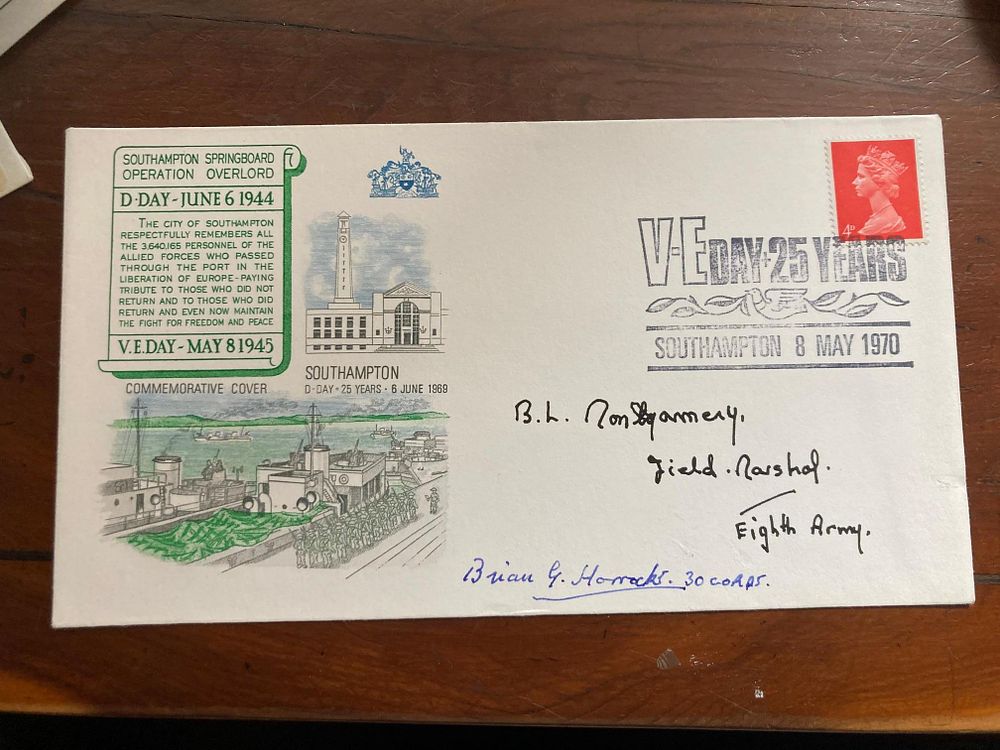
WW2 FM Bernard Montgomery, Brian Horrocks signed 1970 VE Day cover. Field Marshal Bernard Law Montgomery, 1st Viscount Montgomery of Alamein (17 November 1887 - 24 March 1976), was a senior British Army officer who served in the First World War, the Irish War of Independence, and the Second World War. Montgomery first saw action in the First World War as a junior officer of the Royal Warwickshire Regiment. At Méteren, near the Belgian border at Bailleul, he was shot through the right lung by a sniper during the First Battle of Ypres. On returning to the Western Front as a general staff officer, he took part in the Battle of Arras in April-May 1917. He also took part in the Battle of Passchendaele in late 1917 before finishing the war as chief of staff of the 47th (2nd London) Division. In the inter-war years he commanded the 17th (Service) Battalion, Royal Fusiliers and, later, the 1st Battalion, Royal Warwickshire Regiment before becoming commander of the 9th Infantry Brigade and then general officer commanding (GOC), 8th Infantry Division. During the Western Desert campaign of the Second World War, Montgomery commanded the Eighth Army from August 1942. He subsequently commanded the Eighth Army during the Allied invasion of Sicily and the Allied invasion of Italy. During the Normandy campaign, he was in command of all Allied ground forces from 6 June 1944 until 1 September 1944. He then continued in command of the 21st Army Group for the rest of the North West Europe campaign, including the failed attempt to cross the Rhine during Operation Market Garden. When German armoured forces broke through the US lines in Belgium during the Battle of the Bulge, Montgomery received command of the northern shoulder of the Bulge. Montgomery's 21st Army Group, including the US Ninth Army and the First Allied Airborne Army, crossed the Rhine in Operation Plunder in March 1945. By the end of the war, troops under Montgomery's command had taken part in the encirclement of the Ruhr Pocket, liberated the Netherlands, and captured much of north-west Germany. On 4 May 1945, Montgomery accepted the surrender of the German forces in north-western Europe at Lüneburg Heath, south of Hamburg, after the surrender of Berlin to the USSR on 2 May. After the war he became Commander-in-Chief of the British Army of the Rhine (BAOR) in Germany and then Chief of the Imperial General Staff (1946-1948). From 1948 to 1951, he served as Chairman of the Commanders-in-Chief Committee of the Western Union. He then served as NATO's Deputy Supreme Allied Commander Europe until his retirement in 1958. Lieutenant-General Sir Brian Gwynne Horrocks, KCB, KBE, DSO, MC (7 September 1895 - 4 January 1985) was a British Army officer, chiefly remembered as the commander of XXX Corps in Operation Market Garden and other operations during the Second World War. He also served in the First World War and the Russian Civil War, was taken prisoner twice, and competed in the modern pentathlon at the 1924 Paris Olympics. Later he was a television presenter, wrote books on military history, and was Black Rod in the House of Lords for 14 years. In 1940 Horrocks commanded a battalion during the Battle of France, the first time he served under Bernard Montgomery, the most prominent British commander of the war. Montgomery later identified Horrocks as one of his most able officers, appointing him to corps commands in both North Africa and Europe. In 1943, Horrocks was seriously wounded and took more than a year to recover before returning to command a corps in Europe. It is likely that this period out of action meant he missed out on promotion; his contemporary corps commanders in North Africa, Oliver Leese and Miles Dempsey, went on to command at army level and above. Horrocks' wound continued to impair his health and led to his early retirement from the army after the war. Since 1945, Horrocks has been regarded by some as one of the most successful British generals of the war, ”a man who really led, a general who talked to everyone, down to the simplest private soldier” and the ”beau ideal of a corps commander”. General Dwight D. Eisenhower, the Supreme Allied Commander in Western Europe, called him ”the outstanding British general under Montgomery”.