Bidspirit auction | WW2 David Scott - Malden
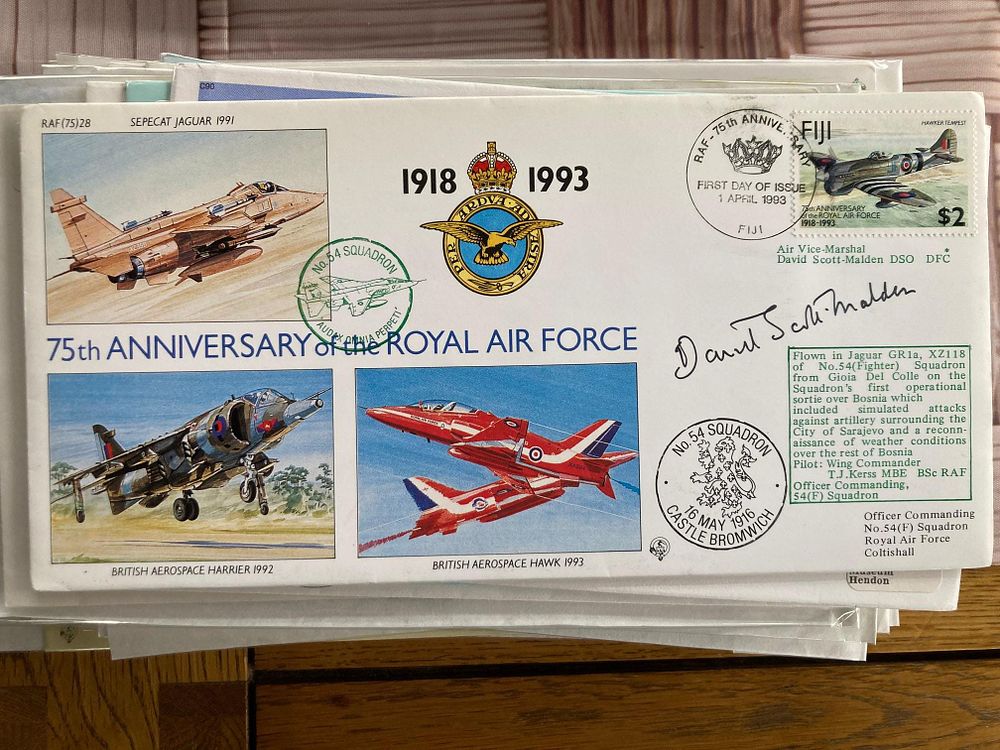
WW2 David Scott - Malden Battle of Britain signed 75th Anniv RAF 54 Sqn cover; RAF(75)28c75th Anniv RAF 54 Sqn David Scott - Malden Battle of Britain pilot Ace. Apr 1993 Fiji FDI Postmark on $2 Fiji Hawker Tempest stamp for 75th Anniversary of the RAF Special Postmark. 75th Anniversary of the RAF No. 54 Squadron flown cover flown in Jaguar. Personally signed Air Vice Marshal David Scott - Malden DSO DFC Battle of Britain fighter pilot Ace. Certified Copy Signed on back by Gp Capt Bill Randle DFM, WW2 Wellington pilot and Comete Line Escaper. He joined the University Air Squadron in November 1938 and transferred to the RAFVR on 14th June 1939 as an Airman u/t Pilot. Scott-Malden was called to full-time service and commissioned on 3rd October 1939. On 1st January 1940 he was posted to RAF College FTS Cranwell and after completing his flying training he went to No. 1 School of Army Co-operation at Old Sarum for a course in late May 1940. The course had hardly began when the chief instructor announced that he had 'a severe disappointment' to communicate: 'Gentlemen' he said 'you are to be transferred immediately to fighters'. Scott-Malden joined in 'the wild whoop as the classroom emptied, leaving the chief instructor standing alone beside the blackboard'. On 10th June 1940 Scott-Malden arrived at 5 OTU Aston Down and after converting to Spitfires joined 611 Squadron at Digby on 23rd June 1940, just before the start of the Battle of Britain. He said at the time 'Twelve months before Dunkirk I was receiving Cambridge's Gold Medal for Greek Verse - an unusual qualification for a fighter pilot. A well trained mind is an asset, but in the skies of Britain in 1940 to be too academic was not a recipe for survival. I was lucky to come through. Many of my university friends did not'. On 4th October 1940 he went to 603 Spitfire Squadron at Hornchurch. He probably destroyed a Messerschmitt BF109E on the 12th October 1940. He added to his score by damaging two Fiat CR42 biplane fighters in the raids by the Italian Regia Aeronautica on 23rd November 1940. David then shared a Dornier 17 bomber as Destroyed on the 29th November 1940. His score was quoted in wartime at the time of the end of 1940 as being around 2 and 2 damaged but was including the Probable Destroyed and the shared Destroyed plus 2 Damaged. Scott-Malden became a Flight Commander in May 1941. On the 11th he took 'A' Flight to Drem for a night-flying course. On the 28th May 1941 he probably destroyed a Me109 and damaged another, on 7th, 14th, 21st June and 8th and 12th July he damaged Me109s. Adding to his score and getting his eye in, in terms of gunnery, he added: on 17th, 19th and 26th August 3 destroyed Me109s and on 18th September he probably destroyed another. Scott-Malden was awarded the DFC (gazetted 19th August 1941) and in late September he was promoted and given command of 54 Squadron at Hornchurch. His score now was at least 3 and 1 Shared Destroyed, 3 Probably Destroyed (Shown as 7 victories in wartime lists then) plus 7 Damaged. On 4th November 1941 he damaged another Me109. In late November 1941 Scott-Malden was posted to HQ 14 Group Inverness on staff duties. He was appointed to lead the North Weald Norwegian Wing in March 1942. He got a probable Fw190 on 28th April, damaged two Me109s on 4th May, probably destroyed a Fw190 on the 19th and damaged a Me109 on the 27th April 1941. David Scott-Malden was awarded a Bar to the DFC (gazetted 5th June 1942). On 19th and 29th June 1942 he shared in destroying Fw190s and on 19th August, over Dieppe, he damaged a Do217. His score was now taken to be at least:3 and 3 shared Destroyed (4. 5 victories) plus 5 Probably Destroyed and 12 Damaged claims. He had hit 24 enemy aircraft in total and was probably more honest in his claims than others. He was awarded the DSO (gazetted 11th September 1942) and the Norwegian War Cross (gazetted 6th October 1942). The latter was presented by King Haakon of Norway who then invited Scott-Malden to lunch at Claridges. He was then posted away for a rest and then sent on a speaking tour of American universities. From July to October 1943 Scott-Malden was Liaison Officer with 8th Bomber Command USAF. He commanded RAF Hornchurch, aged 23, from 28th October 1943 to 6th February 1944, when he was posted to a mobile GCU in 2nd TAF, preparing for the invasion of Europe. Initially they lived in tents on Goodwood racecourse. After D-Day the unit moved to Normandy. In August 1944 Scott-Malden was promoted to Group Captain and took command of 126 Wing. He was posted to the Air Ministry in April 1945, to work on redeployment of Air Forces from Europe to the Far East. He was made a Commander, Order of Orange-Nassau in 1945. Scott-Malden stayed in the RAF postwar, reverting to squadron leader, and had the customary sequence of staff and command appointments, including assistance with initial plans for the Suez campaign. Good condition. Part of Single Vendor collection.