Bidspirit auction | WW2 Lt Col G Jellicoe
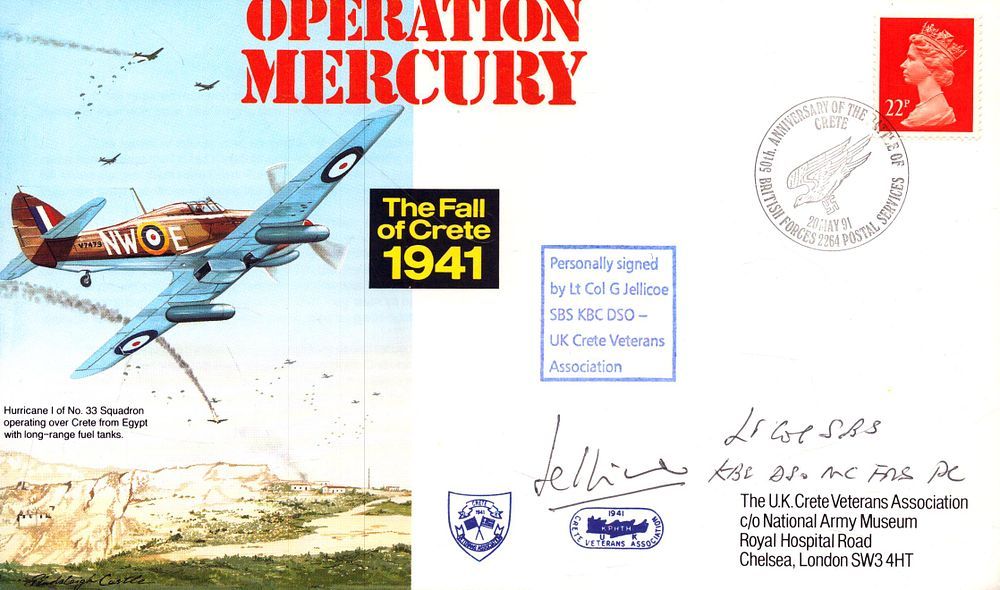
WW2 Lt Col G Jellicoe Mc SBS DSO signed Operation Mercury The Fall of Crete 1941 cover. As well as commanding the Special Boat Service in the Second World War, George Jellicoe was a long-serving parliamentarian, being a member of the House of Lords. 50th Anniversary stamped 20 May 1991, FDC. Scarce limited edition cover, only 50 issued, numbered on back. Features Hurricanes of 33 sqn operating over Crete from Egypt with long range fuel tanks. The Battle of Crete, codenamed Operation Mercury, was a major Axis airborne and amphibious operation during World War II to capture the island of Crete. The battle began on the morning of 20 May 1941, with multiple German airborne landings on Crete; Greek and other Allied forces, along with Cretan civilians, defended the island. After the first day of fighting, the Germans had suffered heavy casualties and Allied troops were confident that they would defeat the invasion. The next day, through communication failures, Allied tactical hesitation, and German offensive operations, Maleme Airfield in western Crete fell, enabling the Germans to land reinforcements and overwhelm the defensive positions in the north of the island. Allied forces withdrew to the south coast; more than half were evacuated by the British Royal Navy and the remainder surrendered or joined the Cretan resistance. The defence of Crete evolved into a costly naval engagement; by the end of the campaign the Royal Navy's eastern Mediterranean strength had been reduced to only two battleships and three cruisers. The Battle of Crete was the first occasion where Fallschirmjager (German paratroops) were used en masse, the first mainly airborne invasion in military history and the first time the Allies made significant use of intelligence from decrypted German messages from the Enigma machine, and the first time German troops encountered mass resistance from a civilian population. Due to the number of casualties and the belief that airborne forces no longer had the advantage of surprise, Hitler became reluctant to authorise further large airborne operations, preferring instead to employ paratroopers as ground troops. In contrast, the Western allies were impressed by the potential of paratroopers and started to form airborne-assault and airfield-defence regiments. Good condition. Part of Single Vendor collection. We combine postage on multiple winning lots and can ship worldwide.