Bidspirit auction | WW2 Pathfinder CO Escaper AVM
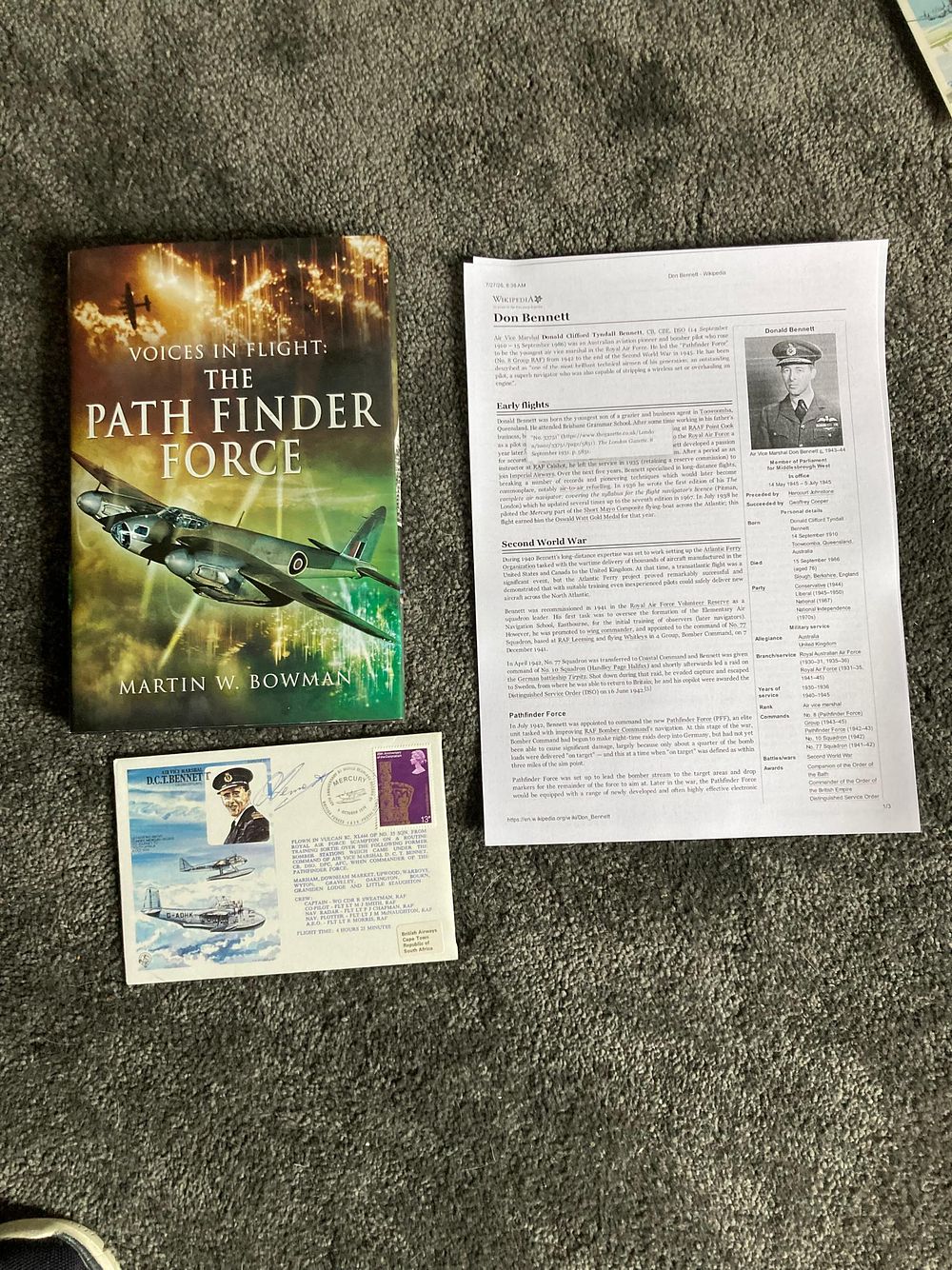
WW2 Pathfinder CO Escaper AVM Don Bennett signed on his own Historic Aviators cover, Pathfinder Force Hardback book, biography. Don Bennett became passionately interested in aviation while still a young boy. He was born on 14th September 1910 in Toowoomba, Queensland, Australia and soon began to learn all about the rigours of life on a cattle farm - his father's business. He was encouraged to pursue a career in medicine and, whilst at school, bent his energies in that direction. On leaving school he joined his father's business but the aviation bug was by then firmly entrenched in him and, at the very first opportunity (he had to wait a short while to reach the age of eligibility), he applied to join the RAAF. After a succession of further entanglements in what seemed interminable red tape, he finally enlisted in July 1930 as a cadet officer for Pilot training. He stayed in Australia, training at Point Cook, for one year. At this stage the authorities, as they had told him they would, sent him off to England. Transferred to the RAF he was posted to No 29 Squadron at North Weald, on Siskins, where after a year he applied to train on flying boats and was transferred to Central Navigation School, Calshot. He then did a brief spell flying the same Supermarine Southampton and Short Singapore under the command of Arthur Harris at Pembroke Dock before returning to Calshot, as an instructor and lecturer for three more years. By now it was 1935 and during his stay at Calshot he had managed to cram in a wide range of interesting and useful flying education. He had acquired his B Pilot's licence, Wireless Operator's licence, First Class Navigator's licence, Ground Engineer's A.C.and X Licences and Instructor's Certificate. His intention was to pursue a career in Civil Aviation and to this end he had also managed to put in quite a number of weekend stints flying De Havilland Dragon Airliners for Jersey Airways Limited. In August 1935 Bennett left the RAF. Shortly afterwards he married a Swiss girl and joined Imperial Airways. He spent the next few years in a variety of aviation-orientated ventures including the first Transatlantic flight with a payload; some interesting experimental work with the Mayo Composite Aircraft and Flight Refuelling. In 1938 he set up the long range record for a sea plane with a flight in the Mayo Composite Aircraft from Scotland to South Africa - a world record which remains unbroken. Though, when war broke out in 1939, he was still a civilian pilot he immediately joined in a variety of war activities. Two days after France capitulated he was detailed to rescue General Sikorksi, the late Polish Premier and other Polish officials from German-occupied Bordeaux. He then took on the daunting job of recruiting and training a team to initiate the 'Atlantic Bridge' by flying American Hudsons from Newfoundland (USA still being neutral) to Britain. He led a formation of 7 Hudsons from Gander to Aldergrove on 10 November 1940 - the first ever flight across the Atlantic in winter. He remained in charge of this important operation until August 1941 when he once again donned military uniform and was re-commissioned with the acting rank of Wing Commander but the Path Finder policy for Bomber Command which he had proposed was still not acceptable. After a brief spell he got command of a bomber Squadron based at Leeming, on Whitley bombers, where he set about trying to increase the effectiveness of operations at 77. It soon became evident that the single greatest failing - and it seemed to him the cause of the wastefulness - was the lack of navigational skill and knowledge on operations. After doing what he could to try to alleviate this problem he transferred from 77 Squadron to command No 10, still at Leeming, but flying Halifaxes. He was shot down whilst carrying out a low level attack on the Tirpitz in Trondheim Fjord but narrowly escaped German troops and with some help from Norwegian Patriots reached Sweden. He managed to get an aircraft to come over from Scotland to fly him back to UK, all within four weeks, and in time to learn that his Path Finder policy had been accepted by the Air Ministry. This was 'inflicted' on the C in C of Bomber Command who then appointed Tait to command a new elite force with the rank of Group Captain. On 5th July 1942 he was given the task of melding one squadron from each of Nos. 1,3,4 and 5 Group, Bomber Command with No 109 Squadron (Wellingtons and Mosquitos) to form this new force. On 15th August it came into (official) being at RAF Wyton, Huntingdonshire. The main squadrons were 7 (Stirlings); 35 (Halifaxes); 83 (Lancasters); and 156 Squadron (Wellingtons), based at four different locations. After some administrative changes they became 8 Group and Bennett was promoted to Air Commodore and then Air Vice Marshall.