Bidspirit auction | 17th Century Carved Oak Bible
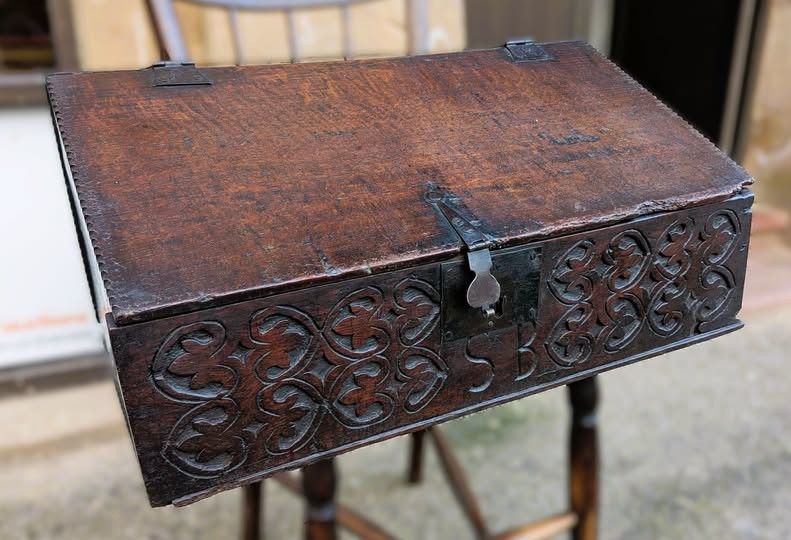
17th Century Carved Oak Bible Box - A 17th-century carved oak table desk, commonly referred to as a Bible box. Charles II Inlaid Desk Box, circa 1660-1680 25” width 15.5 depth 12” height The single plank lid above a horizontal box carved with bold foliate geometric design, centred upon an elaborate iron lock-plate with inlaid initials “S B”. The carved shapes emerging from or nestled inside the hearts are stylized tulips. Combining a heart and a tulip is one of the most iconic design pairings in 17th-century folk art, and they carry a deeply interconnected meaning: The Symbolism of Love and Marriage: While the heart naturally represents love and devotion, the tulip at this time symbolized ”perfect love” and grand passion. Carving a tulip growing out of a heart explicitly reinforced the theme of a blossoming, fruitful marriage. The ”Tulip Mania” Influence: In the mid-to-late 17th century, tulips were a massive luxury status symbol across Western Europe following the Dutch ”Tulip Mania”. Having tulips carved onto a personal storage chest or box was a provincial way to signal prosperity, rarity, and wealth. The William and Mary Connection: By the later part of the century (the 1680s and 1690s), English craftsmen heavily featured the tulip motif as a celebratory tribute to the Dutch heritage of the new co-monarchs, William III and Mary II. The way the petals are geometric and ”chipped” into the wood is standard for English rural woodworkers, who abstracted the flower into clean lines that fit perfectly within the framework of the hearts. I wonder who the SB was ? It was obviously the individual the Desk Box belonged to – they would have been wealthy and literate. Prominent English Figures (Circa 1670) include the following gents. However, it could have been a wedding gift to a lady, hence the chip carved hearts. Whoever it belonged to and whatever it was used for; its stunning. Samuel Butler (1613–1680): He was one of the most famous satirists and poets of the Restoration era. His monumental satirical poem, Hudibras, was wildly popular with King Charles II and the royal court during the 1660s and 1670s. Sir Samuel Barnardiston (1620–1707): A prominent Whig politician, wealthy merchant, and Member of Parliament. He is famously credited with inadvertently inspiring the term ”Roundhead” during the English Civil War due to his short haircut. Slingsby Bethel (1617–1697): A powerful member of the Worshipful Company of Leathersellers and a staunch republican author. By 1670, he was a highly influential, wealthy political figure in London, later serving as Sheriff.