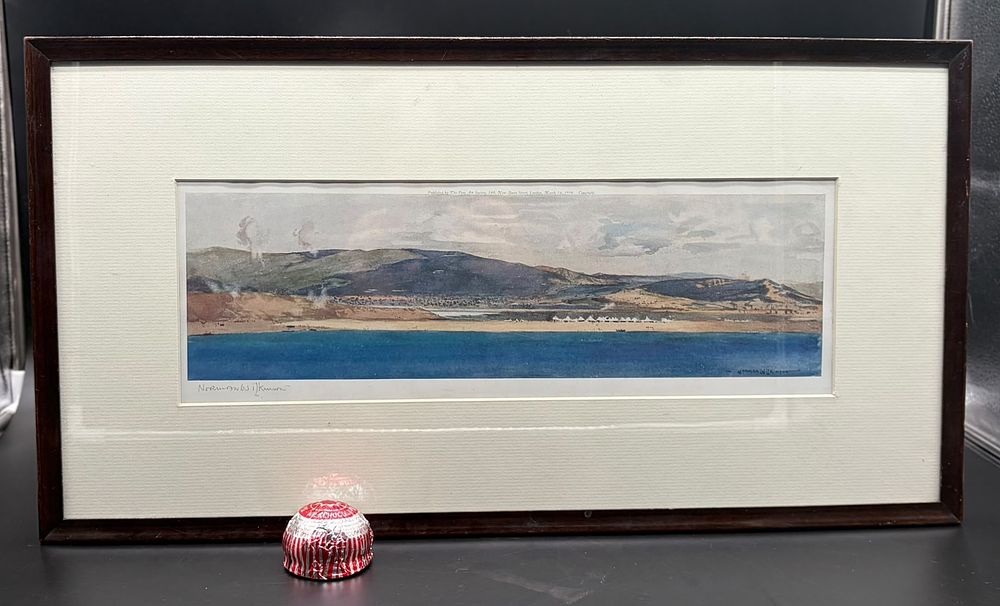
Bidspirit auction | 1916 Norman Wilkinson Color Lithograph
1916 Norman Wilkinson Color Lithograph of Gallipoli - A color photomechanical lithograph after a watercolor by Norman Wilkinson (the man who invented dazzle camoflauge) depicting a coastal military encampment during the Gallipoli campaign of World War I. Norman Wilkinson (1878–1971) was a prominent British marine painter, illustrator, and poster artist who documented the First World War. His 1916 publication, The Dardanelles: Colour Sketches from Gallipoli, was a collection of color lithographs and watercolor plates illustrating naval operations and troop landings during the disastrous Gallipoli Campaign. About the Artist and the Work Norman Wilkinson served as a lieutenant commander in the Royal Naval Volunteer Reserve during World War I and was stationed on submarine patrols and ships off the Dardanelles and Gallipoli. From his vantage point on vessels like the HMS Jonquil, he created vivid watercolor and color plate sketches ”on the spot” depicting beach assaults, explosions, and naval bombardments. Wilkinson is also famously credited with inventing dazzle camouflage, a geometric ship-painting technique designed to confuse enemy U-boat commanders regarding a ship's heading and speed The panoramic scene shows white tents pitched along a sandy shoreline, identified by contemporary records as Suvla Bay, set against rolling hills and distant plumes of smoke. The work is printed on paper and housed behind glass in a dark wood frame with a cream mat. A gallery label for J. WILSON & CO. 121 SPARKS ST. LTD OTTAWA is affixed to the brown paper backing. The print features a printed signature in the lower right within the image area reading NORMAN WILKINSON and a hand-written pencil signature in the lower left margin reading Norman Wilkinson. A publisher's line along the top edge of the image reads Published by The Fine Art Society 148, New Bond Street, London, March 16, 1916. Copyright.