Bidspirit auction | A Pair of Georgian Shoe
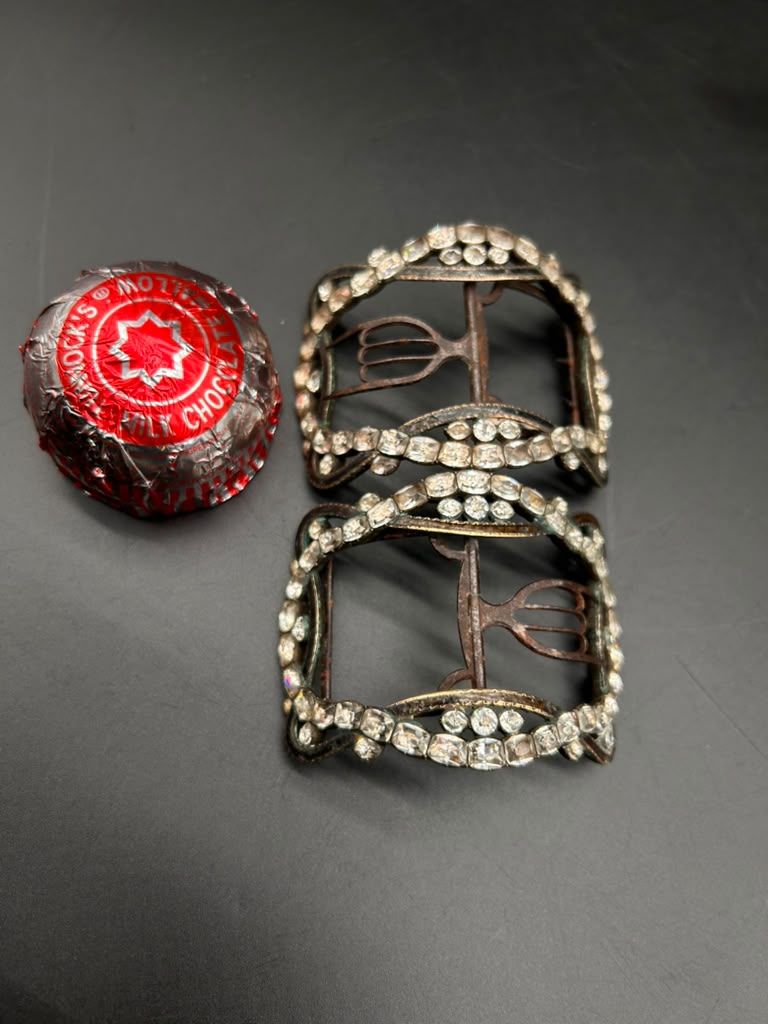
A Pair of Georgian Shoe Buckles Owned by Jacobite Commander from Culloden - Late 18th century (circa 1770–1790). The curved rectangular profile, ribbon-like borders, and large size (shown next to a Tunnock's Teacake for scale) are characteristic of late Georgian ”Artois” style buckles. Provenance via Lyon & Turnbull (Lot 10 Five Centuries Auction Septemeber, 2026) who described it as belonging to The Earls of Airlie - understood to have been owned by David Ogilvy, de jure 6th Earl of Airlie (1725–1803), then styled Lord Ogilvy. (details below) Each buckle is constructed with a slightly arched rectangular frame, typical of late 18th-century footwear accessories. The metal frames are decorated with an openwork scrolling border, housing a series of circular and oval multifaceted clear glass paste stones. The reverse of each piece retains a functional steel chape mechanism. This includes a pivoting frame with double-pronged tongues, often referred to as tines, designed to secure a leather shoe strap. No maker marks, hallmarks, or signatures are visible on the metalwork or the internal mechanisms. David Ogilvy’s key achievements at Culloden At the Battle of Culloden (16 April 1746), David Ogilvy, Lord Ogilvy - who was just 21 years old -commanded Lord Ogilvy’s Forfarshire Regiment, one of the best-disciplined units in the Jacobite army. While the battle ended in a devastating defeat for Bonnie Prince Charlie, Ogilvy and his men distinguished themselves in the final stages of the fight: Raised and Commanded a Two-Battalion Regiment. In October 1745, Ogilvy joined the Jacobite Rising in Edinburgh with roughly 600 men recruited largely from his family estates in Angus (Forfarshire). By the time of Culloden, his forces had expanded into two battalions totalling around 500 active men on the field. Held the Second Line on the Right Flank. At Culloden, Ogilvy’s regiment was positioned on the far right of the Jacobite second line, directly behind the Atholl Brigade. Covered the Jacobite Retreat. When the initial Highland charge collapsed under heavy government artillery and musket fire, the front lines broke into a chaotic rout. Instead of panicking, Ogilvy’s regiment—alongside the Royal Écossais and Kilmarnock’s Footguards—stood its ground. Fought Off Government Cavalry. During a disciplined fighting withdrawal, Ogilvy's men repeatedly wheeled and formed ranks to deliver steady volleys of covering fire. This held back the advancing British cavalry (Lord Mark Kerr's and Cobham's Dragoons), buying crucial time for thousands of fleeing Jacobites on the right wing to escape slaughter. Executed an Orderly Withdrawal. Unlike most Jacobite units that scattered in disarray, Ogilvy led his regiment off the battlefield in intact formation. They crossed the River Nairn and marched south to Ruthven Barracks. When Prince Charles sent word for the army to disperse, Ogilvy marched his men in good order back over the Cairngorms to Glen Clova, formally disbanding them on 21 April 1746.