Bidspirit auction | [MUSIC AUTOGRAPHS] - HECTOR BERLIOZ
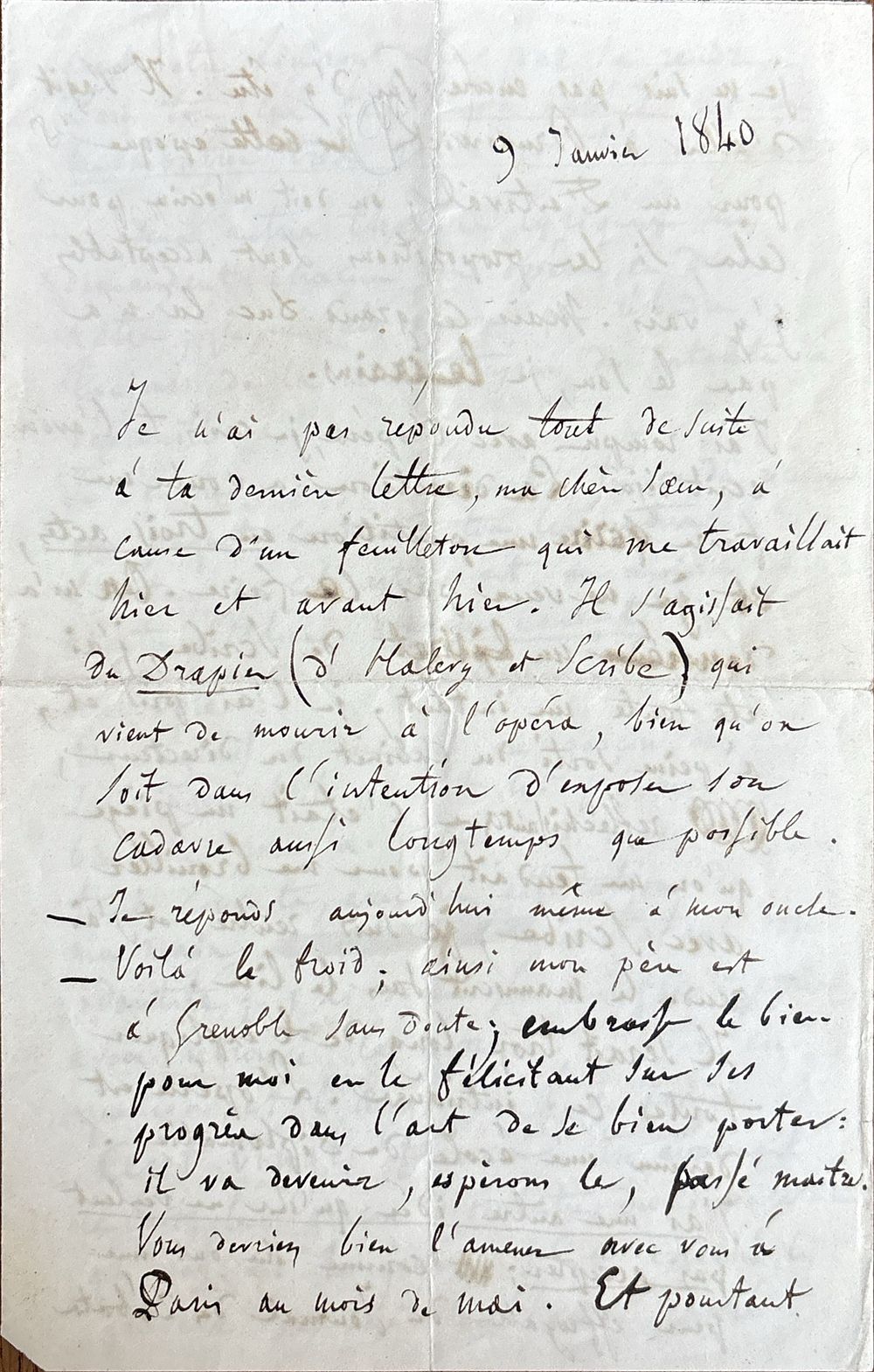
[MUSIC AUTOGRAPHS] - HECTOR BERLIOZ (1803–1869) - Important Autograph Letter Signed - HECTOR BERLIOZ (1803–1869) - Important Autograph Letter Signed, concerning the Paris Opéra, Roméo et Juliette and his search for a new symphonic idea, 9 January 1840 Autograph letter signed, in French, dated 9 January 1840, four pages closely written in Berlioz’s hand and signed on the fourth page. An exceptionally substantial letter concerning Berlioz’s relations with the Paris musical establishment, his compositional projects, Roméo et Juliette, the Paris Opéra, Eugène Scribe, the Journal des Débats, and his search for a new large-scale symphonic conception. Writing only weeks after the first performances of his dramatic symphony Roméo et Juliette, Berlioz gives a remarkably candid account of his professional and creative circumstances. He first discusses the recent death of Drapier, associated with Halévy and Scribe, observing with characteristic irony that although the man has died at the Opéra, there appears to be every intention of keeping his “corpse” there for as long as possible. Berlioz then turns to prospective engagements, mentioning the possibility of travelling to Brunswick for a festival, provided that the proposals made to him prove acceptable. The most substantial portion of the letter concerns his deteriorating relationship with the Paris Opéra. Berlioz states unequivocally: “J’ai rompu avec l’opéra…” The management, he explains, wished him to compose a score “en trois actes”, a proposal he was unwilling to accept. He had been given a libretto by the celebrated dramatist and librettist Eugène Scribe and had initially been tempted by it; almost immediately, however, he suspected that the proposal might be a manoeuvre intended to embroil him with Scribe, and returned the manuscript without reading it. His exasperation with the institution is condensed into a memorable observation: “L’opéra est devenu une école de Diplomatie.” Berlioz further reveals that he had another idea which the management would not accept, attributing their reluctance to what he describes as their extraordinary fear of the Journal des Débats, the influential newspaper for which he himself served as music critic. Other lyric theatres, he continues, have approached him about writing new works, but he remains uncertain and suspicious: “Je ne sais encore que résoudre. Toujours de la ruse, toujours des intérêts à débrouiller…” The letter then reaches a passage of particular importance for Berlioz’s creative biography. Reflecting on what might follow Roméo et Juliette, he writes: “Je cherche une nouvelle idée de grande Symphonie, mais c’est bien difficile à trouver. Ça viendra quand je n’y songerai plus, comme Roméo et Juliette.” The date makes the statement especially significant. Roméo et Juliette had received its first performances in Paris only weeks earlier, in November and December 1839. The letter thus captures Berlioz at the moment when, having only just brought one of his most ambitious works before the public, he was already searching for the conception of another “grande Symphonie”. His remark that the idea would come when he ceased looking for it, “comme Roméo et Juliette”, also provides a revealing first-hand reflection on his own creative process. This search for a new symphonic idea is immediately juxtaposed with the practical realities of a professional composer’s life: Berlioz remarks that he must write operas in order to earn money, despite the frustrations of dealing with theatrical management described earlier in the letter. The letter also contains an anecdotal passage concerning Schlesinger, a musical score and a young musician from the Conservatoire, before turning to personal matters and family news. Throughout the four pages the manuscript contains cancellations, substitutions, corrections and interlinear additions, resembling the immediacy of Berlioz’s composition and offering a vivid impression of his highly personal epistolary style. A highly significant Berlioz letter of substantial musical content, written at a pivotal moment immediately following the first performances of Roméo et Juliette. Particularly notable are Berlioz’s first-hand comments on his break with the Paris Opéra, the proposed three-act work and Scribe libretto, his relationship with the Journal des Débats and, above all, his explicit statement that he was searching for “une nouvelle idée de grande Symphonie”. The combination of extensive autograph text and substantial compositional content places the letter well above the level of routine Berlioz correspondence. Provenance: Accompanied by the catalogue description of an earlier Italian antiquarian or collector, identifying the document and reproducing and commenting upon substantial passages from the letter; further provenance not presently established. One item: autograph letter signed, four pages, 9 January 1840, with autograph cancellations, corrections and revisions.