Bidspirit auction | [MUSIC AUTOGRAPHS] - FERRUCCIO BUSONI
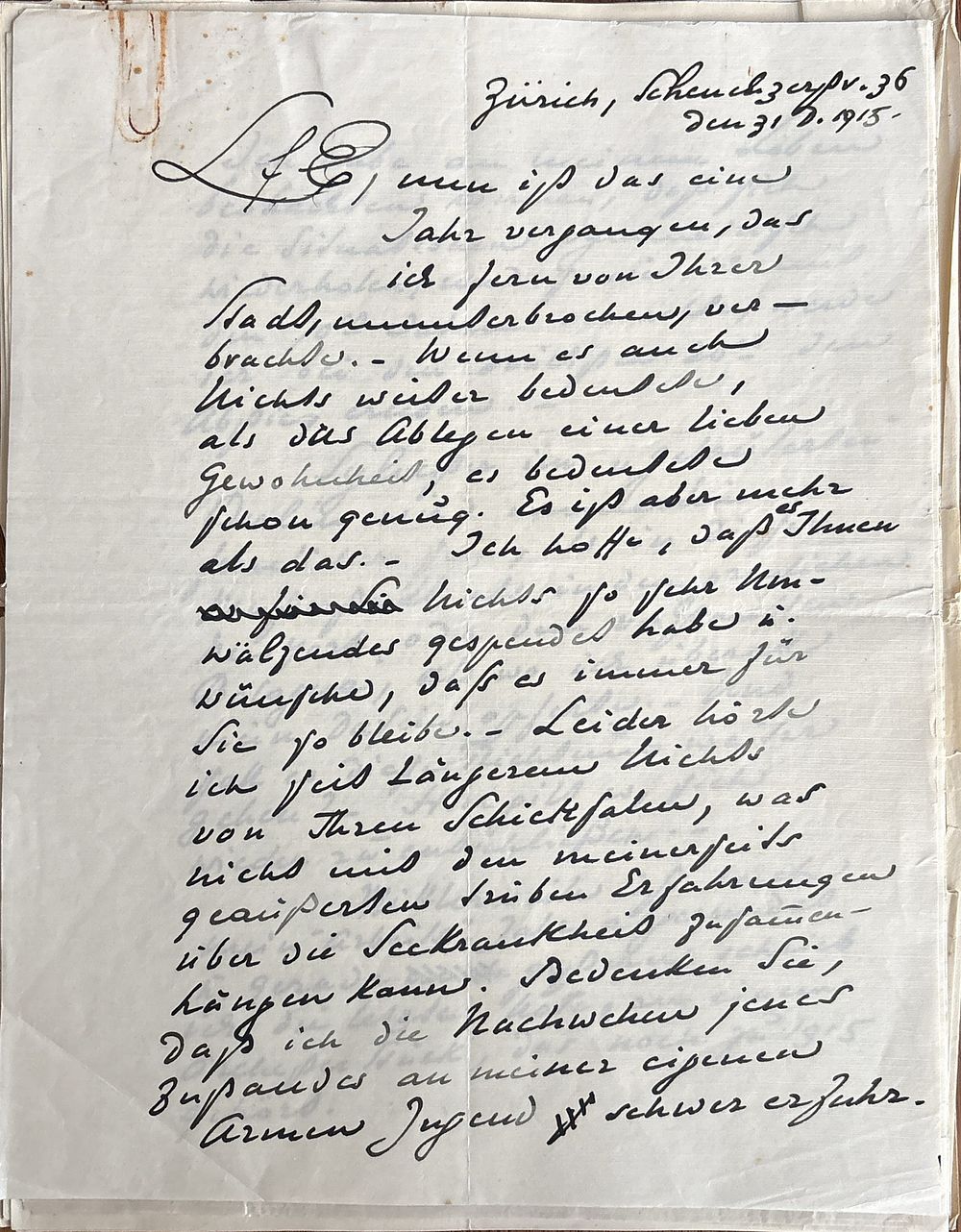
[MUSIC AUTOGRAPHS] - FERRUCCIO BUSONI (1866–1924) - Important archive of 24 autograph letters signed - FERRUCCIO BUSONI (1866–1924) - Important archive of 24 autograph letters signed, 4 illustrated autograph postcards signed with portrait, and 2 autograph postcards signed, to Edith Andreae, sister of Walther Rathenau. Berlin, Bottmingen, Hamburg, London, New York, Warsaw and Zurich, 1910–1924. 24 autograph letters signed, 4 illustrated autograph postcards signed with portrait, and 2 autograph postcards signed, addressed to Edith Andreae (1883–1952). Berlin, Bottmingen, Hamburg, London, New York, Warsaw and Zurich, 1910–1924. 69 manuscript pages, ranging in size from large quarto to octavo, in addition to the postcards. Four letters on headed paper. An important and revealing series of letters spanning fourteen years of Busoni’s life and addressed to Edith Andreae, sister of the German industrialist, statesman and intellectual Walther Rathenau. Nearly twenty years Busoni’s junior and, like him, married, Andreae remained bound to the composer until his death by a close and deeply confidential friendship. The correspondence follows Busoni through three distinct phases of his life and career: the intense concert activity of the years immediately preceding the First World War; his wartime years in Zurich; and his final return to Berlin, where he once again taught his advanced composition class at the Academy of Arts. Personal confidences and reflections on friendship, mortality and contemporary events sit alongside important references to his compositions and artistic projects, making the letters an unusually extensive record of both his private and creative lives. Berlin, 3 January 1915. “... In the last few days I have also succeeded, to my very great satisfaction, in bringing to completion a drama intended for music” — probably his opera Doktor Faust — “the beginnings of which were known to you. / This is a personal confidence, which should show you how much more I trust you than others ...” New York, 23 June 1915. “... I am now seriously considering the plan of reaching Switzerland by way of Italy. I would give a hundred United States for an old corner of Europe. / If this comes about, I shall bring several things with me ... A Rondo Arlecchinesco for orchestra and an extensive work on the Well-Tempered Clavier, as well as various smaller compositions ... If the humour in the Rondo truly succeeds in making itself felt, its effect ought to be heartbreaking ...” Zurich, 31 December 1915. “... Meanwhile my ‘working year’ has also come to an end, and only yesterday I wrote the final note of an orchestral piece” — the Rondo arlecchinesco, Op. 46, for tenor and orchestra — “which still belongs to 1915. / At the same time, work has progressed on the composition of a one-act piece” — probably Arlecchino oder Die Fenster — “In conceiving this work I had Reinhardt in mind. It calls for a spoken role and exuberant stage direction ...” The work received its first performance, directed by Hans Rogorsch, at the Stadttheater Zurich in 1917. Zurich, 6 December 1918. “... As for myself, I have always tried gradually to move towards inward contemplation; I have practised it consistently and even preached it, without for that reason renouncing life before life itself is extinguished. ‘How much longer we have to live’ is something we do not know at any moment of our existence ... / I doubt that the world can change; the individual who has set out upon an honourable path must continue along it calmly and with head held high ...” Berlin, 13 June 1921. “... I feel clearly that the thread connecting us has not yet reached its end; I count on, and hope, that we shall be able to continue spinning it together. Have patience and forbearance. I am in good condition and more receptive than usual: less impetuous, but for that very reason more deeply — and often painfully — sensitive ...” Berlin, 24 June 1922. Writing on the very day of Walther Rathenau’s assassination, Busoni offers Andreae his sympathy on the murder of her brother: “... there can be only a few senseless people who do not inwardly mourn the tragic fate of your brother and condemn without reservation the deed that was committed ...” Rathenau, then German Foreign Minister, had been assassinated earlier that day by members of the far-right Organisation Consul. Berlin, 26 April 1924. “... The last thing I saw in Berlin was the temple of art built by the local and contemporary Palladio, on Bülowplatz. They were staging there a mock fairground scene, with music by Stravinsky: very successful and stimulating, a little Gesamtkunstwerk ... / How kind of you to knock once again at my door. Better days alternate with less good ones: on one of the former I should certainly wish with all my heart to have you here, though I am always afraid that you might not happen to come at the favourable moment ...” Busoni died in Berlin only three months later, on 27 July 1924,