Bidspirit auction | [MUSIC AUTOGRAPHS] - FERRUCCIO BUSONI
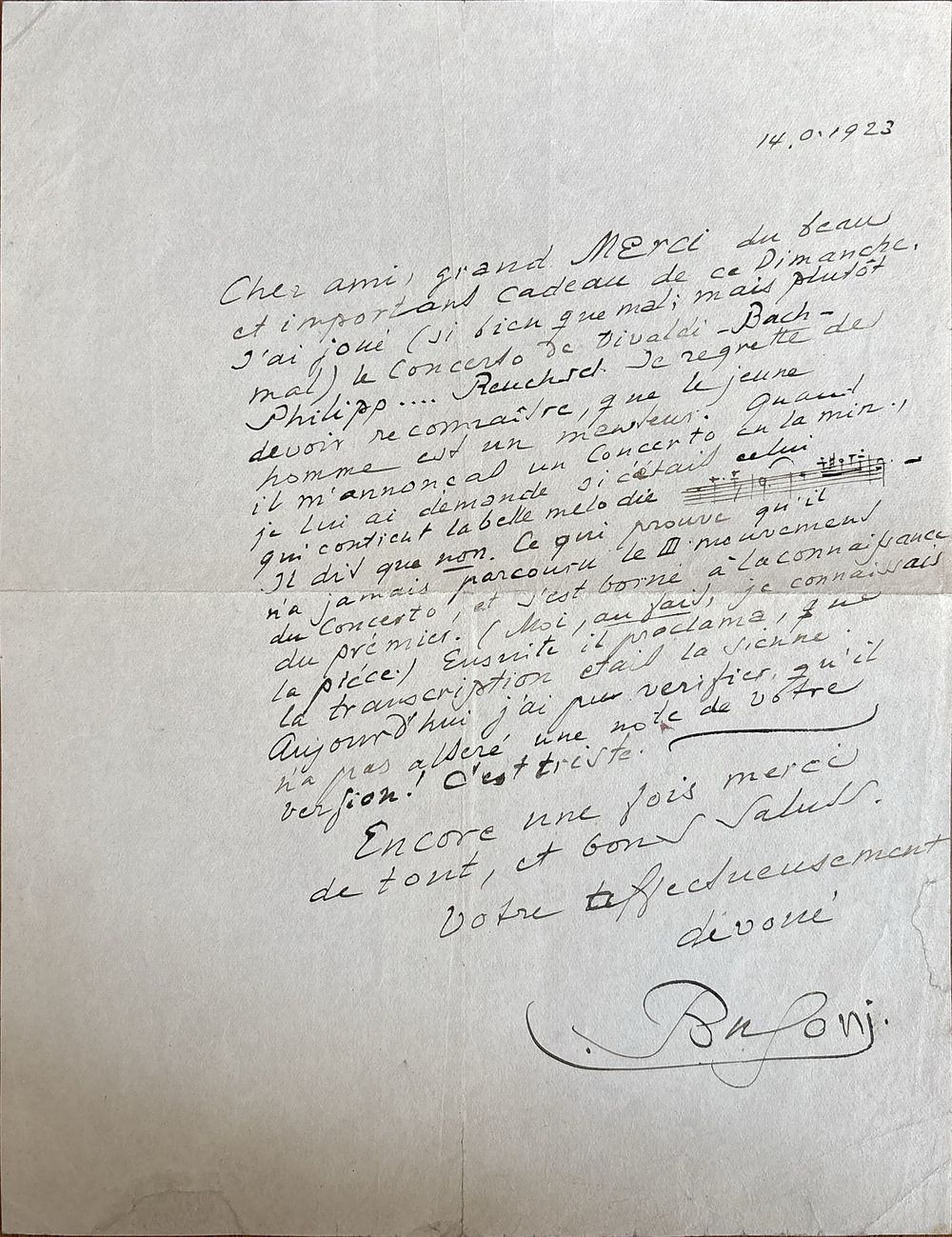
[MUSIC AUTOGRAPHS] - FERRUCCIO BUSONI (1866–1924) - Important autograph letter signed to Isidore Philipp - FERRUCCIO BUSONI (1866–1924) - “I regret having to acknowledge that the young man is a liar” Important autograph letter signed to Isidore Philipp, with an autograph musical quotation and a forceful accusation of plagiarism and incompetence, Paris, 14 October 1923 Autograph letter signed “Busoni”, in French, to the French pianist and pedagogue Isidore Philipp (1863–1958). Paris, 14 October 1923. One page, large quarto, written in pencil and containing an autograph musical quotation of three bars. A striking late letter from Busoni to his friend and fellow pianist Isidore Philipp, concerning the A-minor concerto associated with Vivaldi and Bach and containing an unusually severe denunciation of a young musician whom Busoni explicitly calls a liar. Busoni begins warmly: “Cher ami, grand MERCI du beau et important cadeau de ce Dimanche.” (“Dear friend, many THANKS for the beautiful and important gift this Sunday.”) He then reports having played the “Concerto de Vivaldi-Bach-Philipp … Reuchsel”, adding self-deprecatingly that he had played it “si bien que mal; mais plutôt mal” (“as best I could, though rather badly”). His tone changes abruptly when he turns to the young musician in question: “Je regrette de devoir reconnaître, que le jeune homme est un menteur.” (“I regret having to acknowledge that the young man is a liar.”) Busoni explains that when the young man had mentioned a concerto in A minor, he asked whether it was the concerto containing a particular “beautiful melody”. At this point Busoni writes out the melody directly in the letter in a three-bar autograph musical quotation. The young man denied that this was the work in question. For Busoni, the answer demonstrated that he did not properly know the concerto: “Ce qui prouve qu’il n’a jamais parcouru le III mouvement du Concerto, et il s’est borné à la connaissance du premier.” (“Which proves that he has never gone through the third movement of the Concerto and has confined himself to knowing the first.”) The accusation then becomes more serious. The young man had claimed, Busoni writes, that the transcription was his own. Having now examined Philipp’s version, Busoni finds that not a single note has been changed: “Ensuite il proclama, que la transcription était la sienne. Aujourd’hui j’ai pu verifier qu’il n’a pas altéré une note de votre version! C’est triste.” (“Then he declared that the transcription was his own. Today I have been able to verify that he has not altered a single note of your version! It is sad.”) He closes by thanking Philipp once again and signs warmly: “Votre affectueusement dévoué, Busoni.” (“Yours affectionately and devotedly, Busoni.”) Busoni and Isidore Philipp Isidore Philipp (1863–1958), the distinguished French pianist, composer and pedagogue, maintained a long-standing friendship and correspondence with Busoni. Their surviving letters constitute an important source for Busoni’s musical and professional life. The present letter is particularly attractive for combining their personal correspondence with a concrete discussion of performance, transcription and musical authorship. Busoni’s autograph quotation of the melody functions as evidence within his argument: the musical notation is not merely illustrative, but integral to his demonstration that the young musician neither properly knew the concerto nor had produced the transcription he claimed as his own. Provenance: L. Rodoni Collection, Biasca, recorded as the location of the autograph in the published Busoni–Philipp correspondence; subsequently offered by Kotte Autographs as part of a group of three autograph letters signed by Busoni to Isidore Philipp, dating from 1916 to 1923. A particularly vivid document of Busoni’s uncompromising views on musical authorship: an autograph letter in which musical notation itself becomes part of the evidence in his exposure of what he regarded as a false claim to another musician’s transcription. One item: autograph letter signed, one page, with three-bar autograph musical quotation, Paris, 14 October 1923.