Bidspirit auction | [MUSIC AUTOGRAPHS] - FERRUCCIO BUSONI
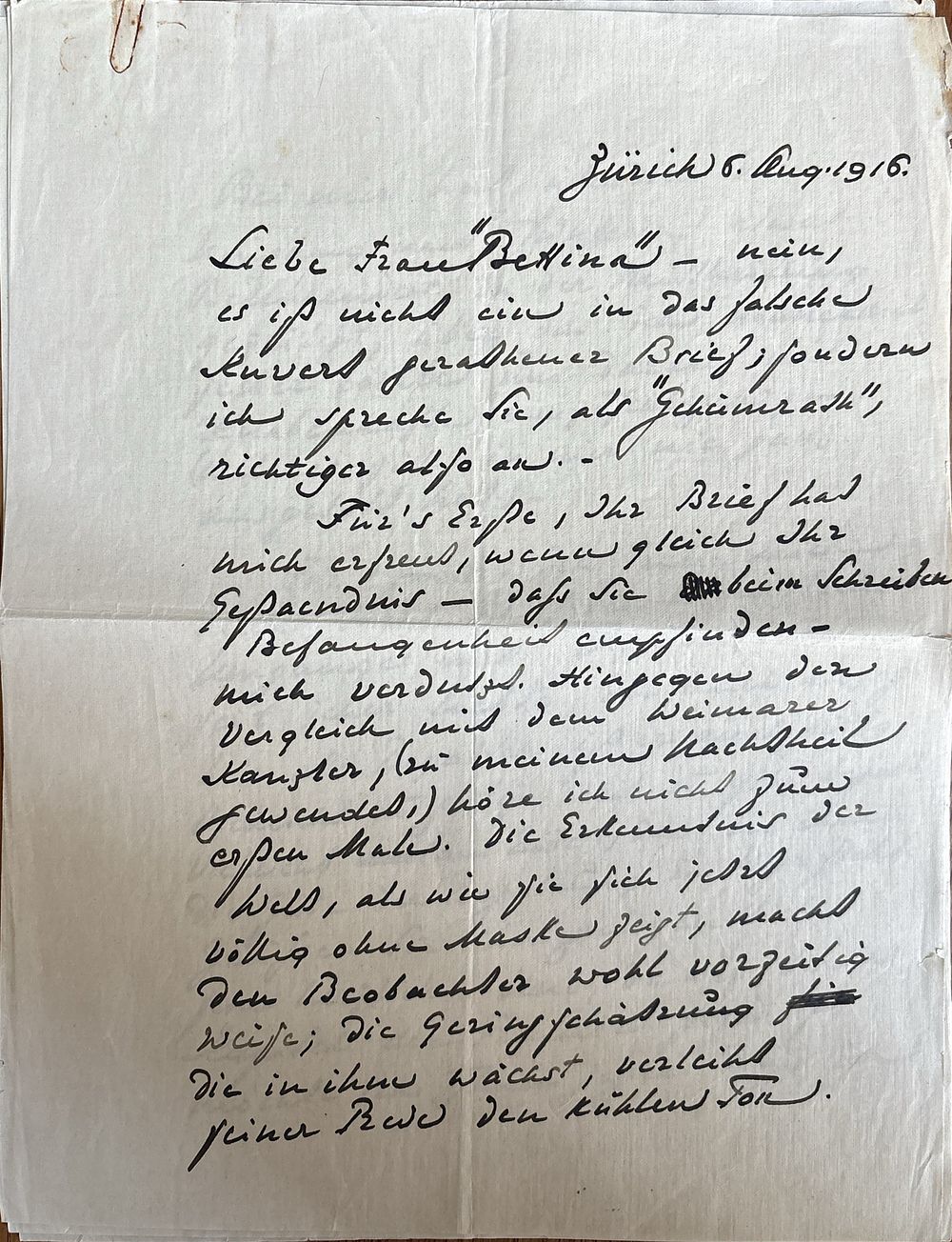
[MUSIC AUTOGRAPHS] - FERRUCCIO BUSONI (1866–1924) - Substantial autograph letter signed - FERRUCCIO BUSONI (1866–1924) - Substantial autograph letter signed, discussing Beethoven, Busoni’s own theatrical projects and his artistic circle during his Swiss exile. Zurich, 6 August 1916. Autograph letter signed, in German, to “Frau Bettina”. Zurich, 6 August 1916. Four pages, manuscript in ink, signed with Busoni’s characteristic monogrammatic signature. A substantial and highly personal letter from Busoni’s Swiss exile, combining musical criticism with reflections on his own work and news of his contemporary artistic circle. Responding to his correspondent’s remarks, Busoni discusses Beethoven at considerable length, reflecting upon his intellectual character and the distinctive quality of his music. He writes that Beethoven’s extraordinary “Geistesschärfung” (“intellectual acuity”), perceptible throughout his work, prevents him from sensing the supposed “kühlen Ton” (“cold tone”) sometimes attributed to the composer. Busoni then turns to his own artistic plans, mentioning his theatrical Capriccio (“Intermezzo, Marionettenspiel, groteskes Schemen-Spiel”) and discussing the difficulties he faced in bringing his projects to completion. The letter also provides a vivid account of Busoni’s contemporary circle. He names several Berlin friends, including Sobernheim, Israel, Butting, Rita B. and Ludwig Rubiner, and mentions the composer Ermanno Wolf-Ferrari, then also in Zurich, whom he describes as: “ein feiner u. weltspannender, sympathischer, nicht uninteressanter” (“a refined and cosmopolitan, likeable, not uninteresting figure.”) Written during Busoni’s wartime residence in neutral Zurich, the letter brings together his engagement with the musical past, his own creative ambitions and the network of writers and musicians around him. Particularly noteworthy is the extended discussion of Beethoven, which offers direct evidence of Busoni’s response to a composer who occupied a central place in his thinking about the history and future of music. Condition: Four manuscript pages with original folds; some marginal wear, small tears and losses, particularly to the final leaf, but without substantial loss of text. Ink strong and generally very legible.