Bidspirit auction | [MUSIC AUTOGRAPHS] - SAR ANTONOVICH
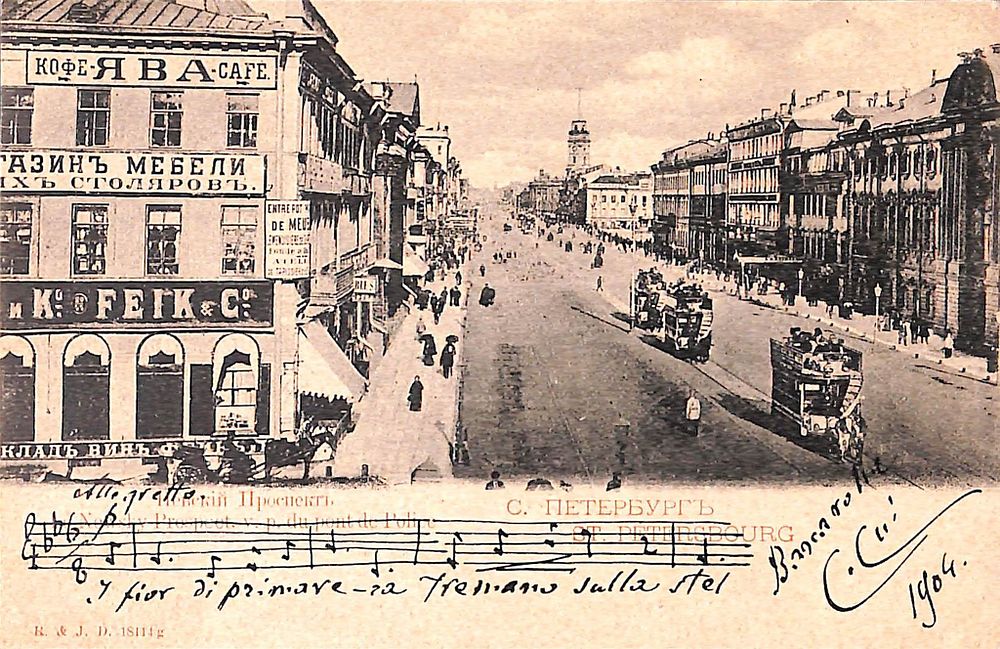
[MUSIC AUTOGRAPHS] - SAR ANTONOVICH CUI (1835–1918) - Autograph Musical Quotation Signed - CÉSAR CUI AND THE SALON ROMANCE CÉSAR ANTONOVICH CUI (1835–1918) Autograph Musical Quotation Signed, with an Italian vocal text. St Petersburg, 1904. Autograph musical quotation signed on a contemporary black-and-white illustrated postcard depicting Nevsky Prospekt, St Petersburg. In brown ink, comprising a complete stave in treble clef, marked “Allegretto”, with musical notation and an Italian vocal text, “I fior di primavera tremano sulla stella”, followed at right by Cui’s characteristic autograph monogram “C. C.” and the date 1904. The quotation consists of a self-contained melodic phrase, carefully notated on a complete stave and supplied with the agogic indication Allegretto. Beneath the melody Cui writes the Italian words: “I fior di primavera tremano sulla stella.” (“The flowers of spring tremble upon the star.”) The use of an Italian text is particularly evocative of a significant aspect of Cui’s output. Although remembered principally for his association with Balakirev, Mussorgsky, Rimsky-Korsakov and Borodin in the group traditionally known as the Five, Cui was also a prolific composer of vocal miniatures. The intimate scale and lyrical character of the present quotation belong naturally to the cultivated world of the nineteenth-century art song and salon romance. The choice of support adds considerably to the appeal of the piece. The musical autograph appears on a postcard showing Nevsky Prospekt, one of the defining urban spaces of St Petersburg, the city in which Cui spent most of his adult life and pursued his parallel careers as musician, critic and military engineer. An appealing and unusually substantial signed musical souvenir from one of the Five. More than a simple signature, the postcard preserves an entire autograph melodic phrase, complete with tempo indication and Italian vocal text, signed with Cui’s monogram and dated 1904. Its placement beneath an image of Nevsky Prospekt gives the piece an especially attractive connection with St Petersburg and with the musical world in which Cui spent the greater part of his career.