Bidspirit auction | [MUSIC AUTOGRAPHS] - GAETANO DONIZETTI
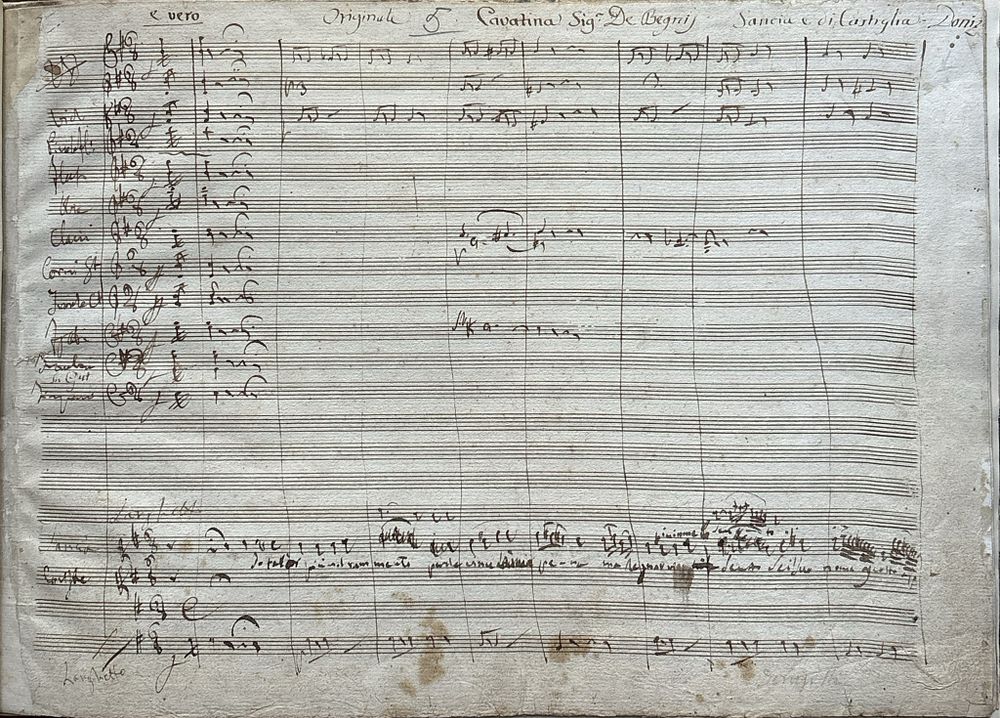
[MUSIC AUTOGRAPHS] - GAETANO DONIZETTI (1797–1848) - Autograph composing manuscript of the aria “Io talor più nol rammento” - GAETANO DONIZETTI (1797–1848) Autograph composing manuscript of the aria “Io talor più nol rammento” from Sancia di Castiglia, with extensive revisions and alternative versions. [Naples, 1832]. Unpublished in a modern critical edition. DONIZETTI, Gaetano. Autograph composing manuscript of Sancia’s aria with female chorus, “Io talor più nol rammento”, from Act I, Scene III of Sancia di Castiglia. [Naples, 1832]. 15 pages, large oblong quarto (approximately 26.6 × 37.5 cm), on 20-stave paper, manuscript in brown ink. An important autograph manuscript of a complete musical number from Sancia di Castiglia, preserving numerous cancellations, corrections, additions and alternative versions that document Donizetti’s compositional process. The aria has not been published in a modern critical edition. The manuscript contains the complete aria, excluding the preceding recitative, scored for piccolo, flutes, oboes, clarinets, horns, trumpets, bassoons, trombones, timpani and strings. The music is laid out as a single orchestral system across 20-stave paper. In eight bars of the closing orchestral ritornello, the scoring is indicated by letters and repeat signs. The upper margins of the opening pages contain several annotations, including “e [sic] vero”, the closing words of the preceding recitative, and: “Originale [...] Cavatina Sig.a De Begnis Sancia e [sic] di Castiglia Doniz[etti]”. Of particular musicological interest are the numerous autograph cancellations, revisions, corrections and additions throughout the manuscript, which preserve direct evidence of Donizetti at work on the number. Several passages in the vocal part are moreover supplied in alternative versions, making the manuscript a particularly revealing witness to the evolution of the aria. With occasional gathering numbers, possibly autograph, and modern pencil pagination. No place or date indicated, [Naples, 1832]. Modern quarter calf, with gilt lettering to the spine: “Donizetti Sancia di Castiglia MS”. An important witness to the first Sancia di Castiglia The two-act opera seria Sancia di Castiglia was composed in the autumn of 1832 for the Teatro San Carlo in Naples. Donizetti dedicated the score to his former teacher Johann Simon Mayr, a gesture indicative of the importance he attached to the work. As William Ashbrook observed, the opera combines the tradition of spagnuolismo, then fashionable at the Bourbon court in Naples, with the emphasis on pathos and suffering that became one of the defining characteristics of Donizetti’s dramatic style. Natale Gallini suggested that the present manuscript may have been prepared for a later performance of the opera. The surviving evidence, however, points instead towards its having formed part of the autograph score of the first version of Sancia di Castiglia. That score, now preserved in the library of the Conservatorio di Musica San Pietro a Majella in Naples, notably lacks the present aria. The manuscript may therefore represent an original section separated from the autograph score of the opera’s first version. Its compositional character — particularly the extensive revisions and alternative readings — lends further weight to its importance as a witness to the genesis of the work. A role written for Giuseppina Ronzi de Begnis The title role of Sancia, the widowed Queen of Castile, was written for the celebrated soprano Giuseppina Ronzi de Begnis (1800–1853), one of Donizetti’s most important interpreters. In the drama, Sancia, under the influence of the Saracen prince Ircano, comes close to allowing her own son to drink poison, before ultimately drinking it herself. The role belongs to the remarkable series of tragic female characters Donizetti shaped around Ronzi de Begnis’s vocal and dramatic gifts, alongside her leading roles in Fausta, Maria Stuarda, Gemma di Vergy and Roberto Devereux. The manuscript thus combines exceptional musical and documentary interest: an autograph composing score preserving Donizetti’s revisions and alternative solutions, written for one of the foremost singers associated with his operas and apparently connected directly with the earliest version of Sancia di Castiglia. A compelling document in the history of nineteenth-century Italian opera. Condition: A few small stains and some light browning to the first and last pages; outer edges trimmed; a few old repairs; leaves strengthened and repaired at the hinge; pinholes. Literature: Natale Gallini, “Inediti donizettiani”, Rivista musicale italiana, LV (1953), pp. 257–275; William Ashbrook, Donizetti and His Operas (1982), p. 333; idem, The New Grove Dictionary of Opera, IV, p. 162, s.v. “Sancia di Castiglia”.