Bidspirit auction | [MUSIC AUTOGRAPHS] - GIOACHINO ROSSINI
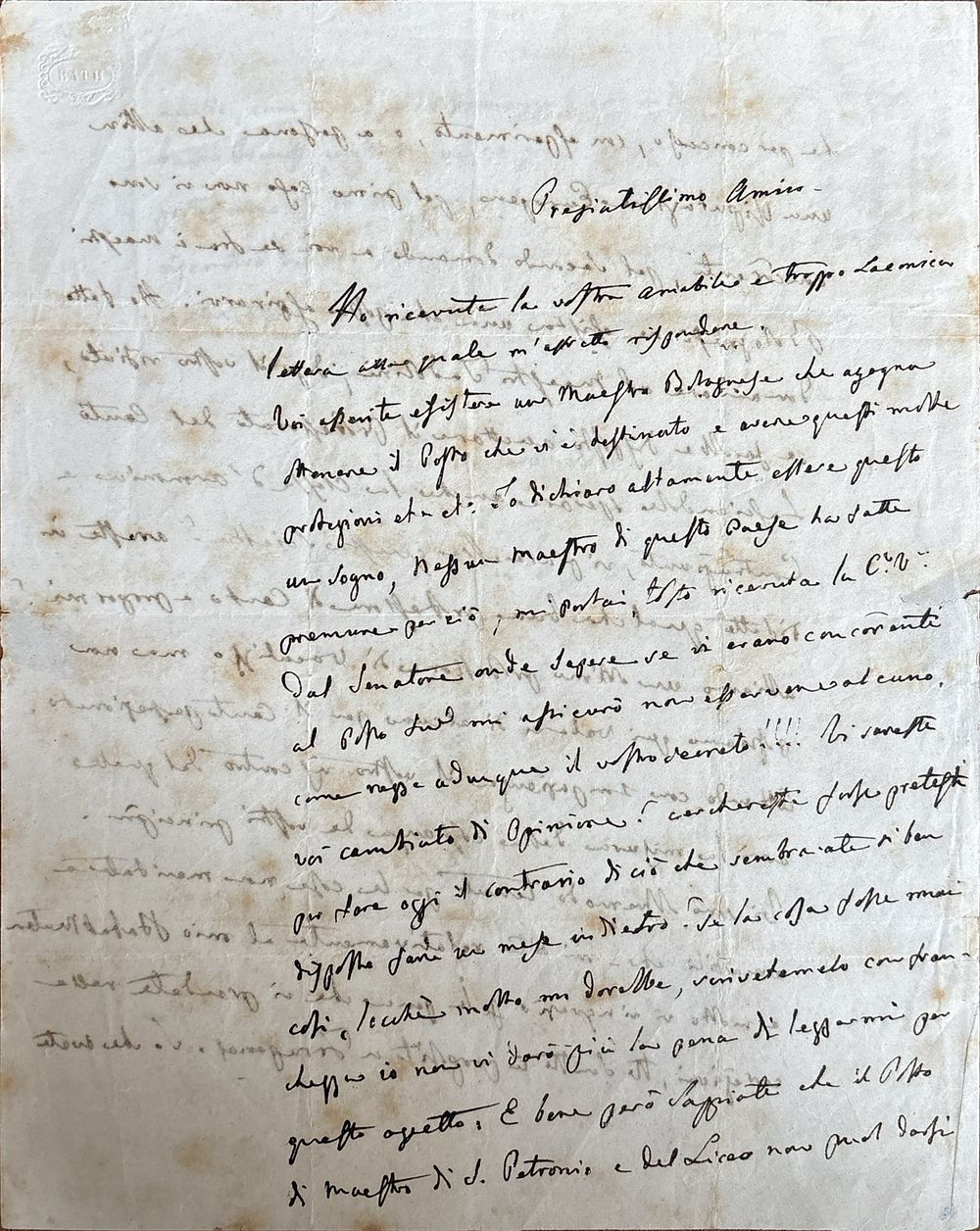
[MUSIC AUTOGRAPHS] - GIOACHINO ROSSINI (1792–1868) - Important Autograph Letter Signed to Gaetano Donizetti - ROSSINI TO DONIZETTI: TWO MASTERS AT A TURNING POINT GIOACHINO ROSSINI (1792–1868) Important Autograph Letter Signed to Gaetano Donizetti, concerning the Bologna Liceo and the final preparation of the Stabat Mater, Bologna, 24 November 1841 Autograph letter signed “Gioachino Rossini”, in Italian, dated Bologna, 24 November 1841, three closely written pages on a bifolium, with the fourth page forming the integral address leaf, addressed in Rossini’s hand to Gaetano Donizetti in Milan. A remarkable letter between two of the defining figures of nineteenth-century Italian opera, concerning the musical establishment in Bologna, the future direction of its celebrated Liceo Musicale and, most importantly, the final preparation of Rossini’s Stabat Mater. Addressing Donizetti warmly as “Pregiatissimo Amico”, Rossini begins by acknowledging his recent letter and characteristically teasing him for its brevity. He then turns to musical affairs in Bologna and discusses the future of the Liceo, an institution with which he maintained a close and influential relationship. His comments on prospective appointments and personalities provide a vivid glimpse of the professional politics surrounding one of Italy’s leading musical institutions. Among the musicians mentioned is Giovanni Tadolini, a particularly significant name in view of the second major subject of the letter: Rossini’s Stabat Mater. Rossini thanks Donizetti for his assistance with the work, including his involvement in the correction of proofs. The date of the letter places this exchange at a crucial moment in the history of the composition. Rossini had begun the Stabat Mater following a commission received during his journey to Spain in 1831. Prevented by ill health from completing the entire score, he initially entrusted several numbers to Tadolini. When the work was subsequently prepared for publication, Rossini replaced Tadolini’s contributions with newly composed movements of his own, creating the final version known today. By November 1841 this process was approaching completion, with the definitive score being prepared for publication by Eugène Troupenas in Paris. The present letter thus places Donizetti directly within the final stages of the work’s preparation. The definitive Stabat Mater received its first Paris performance on 7 January 1842, only six weeks after this letter. Donizetti himself was soon to play an important role in the work’s Italian reception, conducting its celebrated Bologna performances in March 1842. The letter therefore captures a remarkable intersection between the careers of the two composers: Rossini completing one of the masterpieces of his later years while corresponding directly with Donizetti, then at the height of his international operatic career, about both the score and the musical affairs of Bologna. Beyond its importance for the history of the Stabat Mater, the letter is notable for the vividness of Rossini’s private voice. Far from a formal communication, he writes freely to a trusted colleague about personalities, appointments and musical politics, with characteristic wit, scepticism and occasional sharpness. Signed “Gioachino Rossini” at the conclusion and dated “Bologna li 24 Nov. 1841”. The integral address leaf is addressed to Gaetano Donizetti, Milan, and bears contemporary postal markings, including BOLOGNA, manuscript postal annotations, later docketing and traces of sealing and opening. Three pages, 4to, on a folded sheet, approximately 25 × 20 cm. Typical folds and handling consistent with postal transmission; scattered spotting and staining, with losses around the seal area and other signs of age and use; otherwise well-preserved and clearly legible. An eye-opening exchange between two giants of Italian music and a significant documentary evidence about one of Rossini’s greatest sacred compositions. One item: autograph letter signed, three pages with integral address leaf, Bologna, 24 November 1841.