Bidspirit auction | [VARIOUS AUTOGRAPHS, LETTERS, & DOCUMENTS]
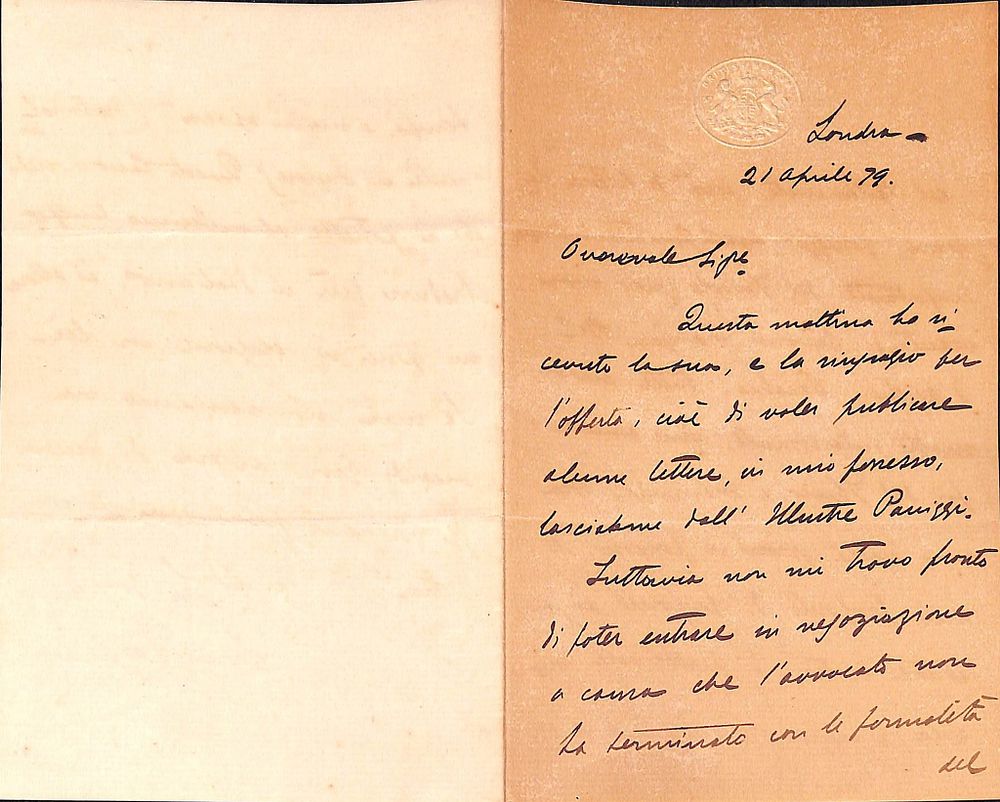
[VARIOUS AUTOGRAPHS, LETTERS, & DOCUMENTS] - LOUIS FAGAN AND ANTHONY PANIZZI - Important Correspondence with the Florentine publisher Gaspero Barbera - LOUIS FAGAN AND ANTHONY PANIZZI LOUIS FAGAN (1845–1903) Important Correspondence with the Florentine publisher Gaspero Barbera, concerning the plan to publish Antonio Panizzi’s papers and correspondence, including letters by Foscolo, Cavour and leading figures of the Risorgimento. London, 21 April–11 June 1879. A group of four autograph letters signed, in Italian, from Louis Fagan to the celebrated Florentine publisher Gaspero Barbèra (1818–1880), London, 21 April–11 June 1879, comprising twelve written pages. On various papers with elegant letterheads or embossed devices, including British Museum stationery and an embossed Arts Club, Hanover Square, stamp. An important correspondence concerning the literary legacy of Sir Anthony Panizzi, written within days of his death and documenting Fagan’s plans to publish the extraordinary collection of private letters left by the former Principal Librarian of the British Museum. The letters provide a first-hand account of the editorial, legal and commercial considerations surrounding the proposed publication, while revealing the remarkable network of political and literary figures represented in Panizzi’s papers. Panizzi had died in London on 8 April 1879. Fagan, who had worked closely with him at the British Museum and would become one of his biographers, writes to Barbera scarcely two weeks later. In the first letter, dated 21 April, he thanks the publisher for his proposal to issue some of the Panizzi letters in Fagan’s possession, while explaining that no immediate decision can be taken because legal and testamentary formalities are still being handled by the solicitor. In a supplementary communication dated 22 April, Fagan asks Barbera to send him a copy of Michele Lessona’s Volere è potere, published by Barbera in 1869, drawing particular attention to a passage on page 274 in which he himself is mentioned. He also refers to two important articles on Panizzi recently published in the London Times, evidence of the immediate public attention surrounding Panizzi’s death and reputation. The correspondence becomes considerably more substantial on 1 June, when Fagan, writing on British Museum stationery, declares his determination to proceed with publication without unnecessary delay and offers Barbera priority for the projected Italian edition. He begins to describe the extraordinary body of correspondence at his disposal, comprising letters addressed to Panizzi by some of the most prominent protagonists of nineteenth-century Italian political and intellectual life. Among the names cited are Ugo Foscolo, whose letters Fagan describes as unpublished and previously unseen; Camillo Benso, Count of Cavour; Luigi Carlo Farini; Massimo d’Azeglio; Sebastiano Tecchio; Giuseppe Pecchio; Santorre di Santa Rosa; Michele Amari; Carlo Poerio; Luigi Settembrini; and Felice Orsini. The correspondence extended well beyond Italy, with letters from major European political figures including Adolphe Thiers and François Guizot. In the final and longest letter, dated 11 June 1879, Fagan supplies Barbera with a list of correspondents and the number of letters represented, while turning to the practical form of the proposed publication. The quantity of material leads him to suggest two volumes rather than one, and he discusses the dimensions of an engraved portrait of Panizzi already prepared for an octavo edition. Of particular interest are Fagan’s comments on editorial discretion and the treatment of private correspondence. He insists on retaining the exclusive right to remove from the proofs any passage or fact that might compromise the reputation of the dead or cause pain to people still living. The letters thus document the ethical problem confronting a nineteenth-century editor working with the papers of a recently deceased public figure: how to reconcile the historical value of private correspondence with obligations towards the individuals and families concerned. Fagan also outlines a carefully considered bilingual publishing strategy. His projected English biography would not reproduce the Italian texts of the letters, thereby avoiding competition with Barbera’s Florentine edition and protecting its commercial prospects. The exchange consequently provides unusually detailed evidence of the negotiation of publication rights, markets and editorial content across national and linguistic boundaries. The correspondence has additional significance because of Fagan’s own close connection with Panizzi and the British Museum. An Italian-born writer, art historian and museum official who spent most of his career in Britain, Fagan was exceptionally well placed to preserve and interpret Panizzi’s legacy. He would subsequently publish The Life and Correspondence of Sir Anthony Panizzi in 1880,