Bidspirit auction | [VARIOUS AUTOGRAPHS, LETTERS, & DOCUMENTS]
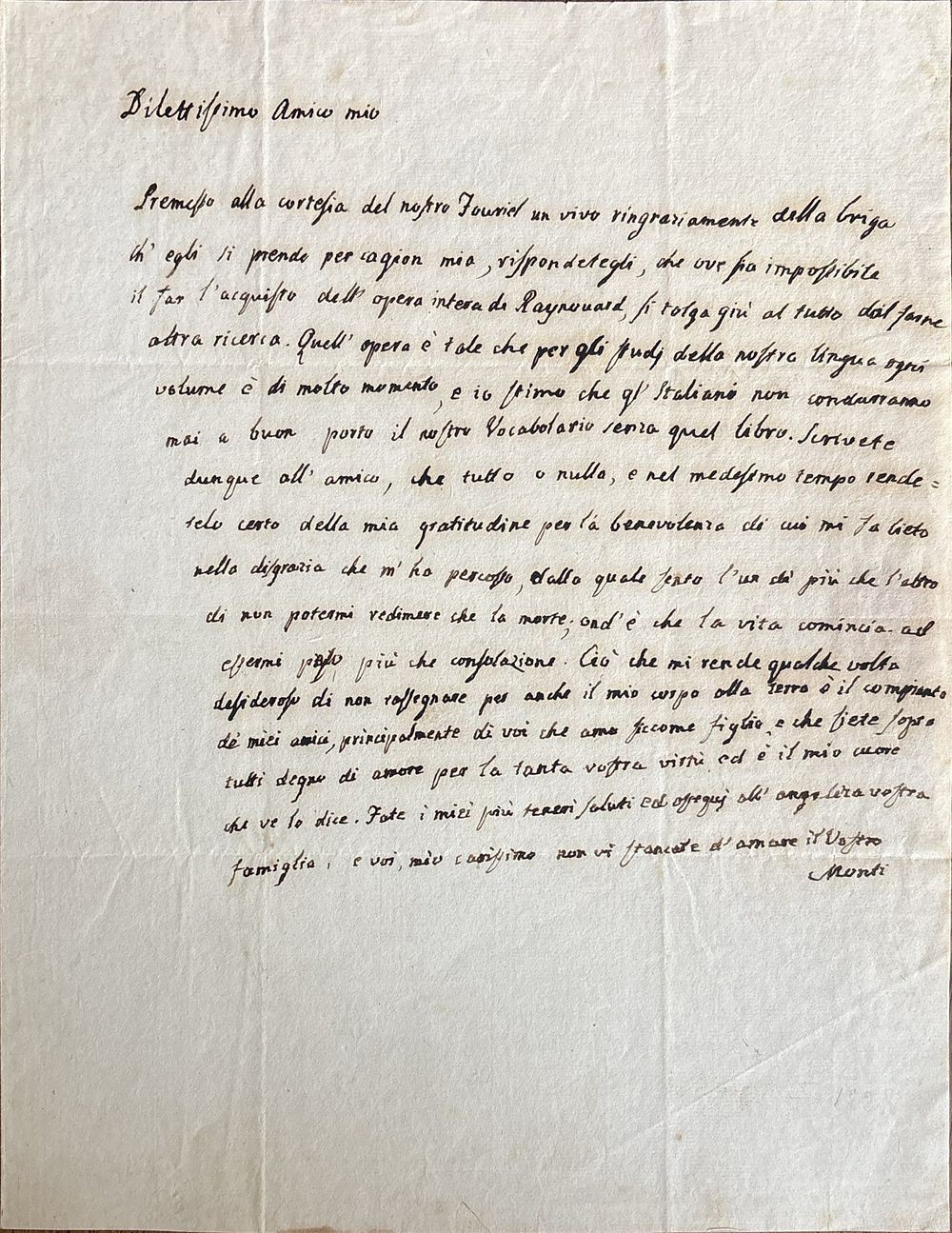
[VARIOUS AUTOGRAPHS, LETTERS, & DOCUMENTS] - VINCENZO MONTI (1754–1828) TO ALESSANDRO MANZONI (1785–1873) - An exceptionally important Autograph Letter Signed - VINCENZO MONTI (1754–1828) TO ALESSANDRO MANZONI (1785–1873) “…whom I love as a son, and who above all others are worthy of love for your holy virtue” An exceptionally important Autograph Letter Signed to Alessandro Manzoni, on Raynouard, the Italian language and Monti’s declining health, with an intimate declaration of paternal affection, [Milan, 2–7 February 1827] Autograph letter signed, in Italian, addressed to Alessandro Manzoni. [Milan, between 2 and 7 February 1827]. One page, quarto, 18 lines, with address. An exceptionally important and deeply personal letter from the final years of Vincenzo Monti’s life, combining his continuing engagement with the history of the Italian language with a moving account of his declining health and a wholehearted declaration of affection for Alessandro Manzoni, whom he describes as one he loves “as a son”. The letter can be dated with unusual precision. On 2 February 1827 Manzoni wrote to Monti informing him that he had received the long-awaited communication from their mutual friend Claude Fauriel and offering to transmit Monti’s reply. Manzoni closed with renewed assurances of his “ancient friendship” and still older admiration for Monti. The present letter was Monti’s prompt response. By 7 February Manzoni’s daughter Giulia (“Giulietta”) had copied a substantial portion of it into a letter to Fauriel. The autograph can therefore be securely dated to 2–7 February 1827. The immediate subject is the celebrated French philologist François-Juste-Marie Raynouard (1761–1836), whose pioneering studies of Provençal and Romance philology played an important part in contemporary debates over the origins and development of the Italian language. Monti asks Manzoni to thank Fauriel warmly for the trouble he has taken on his behalf and explains that, unless the whole of Raynouard’s work can be obtained, the search should be abandoned. In Monti’s judgement, every volume was necessary for the study of Italian and for the successful compilation of a national dictionary. The passage is particularly significant in the context of Monti’s great lexicographical enterprise, the Proposta di alcune correzioni ed aggiunte al Vocabolario della Crusca, and of the intense early nineteenth-century debate over the history and proper constitution of the Italian language. Monti reduces his instructions to Fauriel to a memorable formula: “Scrivete dunque all’amico, che tutto o nulla.” (“Write therefore to our friend: all or nothing.”) He accompanies the request with expressions of gratitude for the kindness Fauriel has shown him in his misfortune. That “misfortune” was no rhetorical commonplace. On 9 April 1826 Monti had suffered a severe apoplectic stroke from which he never fully recovered. His physical decline forms the emotional background to the letter. He writes with striking candour of the calamity that has overtaken him and of a life that has become increasingly burdensome, expressing the bleak conviction that only death will bring release. The particular textual importance of the autograph lies in what follows. The passage copied by Giulietta Manzoni to Fauriel on 7 February — and subsequently transmitted through the printed epistolary tradition — reproduces Monti’s discussion of Raynouard and his poignant reference to his illness. The autograph, however, continues beyond the text transmitted by Giulietta. In these concluding lines Monti turns directly to Manzoni. After reflecting upon the “disgrace” that has struck him and the burden his life has become, he addresses Manzoni in language of extraordinary tenderness: “…che amo siccome figlio e che siete sopra tutti degno di amore per la santa vostra virtù…” (“…whom I love as a son, and who above all others are worthy of love for your holy virtue…”) The words give the letter exceptional biographical significance. Beneath the differences of generation, temperament and literary allegiance — Monti, the great surviving representative of Italian Neoclassicism; Manzoni, the central figure of the new Romantic literature — they reveal a relationship of genuine personal devotion, expressed by the ageing Monti in explicitly paternal terms. The affection was reciprocal. Manzoni followed Monti’s declining health closely, reporting anxiously on his condition to Fauriel in November 1826, while he and members of his family continued to visit the invalid poet. The present letter thus belongs not to a ceremonial exchange between two celebrated writers, but to the intimate final chapter of a friendship extending back to Manzoni’s youth. Its date gives the document further resonance. Only four months later, on 15 June 1827, Manzoni sent Monti a copy of the newly completed I Promessi Sposi, affectionately and self-deprecatingly calling his novel a “cantafavola”.