Bidspirit auction | [VARIOUS AUTOGRAPHS, LETTERS, & DOCUMENTS]
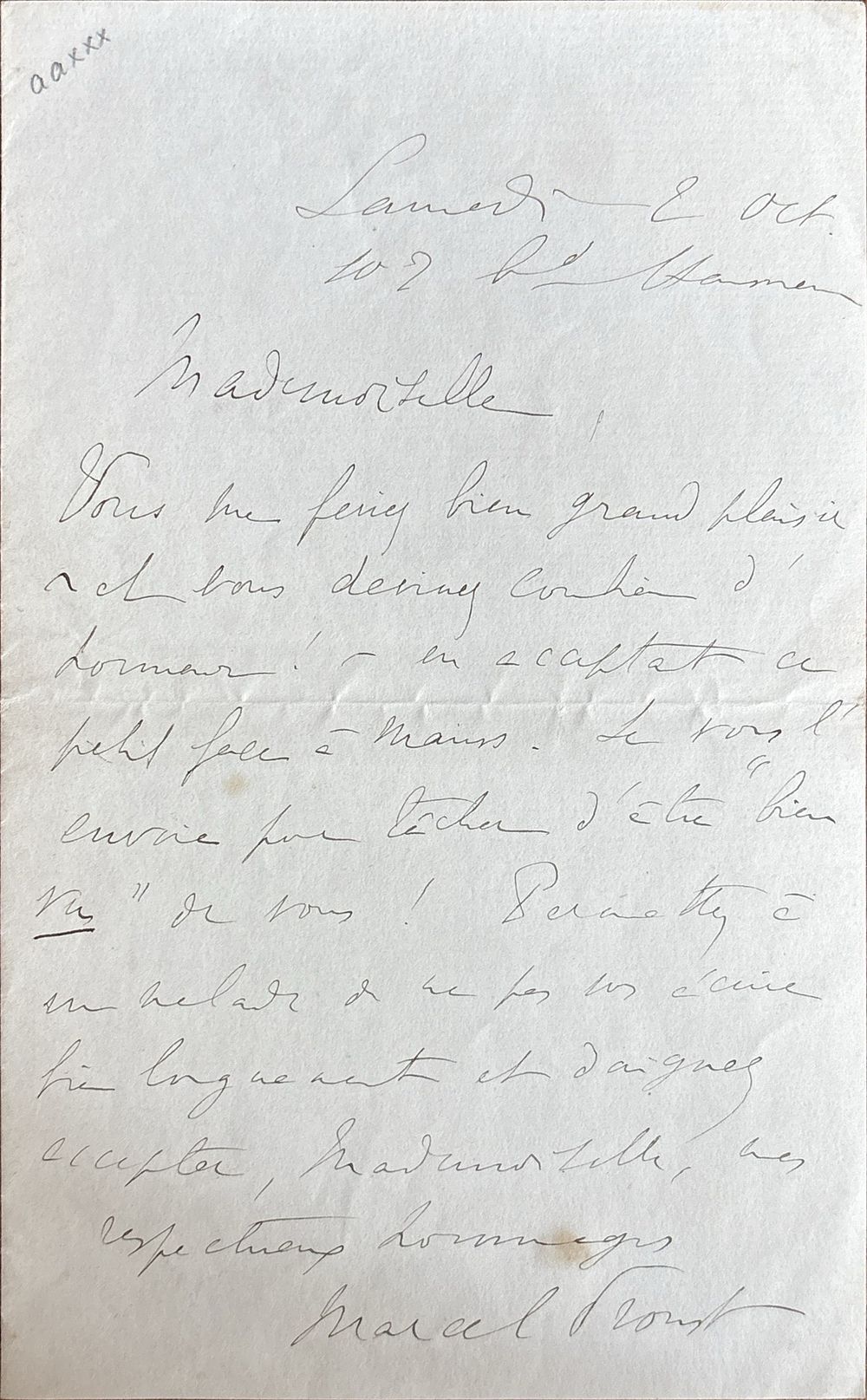
[VARIOUS AUTOGRAPHS, LETTERS, & DOCUMENTS] - MARCEL PROUST (1871–1922) - Autograph Letter Signed accompanying the gift of a face-à-main - MARCEL PROUST (1871–1922) “VOUS ME FERIEZ BIEN GRAND PLAISIR — ET VOUS DEVINEZ COMBIEN D’HONNEUR !” Autograph Letter Signed accompanying the gift of a face-à-main, Paris, Saturday 2 October [?] Autograph letter signed “Marcel Proust”, in French, Paris, Saturday 2 October [?], to an unidentified woman (“Mademoiselle”). One page on a bifolium, written in Proust’s pencil hand and signed at the foot “Marcel Proust”. A charming and highly characteristic presentation letter in which Proust offers his correspondent a small gift, expressing both pleasure and deference at the prospect of her accepting it while taking particular care to ensure that she may exchange it should it not be to her taste. Proust begins with an exquisitely courteous formulation: “Vous me feriez bien grand plaisir — et vous devinez combien d’honneur ! — en acceptant ce petit face-à-main.” (“You would give me great pleasure — and you can imagine what an honour! — by accepting this little lorgnette.”) The face-à-main was a small hand-held lorgnette, an elegant personal accessory associated particularly with the theatres, salons and fashionable society of the period. With his typical solicitude, Proust immediately reassures his correspondent that she may exchange the gift if it does not please her, explaining that arrangements have been made for her to choose something more to her liking. He mentions “la grande maison” from which the object came and emphasises that she should feel entirely free to replace it. What begins as a simple presentation note thus becomes an appealing miniature of Proust’s social manner: generous and ceremonious, yet anxious not to impose and attentive to the tastes and feelings of his correspondent. The subject of the letter has an additional Proustian resonance. A face-à-main, an object made for looking and being seen in theatres, salons and fashionable gatherings, belongs naturally to the material and social world whose objects, gestures and rituals of observation Proust would explore so minutely in À la recherche du temps perdu. A charming Proustian document in which the presentation of an apparently modest gift reveals the writer’s characteristic combination of courtesy, taste and minute consideration for its recipient. Provenance: Previously offered at Sotheby’s, Paris, 16 December 2008, lot 77; subsequently included in a sale of nineteenth- and twentieth-century French literary manuscripts. Condition: Horizontal fold across the sheet, with light handling and age wear; pencil somewhat pale in places, but the text and signature remain legible. Overall very good. One item: autograph letter signed, one page on a bifolium, Paris, Saturday 2 October [?].