Bidspirit auction | [VARIOUS AUTOGRAPHS, LETTERS, & DOCUMENTS]
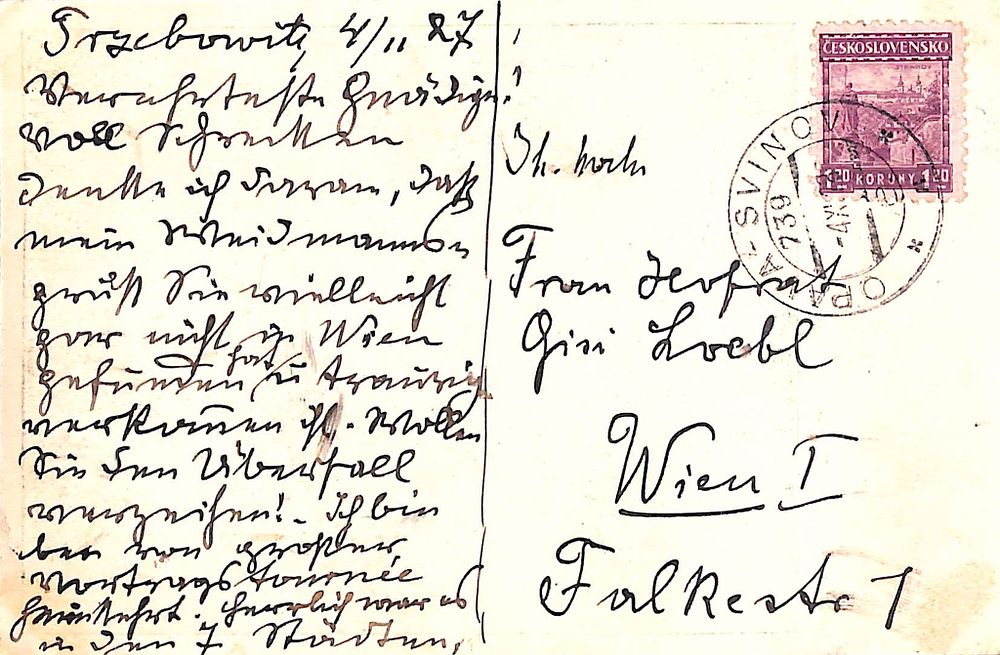
[VARIOUS AUTOGRAPHS, LETTERS, & DOCUMENTS] - MARIA STONA (1859–1944) - Autograph Postcard Signed to Gini Loebl, with a woodcut by E. Hrabal. Grzebowitz - MARIA STONA (1859–1944) Autograph Postcard Signed to Gini Loebl, with a woodcut by E. Hrabal. Grzebowitz, 4 February 1927. Illustrated postcard signed by Maria Stona, the literary pseudonym of Marie Scholz-Stonawski, dated Grzebowitz, 4 February 1927, and addressed to Gini Loebl, wife of a Hofrat (Court Councillor), at Falkestraße 1, Vienna. The reverse bears a black-and-white woodcut by E. Hrabal, entitled Holzhauer, above which Stona has added a brief autograph greeting and her signature. The address side contains a further handwritten message in black ink. With the original Austrian postage and a clearly struck contemporary Kravsko postmark. Born Marie Scholz, and later known as Marie Scholz-Stonawski, Stona published under the pseudonym Maria Stona and established herself as a poet, writer and cultural figure in the German-speaking literary world of Moravia and Silesia. Her work encompassed poetry, prose and travel writing and was closely connected with the cosmopolitan cultural environment of the late Habsburg lands and their successor states. The postcard was sent from Grzebowitz in 1927 to Gini Loebl in Vienna. The manuscript message, written in traditional German cursive script, gives the piece the character of a personal communication between members of this Central European social and cultural network. Of particular visual interest is the woodcut on the reverse, E. Hrabal’s Holzhauer, which transforms the postcard from a simple piece of correspondence into an attractive conjunction of graphic art and literary autograph. Stona has written her greeting immediately above the image and signed it in her own hand. An appealing document of the Mitteleuropean literary world between the wars. Bringing together Maria Stona’s autograph correspondence, an original period woodcut and its complete postal context, the postcard provides an intimate glimpse of the personal networks connecting writers, artists and cultivated society across Austria and the former Habsburg lands during the 1920s.