Bidspirit auction | [VARIOUS AUTOGRAPHS, LETTERS, & DOCUMENTS]
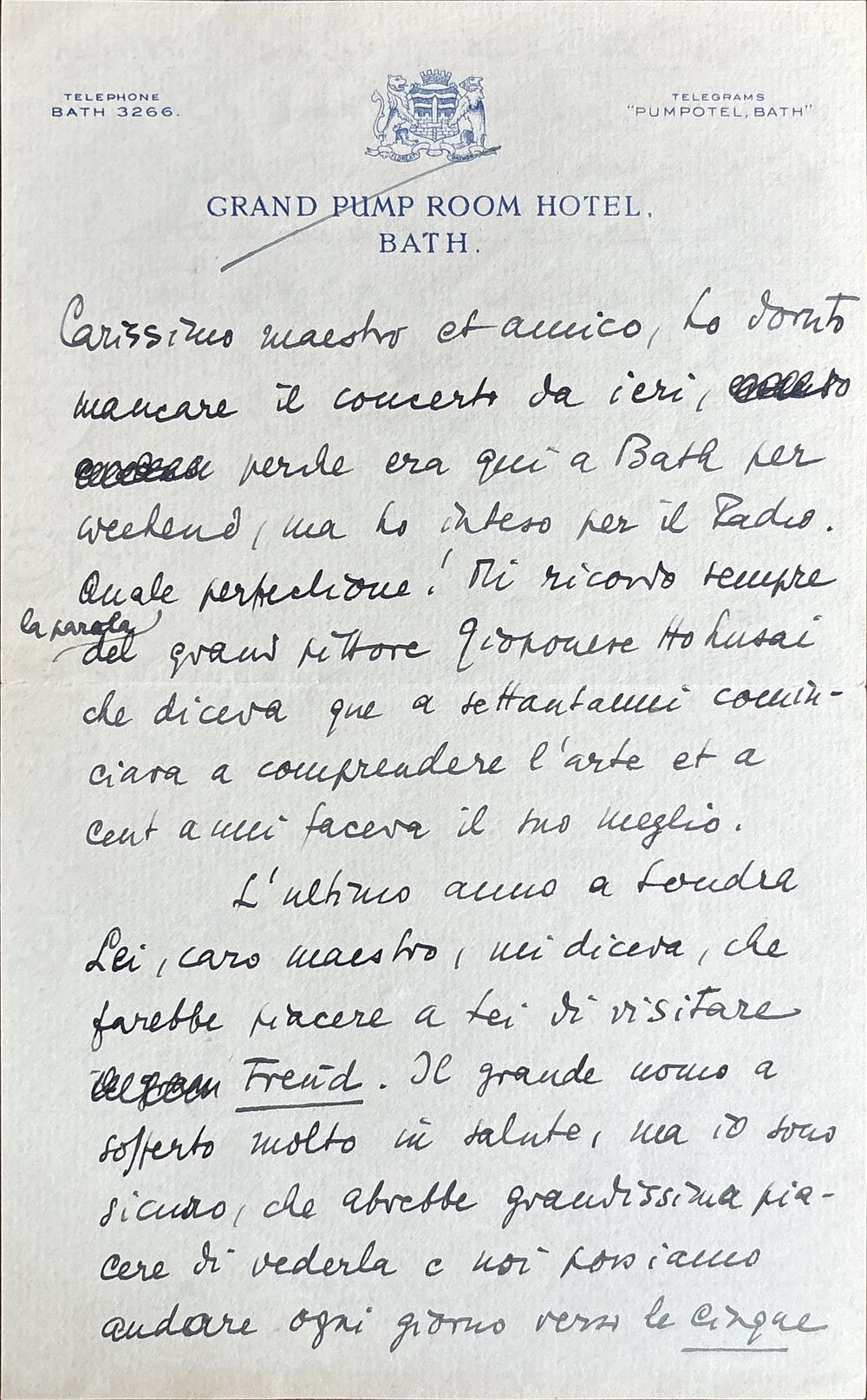
[VARIOUS AUTOGRAPHS, LETTERS, & DOCUMENTS] - STEFAN ZWEIG (1881–1942) TO ARTURO TOSCANINI (1867–1957) - An exceptional letter - STEFAN ZWEIG (1881–1942) TO ARTURO TOSCANINI (1867–1957) ?“THE LAST OPPORTUNITY TO SEE ONE OF THE IMMORTALS OF OUR AGE”?An exceptional letter proposing a visit to Sigmund Freud in London, only months before Freud’s death?Autograph letter signed (“Stefan Zweig”), in Italian, [Bath], May 1939, to Arturo Toscanini, with the original autograph envelope addressed to the conductor at the Langham Hotel, London.?2 pages, written in ink on a single folded sheet of headed stationery of the Grand Pump Room Hotel, Bath, with the hotel’s arms printed at the head; accompanied by the original envelope, addressed in Zweig’s hand to “Maestro Arturo Toscanini, London W1, Langham Hotel”, franked with a George VI 1½d stamp and postmarked London, 10 May 1939.?A remarkable association letter linking three towering figures of twentieth-century European culture — Stefan Zweig, Arturo Toscanini and Sigmund Freud — in which Zweig urges Toscanini to visit the ailing Freud, warning that it may be his last opportunity to see “one of the immortals of our age.”?Writing affectionately to “Carissimo maestro et amico”, Zweig explains that he had been unable to attend Toscanini’s concert because he was spending the weekend in Bath, but had listened to the performance on the radio. His response is ecstatic: “Quale perfezione!” (“What perfection!”)?The performance prompts Zweig to recall an earlier conversation, before he turns to the principal and historically most compelling subject of the letter: Sigmund Freud.?Zweig reminds Toscanini that during the previous year in London the conductor had told him that he would be pleased to visit Freud. Zweig now offers to arrange the meeting personally. Freud, he explains, has suffered greatly from ill health, but Zweig is certain that he would derive enormous pleasure from seeing Toscanini. The two men, he suggests, could go together to visit him at around five o’clock on almost any day.??He then adds an extraordinarily poignant warning: “Ho paura che sia l’ultima occasione per Lei di aver visto uno dei più immortali di nostra epoca.” (“I fear that this may be your last opportunity to have seen one of the great immortals of our age.”)?The words proved tragically prescient. Freud had fled Nazi-occupied Vienna for London in June 1938, already gravely ill with the cancer from which he had suffered for many years. He died at his London home on 23 September 1939, only a few months after this letter was written.?The document is particularly resonant because of Zweig’s own relationship with Freud. The two men had maintained a long friendship and correspondence, and Zweig greatly admired the founder of psychoanalysis. Both were Austrian Jewish intellectuals driven from their homeland by National Socialism, and both found refuge in Britain. Zweig was among those who remained close to Freud during his final London exile.?The recipient adds another exceptional dimension to the letter. Arturo Toscanini, one of the greatest conductors of the twentieth century and an outspoken opponent of Fascism and Nazism, had refused to perform in Mussolini’s Italy and Hitler’s Germany. The proposed encounter therefore brought together three internationally celebrated European figures whose lives had become intimately entangled with the political catastrophe engulfing Europe.?Written in Zweig’s characteristically warm if occasionally idiosyncratic Italian, the letter moves effortlessly from music to friendship and finally to mortality. Its greatest force lies in Zweig’s urgent desire to bring Toscanini and Freud together while there was still time.?An exceptional document of European intellectual history on the eve of the Second World War: Zweig writing to Toscanini about the dying Freud — and urging him not to miss what might be his final opportunity to meet “one of the immortals of our age.”?PROVENANCE:?Arturo Toscanini; addressed to him by Zweig at the Langham Hotel, London.?CONDITION:?The letter with the original horizontal fold and light handling wear; ink clear and well preserved. The accompanying envelope with expected postal wear, creasing and a small loss/tear at the lower edge; stamp and London cancellation preserved. Overall very good.