Bidspirit auction | [HISTORICAL LETTERS & DOCUMENTS] -
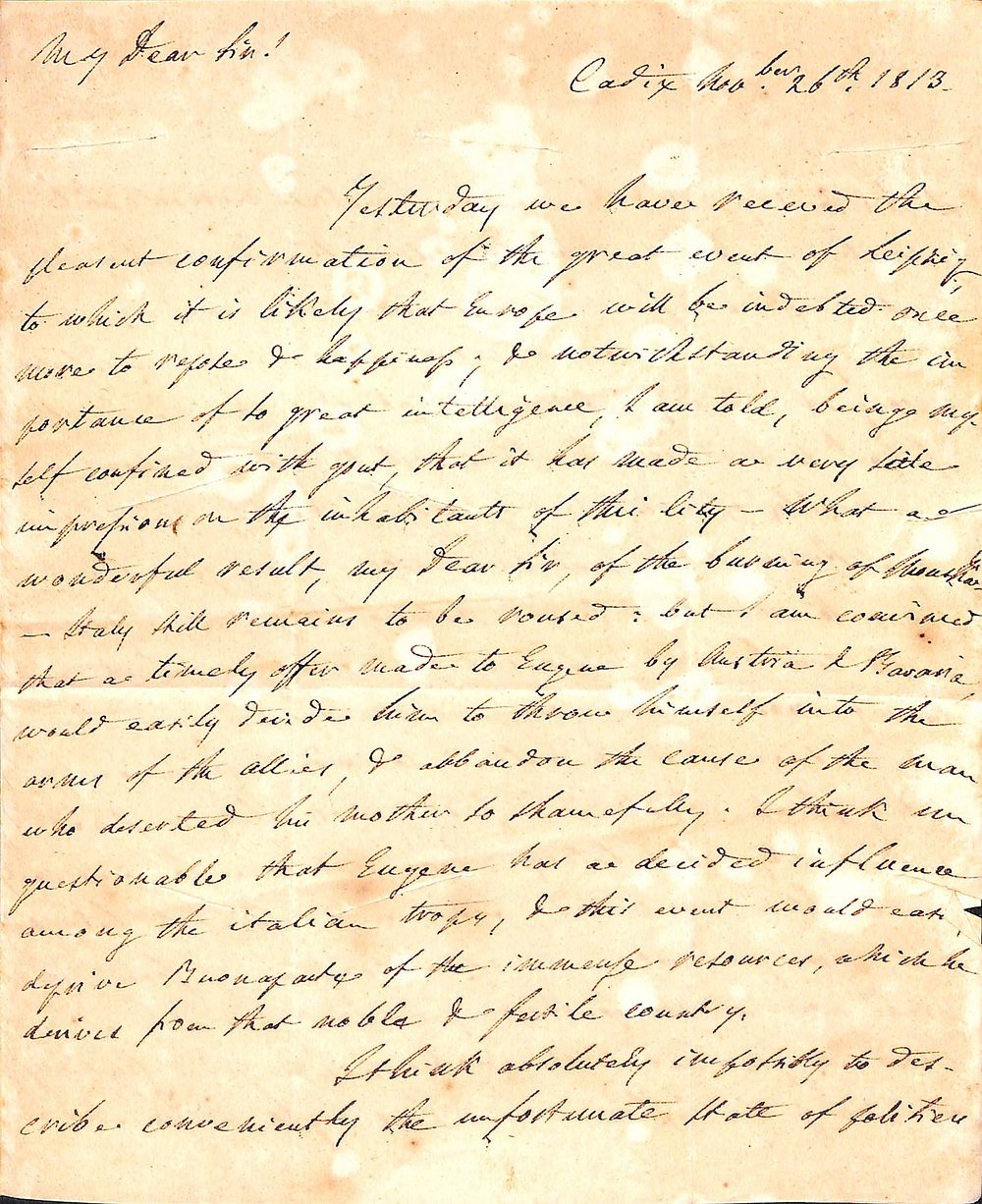
[HISTORICAL LETTERS & DOCUMENTS] - PAOLO ANDREANI (1763–1823) - Important Autograph Letter Signed - PAOLO ANDREANI (1763–1823) - Important Autograph Letter Signed, discussing the Battle of Leipzig, the collapse of Napoleon’s power, the political future of Italy and Spain, and his hopes of returning to England. Cádiz, 26 November 1813. Autograph letter signed, in English, four pages, dated Cádiz, 26 November 1813, and addressed “My Dear Sir” to an unidentified but evidently influential British correspondent. Signed with the formula “Your truly ob. hbl S.v” and Andreani’s autograph signature. An unusually substantial political and personal letter from the celebrated Milanese scientist, explorer and pioneering aeronaut, written from Cádiz as the Napoleonic order in Europe appeared to be unravelling in the aftermath of the Battle of Leipzig. Andreani opens with news of the Allied victory at Leipzig, the great Battle of the Nations of 16–19 October 1813, which had dealt Napoleon one of the most consequential defeats of his career. He welcomes: “the pleasant confirmation of the great event of Leipzig to which it is likely that Europe will be indebted once more to repose & happiness”. He is surprised, however, by the muted response in Cádiz, observing that the news: “has made a very little impression on the inhabitants of this City”. From Leipzig his thoughts turn back to the catastrophe of Napoleon’s Russian campaign the previous year. With evident astonishment at the chain of events set in motion by the French retreat, Andreani exclaims: “what a wonderful result, my Dear Sir, of the burning of Moscow”. Italy occupies a central place in his political reflections. Although Napoleon’s position in Germany had been shattered, Andreani observes that: “Italy still remains to be roused”. He speculates that a sufficiently timely offer from the Allies might persuade Eugène de Beauharnais, Napoleon’s stepson and Viceroy of the Kingdom of Italy, to change sides and: “throw himself into the arms of the allies, & abandon the cause of the man who devoted his mother to shamefully”. Such a defection, Andreani argues, would deprive Napoleon of the substantial resources offered by the Italian territories. The passage is particularly revealing of the fluid political calculations that followed Leipzig, when the future allegiance of Napoleon’s remaining allies and satellite states had become a matter of immediate European importance. Andreani is no less outspoken in his assessment of the political situation in Spain. Writing from Cádiz — the centre of Spanish liberal constitutionalism and the birthplace of the Constitution of 1812 — he expresses deep hostility towards the liberal faction and what he regards as its: “unreasonable patriotism”. For Andreani, political stability requires monarchical authority. He maintains that “nothing else, but a Royal Person at the head can restore order” and suppress “in the cradle the democratic principles, which are taking root daily”. His remarks provide a striking contemporary reaction to the political experiment unfolding in Cádiz. He also detects hostility towards Britain not merely there but in Madrid, where, in his assessment, the Jacobin tendency was attempting to “usurp an influence”. The letter thus combines observations on the military collapse of Napoleonic power with a distinctly conservative assessment of the revolutionary and constitutional forces competing to determine post-war Europe. The political commentary gradually gives way to Andreani’s own increasingly difficult circumstances. Confined to bed by gout and anxious about his financial position, he appeals to his well-connected correspondent for assistance in securing passage aboard an Admiralty vessel to Gibraltar. His ultimate objective is England, where he hopes: “to procure myself the means to live with some comfort in England”. The personal appeal lends an intimate counterpoint to the sweeping geopolitical analysis of the preceding pages: the man who comments on the fate of Napoleon, Italy and constitutional Spain is simultaneously attempting to secure his own passage and financial survival amid the upheavals of war. A compelling letter written at a turning point in European history, combining first-hand political observation with Andreani’s own precarious circumstances. From Cádiz, only weeks after Leipzig, the pioneering Italian aeronaut surveys the consequences of Moscow, anticipates the possible defection of Eugène de Beauharnais, condemns the growth of democratic principles in Spain and looks towards a restored European order, while seeking British assistance for his own return to England. The breadth and candour of the four-page letter make it an unusually vivid testimony to both Andreani’s political outlook and the profound uncertainty surrounding the final phase of the Napoleonic era.