Bidspirit auction | [HISTORICAL LETTERS & DOCUMENTS] -
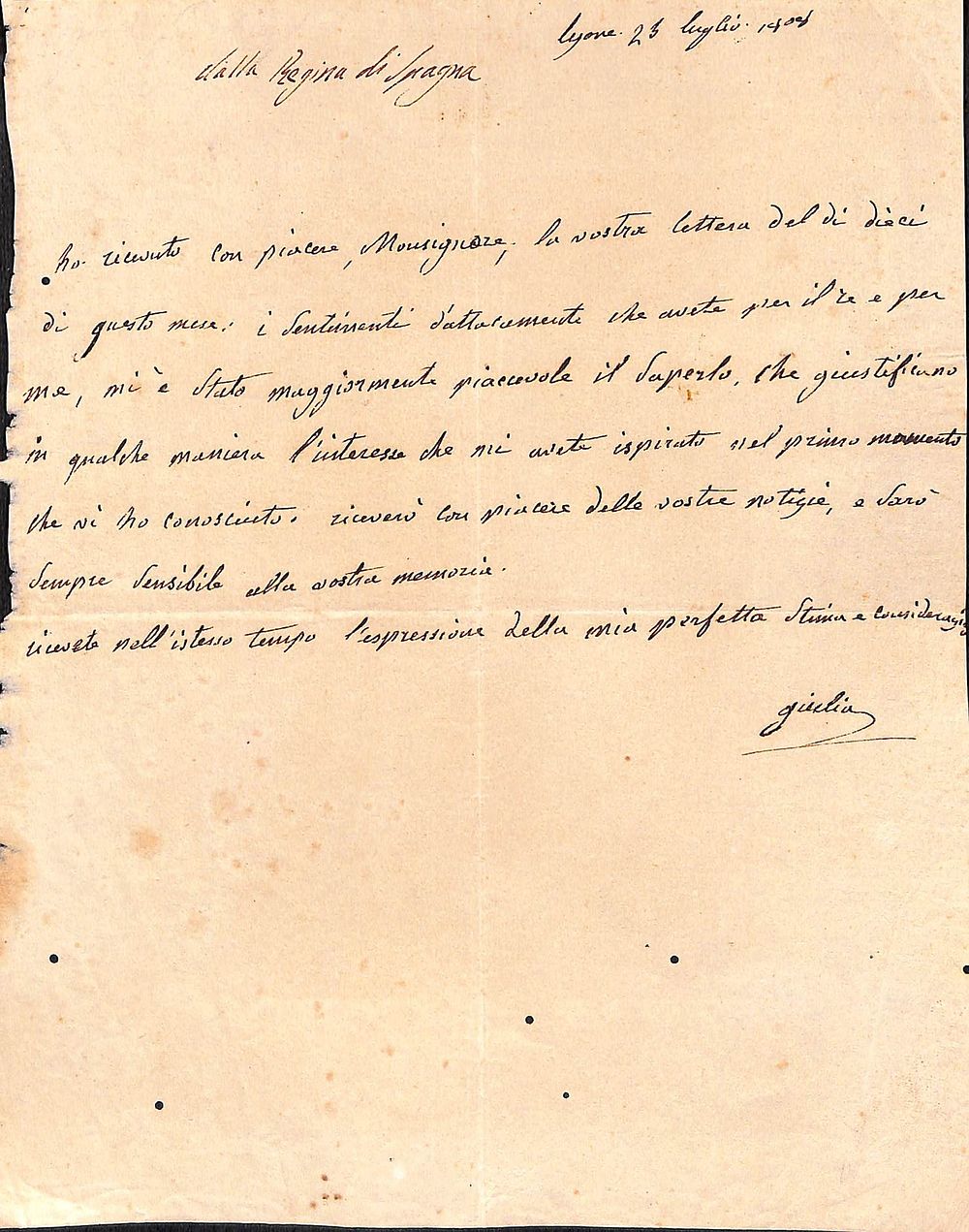
[HISTORICAL LETTERS & DOCUMENTS] - JULIE CLARY BONAPARTE (1771–1845) - Autograph Letter Signed - JULIE CLARY BONAPARTE (1771–1845) - Autograph Letter Signed, probably to Cardinal Joseph Fesch, expressing gratitude for his devotion to Joseph Bonaparte and herself. Lyon, 24 July 1804. Autograph letter signed “Giulia”, in Italian, dated Lyon, 24 July 1804, addressed to an unidentified senior prelate, probably Cardinal Joseph Fesch (1763–1839), Archbishop of Lyon and maternal half-uncle of Napoleon Bonaparte. With an early archival annotation in the upper left corner, “Dalla Regina di Spagna” (“From the Queen of Spain, a title obtained by the writer a few years later”). In good overall condition, with light foxing and the usual folds. A warm letter from Julie Clary, wife of Joseph Bonaparte, written at Lyon during the momentous summer of 1804 and expressing her gratitude for the recipient’s attachment to her husband and herself.Julie thanks her correspondent for his letter of the 10th of the month and responds warmly to the sentiments of devotion he had expressed towards Joseph Bonaparte and herself. She explains that this attachment fully justifies the favourable impression he had made upon them from their first meeting and assures him that she will always be pleased to receive further news and will retain a grateful memory of his kindness. The letter closes with expressions of perfect esteem and consideration. The letter was written at a decisive moment in the transformation of the Bonaparte family into a European dynasty. Only two months earlier, on 18 May 1804, Napoleon had been proclaimed Emperor of the French, making Joseph an Imperial Prince. Julie herself would become Queen of Naples in 1806 and Queen of Spain in 1808, following Joseph’s successive elevation to those thrones. An attractive document from the formative months of the Napoleonic imperial dynasty. Written four years before Julie became Queen of Spain, the letter records the personal relationships linking Joseph Bonaparte’s immediate family with the senior ecclesiastical establishment surrounding Napoleon. Its probable association with Cardinal Fesch, if confirmed, would give the document particular interest as correspondence between two figures at the heart of the Bonaparte family network during the transition from Consulate to Empire.