Bidspirit auction | [HISTORICAL LETTERS & DOCUMENTS] -
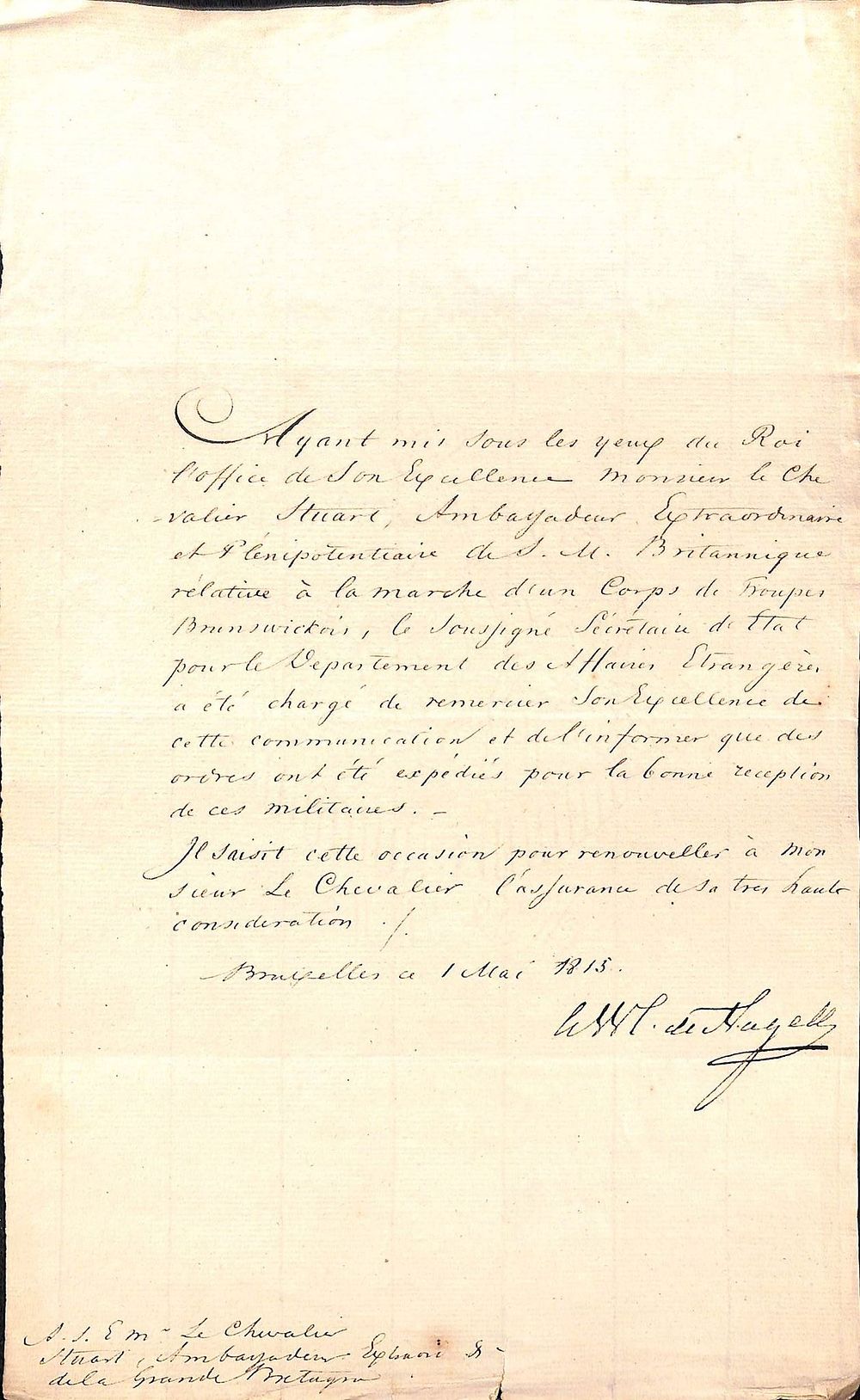
[HISTORICAL LETTERS & DOCUMENTS] - ANNE WILLEM CAREL, BARON VAN NAGELL VAN AMPSEN (1756–1851) - THE HUNDRED DAYS — WATERLOO - Important Letter Signed to Sir Charles Stuart - ANNE WILLEM CAREL, BARON VAN NAGELL VAN AMPSEN (1756–1851) - Important Letter Signed to Sir Charles Stuart, concerning the movement of Brunswick troops into the Netherlands during the preparations for the Waterloo Campaign. Brussels, 1 May 1815. Letter signed by Anne Willem Carel, Baron van Nagell van Ampsen, in French, dated Brussels, 1 May 1815, and addressed to Sir Charles Stuart (1779–1845), British Ambassador Extraordinary and Plenipotentiary at Brussels. Written in his capacity as Secretary of State for Foreign Affairs of the newly established United Kingdom of the Netherlands and signed in full by Van Nagell. An important diplomatic and military document from the Hundred Days, recording the movement of Brunswick troops into the Netherlands as the Allied powers concentrated their forces in Belgium for the campaign that would culminate at Waterloo only seven weeks later. Van Nagell informs Stuart that King William I of the Netherlands has been formally apprised of the movements and intended march of the Brunswick corps. He further confirms that the necessary orders have already been issued to ensure the troops’ reception and passage through the territory of the United Kingdom of the Netherlands. The reference is to the forces of the Duchy of Brunswick, one of the German contingents assembling in the Low Countries after Napoleon’s return from Elba. Their movement formed part of the rapid concentration of Allied forces intended to confront the restored French Empire before Napoleon could consolidate his position or defeat the Coalition armies separately. The date gives the letter particular significance. On 1 May 1815, Napoleon had been back in Paris for little more than a month. The European powers had already renewed their alliance against him, while British, Dutch-Belgian, German and other contingents were assembling in the southern Netherlands. Brussels had consequently become a crucial centre of Allied diplomatic and military activity. The Brunswick contingent would shortly form part of the multinational army commanded by the Duke of Wellington. A compelling document from the preparations for the Waterloo Campaign. Written only seven weeks before the battle, the letter captures the practical process by which the Coalition forces were being assembled in Belgium: governments exchanged intelligence, troop movements were communicated through diplomatic channels, and orders were issued for the reception and transit of Allied contingents. Its specific reference to the Brunswick troops who would fight at Quatre Bras and Waterloo, and whose commander would be killed only six weeks later, gives the document particular immediacy as a record of the military concentration that preceded Napoleon’s final campaign.