Bidspirit auction | [HISTORICAL LETTERS & DOCUMENTS] -
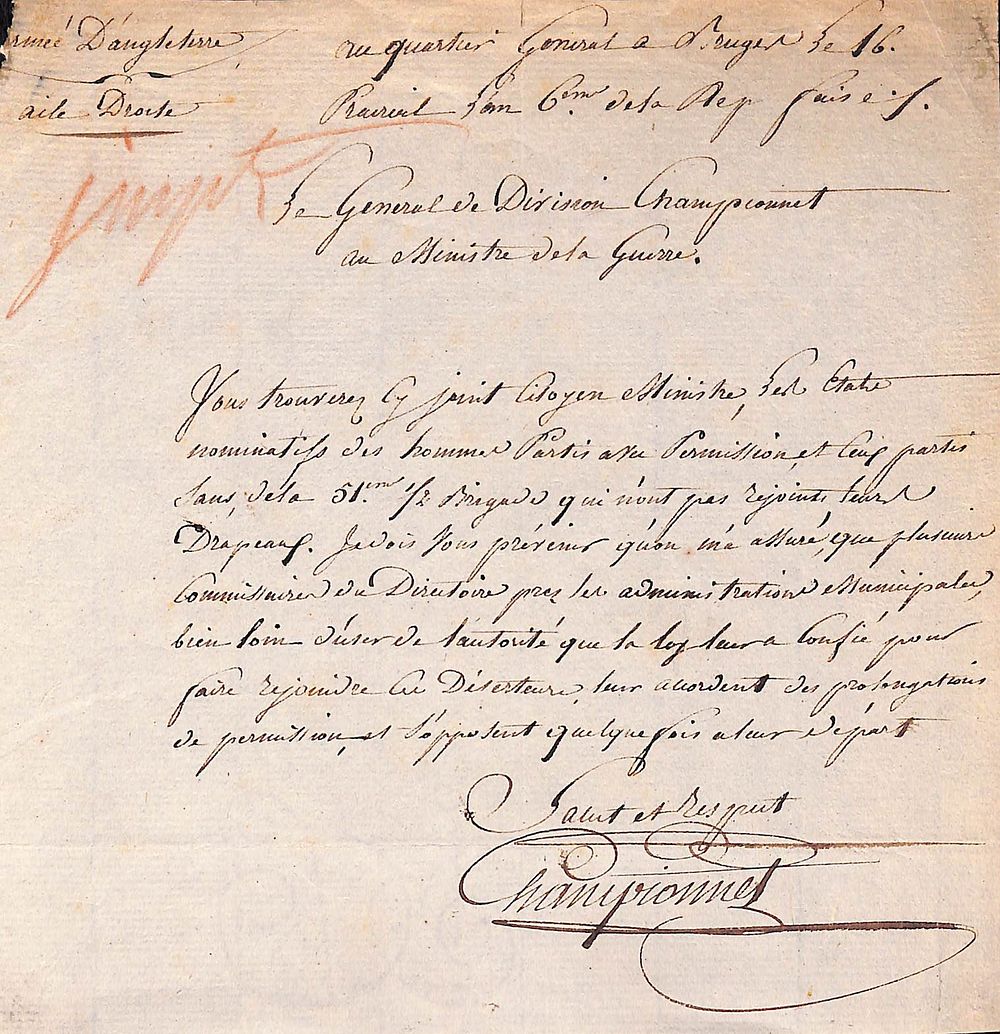
[HISTORICAL LETTERS & DOCUMENTS] - JEANETIENNE CHAMPIONNET (1762–1800) - ARMÉE D'ANGLETERRE - Autograph Letter Signed to the Minister of War - JEAN-ÉTIENNE CHAMPIONNET (1762–1800) - Autograph Letter Signed to the Minister of War, concerning desertion and the reorganisation of the 51st Demi-Brigade during the mobilisation of the Army of England. Headquarters, 16 Fructidor, Year V [2 September 1797]. Autograph letter signed, in French, one page, folio, addressed to the Minister of War and signed by Championnet. Concluding with the republican formula “Salut et Respect”. An important military letter from Championnet during the formation of the Army of England, exposing the difficulties encountered in bringing units up to strength as Revolutionary France began concentrating forces for the projected invasion of Great Britain. A distinguished general of the Revolutionary Wars and later commander of the army that occupied Naples and established the Parthenopean Republic in 1799, Championnet was appointed to command the right wing of the newly constituted Armée d’Angleterre. The present letter belongs to the period in which troops were being assembled and reorganised for operations against Britain. Championnet writes to the Minister of War enclosing nominal rolls of men of the 51st Demi-Brigade who had left their unit on authorised leave but had failed to return to their colours: “Vous trouverez ci joint Citoyen Ministre, les états nominatifs des hommes partis en Permission, et les parties sans délai [de la] 51.me 1/2 Brigade qui n’ont pas rejoints leurs Drapeaux.” (“You will find enclosed, Citizen Minister, the nominal rolls of the men of the 51st Demi-Brigade who left on leave and have not returned to their colours.”) The problem, however, extended beyond the soldiers themselves. Championnet reports that representatives of the Directory attached to the municipal administrations were failing to exercise the authority entrusted to them to ensure the return of deserters. More seriously, some were actively extending their leave or obstructing their departure: “Je dois vous prévenir qu’on m’assure que plusieurs Commissaires du Directoire près les administrations Municipales, bien loin d’user de l’autorité que la loy leur a confiée pour faire rejoindre les Déserteurs, leur accordent des prolongations de permission, et s’opposent quelquefois à leur départ.” (“I must inform you that I am assured that several Commissioners of the Directory attached to the municipal administrations, far from using the authority entrusted to them by law to compel deserters to rejoin their units, grant them extensions of leave and sometimes even prevent their departure.”) The complaint provides revealing evidence of the practical difficulties facing the Revolutionary armies. Orders issued by the central military authorities depended upon municipal officials for their implementation, and Championnet’s intervention exposes the tension between commanders attempting to restore units to full strength and local administrators willing to tolerate — or even facilitate — the continued absence of soldiers from their regiments. The letter acquires particular significance from its date. Written in September 1797, it belongs to the period in which the Directory was turning increasing attention towards Britain and assembling forces along the Channel coast for the projected invasion. Championnet’s concern with the effective strength of the 51st Demi-Brigade thus records at first hand one of the fundamental logistical problems behind France’s ambitious plans: the need to concentrate reliable, fully manned units while simultaneously combating desertion and administrative resistance. A revealing document of the military machinery behind Revolutionary France’s projected invasion of Britain. Championnet’s terse report to the Minister of War captures the gap between strategic ambition and the realities of mobilisation, as a senior commander struggled not merely with absent soldiers but with local officials accused of frustrating their return to the colours. The letter provides particularly direct evidence of the administrative tensions underlying the creation of the Armée d’Angleterre, only two years before Championnet would achieve lasting fame through his conquest of Naples and the establishment of the Parthenopean Republic.