Bidspirit auction | [HISTORICAL LETTERS & DOCUMENTS] -
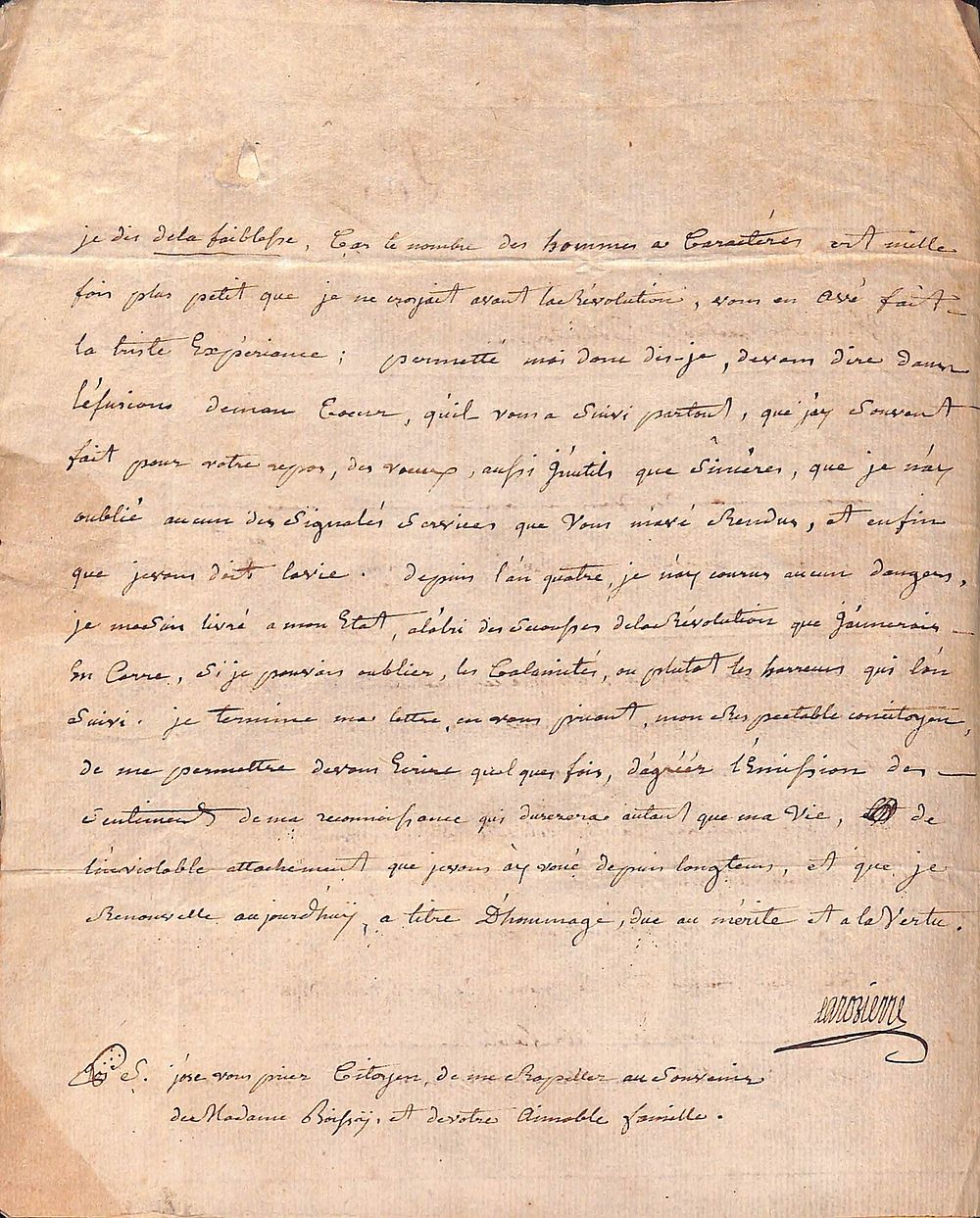
[HISTORICAL LETTERS & DOCUMENTS] - GODEFROI COUPE DE LAROZIERE (1745–1831) - MANSORY IN THE REVOLUTION - Autograph Letter Signed to François-Antoine de Boissy d’Anglas - GODEFROI COUPÉ DE LAROZIÈRE (1745–1831) - Autograph Letter Signed to François-Antoine de Boissy d’Anglas, reflecting on political exile during the Revolution and the bonds of Masonic fraternity. Annonay, 23 Ventôse, Year VIII [14 March 1800]. Autograph letter signed, in French, written on contemporary laid paper. Addressed to the distinguished jurist and politician François-Antoine de Boissy d’Anglas (1756–1826) at Suresnes, near Paris. With contemporary postal markings, including the straight-line “ANNONAY” handstamp, circular departmental mark “69” and manuscript postal charges; retaining the original red wax seal impressed with the sender’s initials and ornamental monogram. A warm and revealing letter from the Annonay notable and Freemason Godefroi Coupé de Larozière to the exiled François-Antoine de Boissy d’Anglas, welcoming the imminent end of his correspondent’s long political exile and offering a strikingly disillusioned reflection on character and loyalty in the aftermath of the French Revolution. A saddler and merchant in Annonay, where he also served as police commissioner, Larozière was an active member of the town’s celebrated Masonic lodge, La Vraie Vertu, founded in 1787. The Masonic character of the correspondence is apparent from its opening, in which Larozière addresses Boissy d’Anglas with the fraternal and honorific formula: “Mon Respectable Compagnon” (“My Esteemed Companion”). The small triangular marks appearing at the beginning of the postscript is another hint to Mansory. Freemasons frequently employed groups of three dots and related coded signs in their correspondence, particularly near names and signatures. Such discreet marks served as marks of recognition between fellow members, allowing them to identify one another as “brothers”, particulary during periods of political censorship and uncertainty. The letter was written at a crucial moment in Boissy d’Anglas’s life, as the recipient prepared to return following the end of his long political exile. Writing from Annonay, Larozière expresses his joy at the prospect of his friend’s return: “Permettez-moi de vous témoigner toute ma sensibilité sur le terme de votre long exil. Je me réjouis de votre retour dans la Capitale, en vous rendant une épouse, une famille, des amis, une patrie.” (“Allow me to express all my feeling at the end of your long exile. I rejoice at your return to the capital, which restores to you a wife, a family, friends and a homeland.”) Against this language of friendship and fraternity, Larozière offers a particularly bitter reflection on the moral consequences of the revolutionary years and what they had revealed about human character: “le nombre des hommes à caractère est mille fois plus petit que je ne croyais avant la Révolution, vous en avez fait l’expérience” (“the number of men of character is a thousand times smaller than I believed before the Revolution; you have experienced this yourself”). Larozière contrasts his correspondent’s experience with the relative security of his own life since Year IV, explaining that he had devoted himself to his profession and remained sheltered from the political upheavals of the period: “Depuis l’an quatre, je n’ay couru aucun danger, je me suis livré à mon État à l’abri des secousses de la Révolution.” (“Since Year IV, I have run no danger; I have devoted myself to my profession, sheltered from the upheavals of the Revolution.”) The letter concludes with a solemn declaration of enduring gratitude and respect: “Agréez l’émission de ma reconnaissance qui durera autant que ma vie à titre d’hommage dû au mérite et à la vertu.” (“Accept the expression of my gratitude, which will endure as long as my life, as a tribute owed to merit and virtue.”). The postscript returns to the intimate world of family and friendship: “Oserai-je vous prier Citoyen, de me rappeler au souvenir de Madame Boissy, et de votre aimable famille.” (“May I venture to ask you, Citizen, to recall me to the memory of Madame Boissy and your charming family.”) A compelling document of friendship, Masonic fraternity and political survival in the aftermath of the French Revolution. Written by Larozière as his correspondent Boissy d’Anglas prepared to return from exile, the letter combines the discreet signs and language of Masonic fellowship with an unusually candid assessment of the disillusionment produced by the revolutionary years. Its postal markings and original red wax seal further preserve the character of a private communication between two men bound by friendship, shared origins and the experience of revolutionary upheaval.