Bidspirit auction | [HISTORICAL LETTERS & DOCUMENTS] -
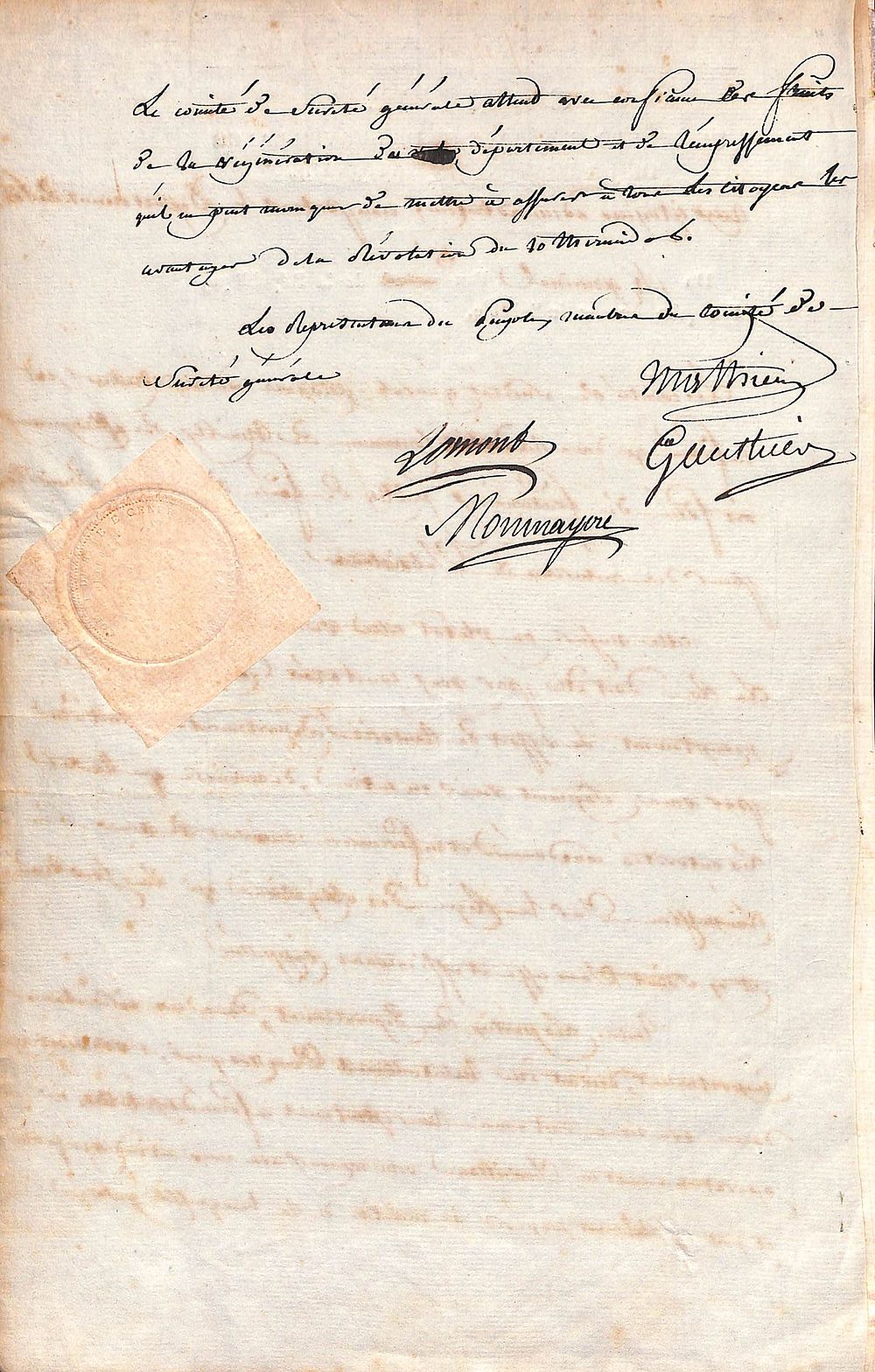
[HISTORICAL LETTERS & DOCUMENTS] - FRENCH NATIONAL CONVENTION — COMMITTEE OF GENERAL SECURITY - Manuscript Document Signed - FRENCH NATIONAL CONVENTION — COMMITTEE OF GENERAL SECURITY - Manuscript Document Signed by four members of the Committee of General Security, ordering measures of surveillance and public security in Paris at the height of the Reign of Terror. 14 Germinal, Year II [3 April 1794]. Manuscript document issued by the Comité de Sûreté Générale et de Surveillance of the National Convention and addressed to the citizen administrators of the Department of Paris. Dated 14 Germinal, Year II of the French Republic [3 April 1794]. Signed by four Representatives of the People: Claude-Jean-Baptiste Lomont, Hugues-Guillaume-Bernard-Joseph Monmayou, Jean-Baptiste-Charles Mathieu and René-Claude Gauthier. Bearing the revolutionary formula “France une et indivisible”. A dramatic document from the height of the Reign of Terror, issued by the Committee of General Security as Danton and Desmoulins stood trial in Paris, and ordering measures of domestic surveillance amid fears over food supplies, public order and counter-revolutionary activity. The Comité de Sûreté Générale formed, alongside the Committee of Public Safety, one of the principal instruments of revolutionary government during the Terror, exercising extensive police and surveillance powers. The present directive, sent to the administrators of the Department of Paris, provides a striking example of those powers in operation at local level. In the context of acute shortages, political suspicion and concern over the black market, the Committee instructs the authorities to: “faire des visites domiciliaires pour des subsistances” (“carry out searches of private homes for provisions”). The language of the document conveys the intensity of the surveillance expected of local officials. At so critical a moment, the Committee insists: “toutes les parties du Département, dans un instant aussi important, doivent être continuellement sous vos yeux” (“every part of the Department, at so important a moment, must remain continually under your eyes”), with the overriding objective of preserving the “tranquillité publique” (“public tranquillity”). The date lends the document exceptional historical immediacy. On 3 April 1794, Georges Danton, Camille Desmoulins and their associates were actually on trial before the Revolutionary Tribunal. Arrested during the night of 30–31 March, they were tried from 2 to 5 April and sent to the guillotine on 5 April. The present order was therefore issued while one of the defining political trials of the Terror was under way, as the revolutionary government moved against some of its most prominent former representatives. The document bears the autograph signatures of four Representatives of the People, Claude-Jean-Baptiste Lomont, Hugues-Guillaume-Bernard-Joseph Monmayou, Jean-Baptiste-Charles Mathieu and René-Claude Gauthier. Particularly striking in retrospect is the involvement of figures who, having participated in the machinery of revolutionary government during the Terror, would only months later take part in the political reaction that brought about the fall of Robespierre. A compelling first-hand document of the machinery of the Terror at work. Issued from the Committee of General Security at the very moment of the trial of Danton and Desmoulins, it brings together domestic searches, the policing of food supplies and the demand for constant surveillance in the name of tranquillité publique, offering vivid evidence of the mechanisms through which revolutionary authority sought to maintain control over Paris during one of the most intense phases of the French Revolution.