Bidspirit auction | [HISTORICAL LETTERS & DOCUMENTS] -
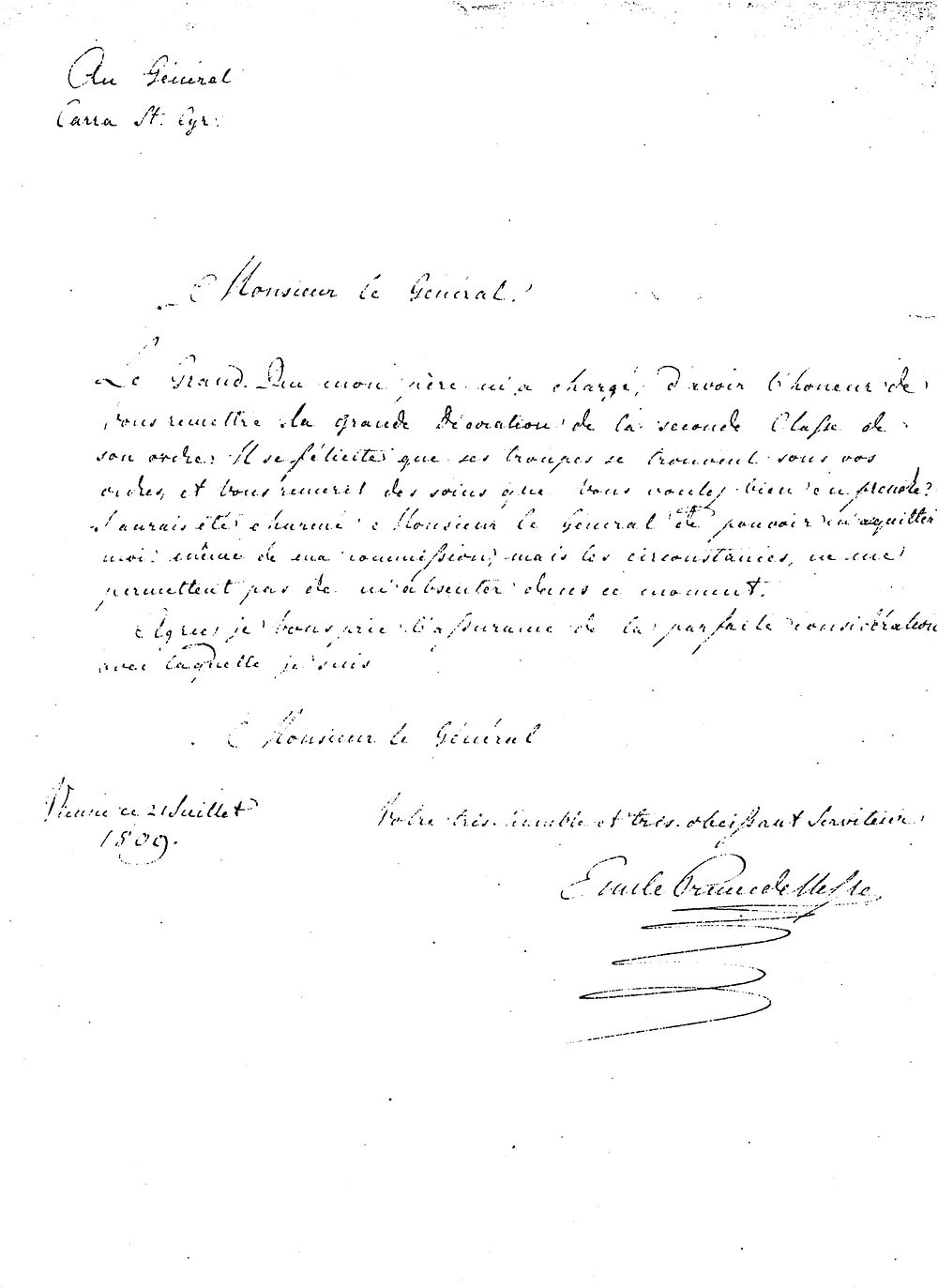
[HISTORICAL LETTERS & DOCUMENTS] - EMILE, PRINCE OF HESSE-DARMSTADT (1790–1856) - Letter Signed to the French General Claude Carra-Saint-Cyr - ÉMILE, PRINCE OF HESSE-DARMSTADT (1790–1856) - Letter Signed to the French General Claude Carra-Saint-Cyr, presenting him with a decoration from Grand Duke Louis I of Hesse in recognition of his command of Hessian troops during the Austrian campaign. 21 July 1809. Letter signed “Émile Prince de Hesse”, in French, one page, quarto, addressed to the French divisional general Claude Carra-Saint-Cyr (1760–1834). A formal letter of military recognition written in the immediate aftermath of the Austrian campaign of 1809, only two weeks after the Battle of Wagram, presenting Carra-Saint-Cyr with a high Hessian decoration and thanking him for his command of the Grand Duchy’s troops. The Grand Duchy of Hesse, a member of Napoleon’s Confederation of the Rhine, had supplied troops to the French war effort, including a Hessian infantry brigade placed under Carra-Saint-Cyr’s command. Writing on behalf of his father, Grand Duke Louis I of Hesse, the nineteen-year-old Prince Émile informs the French general that he has been charged with presenting him with the Grand Decoration of the Second Class of his father’s order: “Le Grand Duc mon père m’a chargé d’avoir l’honneur de vous remettre la grande Décoration de la seconde Classe de son ordre.” (“The Grand Duke, my father, has charged me with the honour of presenting you with the Grand Decoration of the Second Class of his Order.”) The award is explicitly associated with Carra-Saint-Cyr’s command of the Hessian contingent. Émile conveys his father’s satisfaction that his troops should serve under the French general and his gratitude for the care taken of them: “Il se félicite que ses troupes se trouvent sous vos ordres, et vous remercie des soins que vous voulez bien en prendre.” (“He is gratified that his troops find themselves under your command, and thanks you for the care you are kind enough to take of them.”) Prince Émile adds that he would have been delighted to carry out his father’s commission in person, but that his military duties prevent him from leaving his post: “J’aurais été charmé, Monsieur le Général, de pouvoir m’acquitter moi-même de ma commission, mais les circonstances ne me permettent pas de m’absenter dans ce moment.” (“I should have been delighted, General, to carry out my commission in person, but circumstances do not permit me to absent myself at present.”) The letter concludes with the formal expression of respect: “Agréez je vous prie l’assurance de la parfaite considération avec laquelle je suis Monsieur le Général Votre très humble et très obéissant Serviteur.” (“Please accept the assurance of the highest consideration with which I remain, General, your most humble and obedient servant.”) Signed “Émile Prince de Hesse” and dated 21 July 1809. Written scarcely a fortnight after Napoleon’s victory at Wagram on 5–6 July 1809, the letter provides a vivid document of the military alliance binding Napoleonic France to the German states of the Confederation of the Rhine. The decoration conferred upon Carra-Saint-Cyr, together with Louis I’s explicit thanks for his treatment of the Hessian troops under his command, gives the document particular interest as evidence of the personal and ceremonial relationships through which that alliance was maintained in the field.