Bidspirit auction | [HISTORICAL LETTERS & DOCUMENTS] -
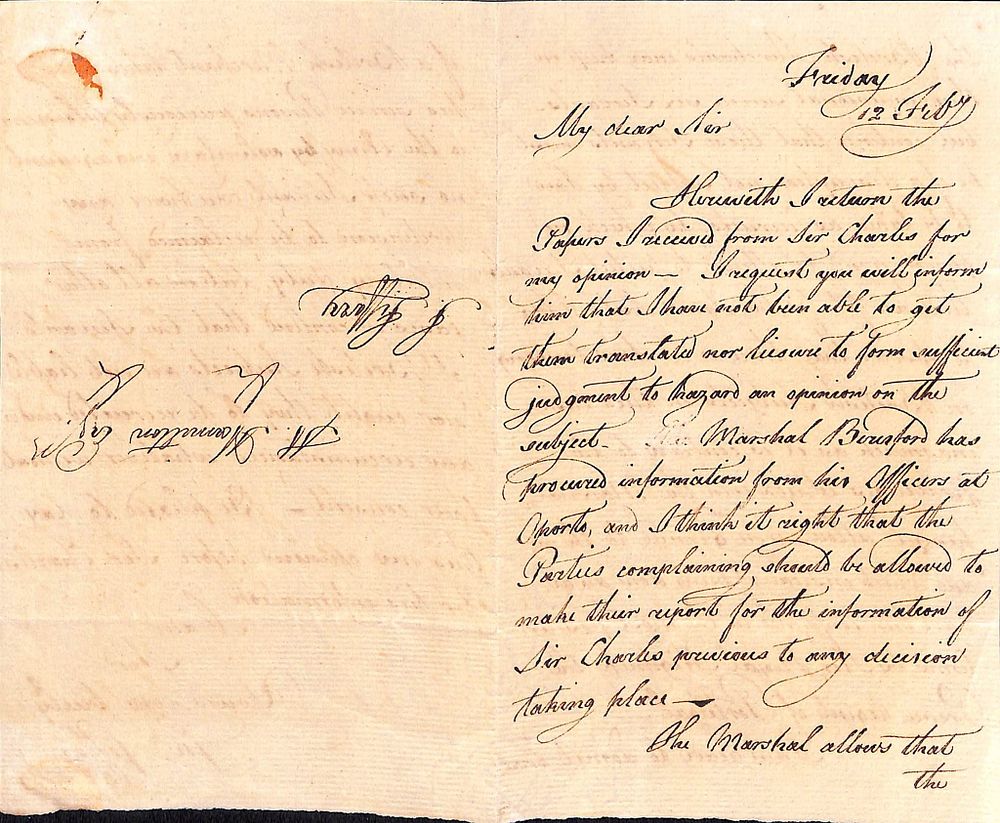
[HISTORICAL LETTERS & DOCUMENTS] - JOHN JEFFERY (1751–1822) - Autograph Letter Signed to William Hamilton - JOHN JEFFERY (1751–1822) - Autograph Letter Signed to William Hamilton, concerning a dispute over the forced recruitment of servants employed by British merchants in Portugal during the Peninsular War. [Lisbon], Friday, [12 February 1813]. Autograph letter signed, in English, several pages, addressed to William Hamilton Esq. (1777–1859), then Under-Secretary of State for Foreign Affairs and prominent archaeologist. With integral address leaf inscribed to Hamilton and signed by Jeffery. An important diplomatic letter from John Jeffery, British Consul-General at Lisbon, defending the privileges of British merchants in Portugal against attempts by the Portuguese military authorities to recruit their servants during the Peninsular War. Jeffery writes to William Hamilton in London concerning a sensitive dispute involving the Portuguese authorities and senior figures in the Anglo-Portuguese military establishment. He begins by returning official papers which he had received for his opinion from Sir Charles Stuart, the influential British minister in Portugal, while admitting that he has not yet been able to examine them sufficiently: “Herewith I return the Papers I received from Sir Charles for my opinion. I request you will inform him that I have not been able to get them translated nor leisure to form sufficient Judgement to hazard an opinion on the subject.” At the heart of the letter is a dispute over attempts to recruit as soldiers the servants employed by British merchants at Oporto. Jeffery notes that William Carr Beresford, Marshal and commander of the Portuguese army, had already sought information from his officers there, but insists that the merchants themselves should be heard before any decision is reached: “Marshal Beresford has procured information from his Officers at Oporto, and I think it right that the Parties complaining should be allowed to make their reports for the information of Sir Charles previous to any decision taking place.” Jeffery then addresses the central legal issue. While the military authorities apparently accepted that individual British merchants might retain six servants, they maintained that this privilege could extend only to men who were not otherwise legally liable for military service: “the British Merchants may keep in their individual service six Servants — but contends that those Servants must be of a description not subject by Law to be taken as Recruits, by which no person would be allowed to protect Servants that are fit for the Army”. Jeffery firmly rejects this interpretation, grounding his argument in the established privileges enjoyed by British subjects in Portugal. In his view, Portuguese recruitment law could not override rights that had not merely survived but had been expressly confirmed by the Prince Regent of Portugal: “I beg to observe that there is no Law binding on British Subjects in this case inasmuch as it is contrary to the Privileges which even the Marshal himself allows were granted to them, and which instead of being done away, have been confirmed in the most positive terms by His Royal Highness the Prince Regent of Portugal”. His proposed solution nevertheless recognises the legitimate claims of military service. A servant who had previously entered the army voluntarily could not escape his obligations simply by entering the employment of a British merchant; in other circumstances, however, Jeffery maintains that servants of British subjects should be exempt from recruitment without their consent: “if a British Merchant takes into his service Persons previously belonging to the Army by voluntary engagement no such Servants can have any pretension to be reclaimed from military duty, but in all other cases I contend that the Servants of British Subjects are not liable nor ought they to be recruited under any circumstances whatever without their consent”. He concludes by asking Hamilton to transmit his formal opinion to Stuart: “Be pleased to lay this my opinion before Sir Charles for his information.” A revealing document of the practical workings of British diplomacy in Portugal during the Peninsular War. Behind an apparently narrow dispute over the recruitment of domestic servants lay competing claims of Portuguese military necessity and the long-established privileges of the British mercantile community. Jeffery’s detailed legal argument, together with his references to Sir Charles Stuart and Marshal Beresford, places the letter directly within the diplomatic and military administration of the Anglo-Portuguese alliance at a crucial stage of the war.