Bidspirit auction | [HISTORICAL LETTERS & DOCUMENTS] -
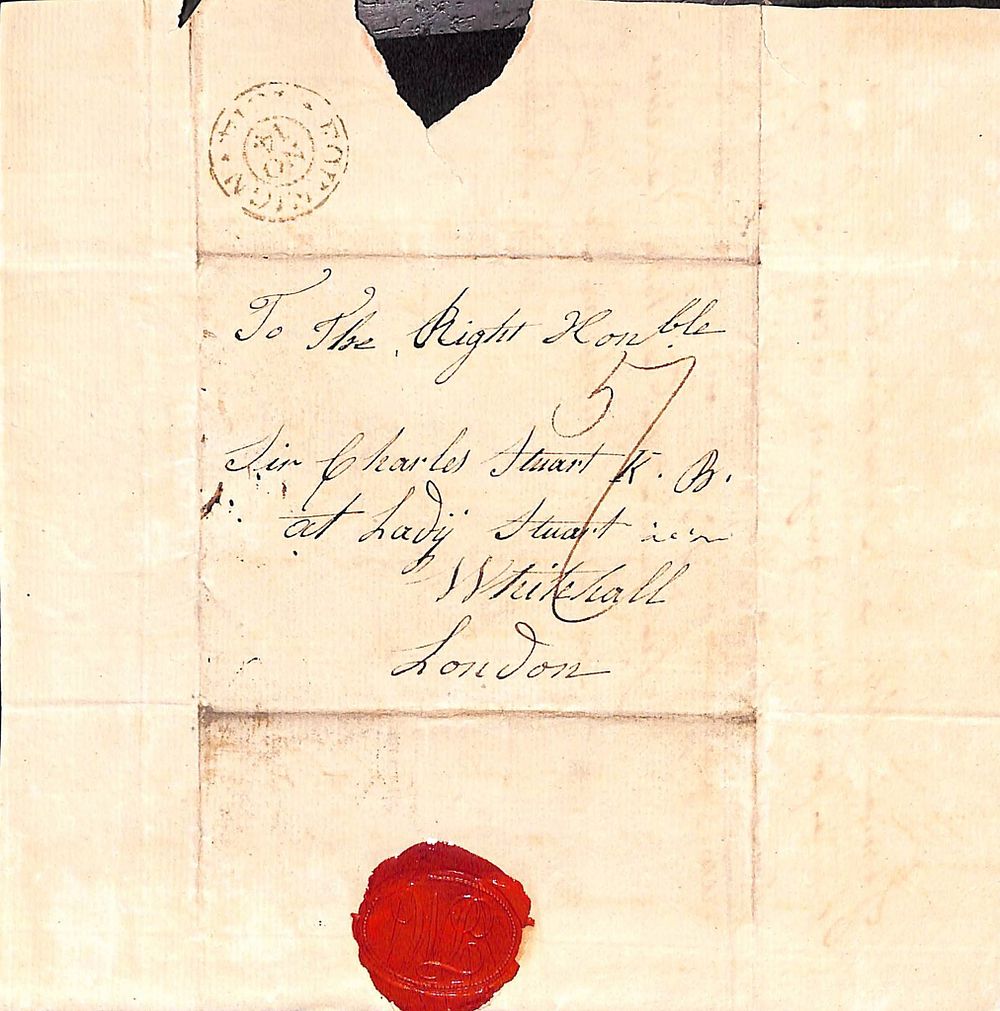
[HISTORICAL LETTERS & DOCUMENTS] - THOMAS MEUNIER (early 19th century) - TRADE BETWEEN LISBON AND PARIS AFTER NAPOLEON - THOMAS MEUNIER (early 19th century) - TRADE BETWEEN LISBON AND PARIS AFTER NAPOLEON Autograph letter signed, in French, five closely written pages on watermarked paper, dated Lisbon, 28 November 1814, and addressed to Sir Charles Stuart (1779–1845). Complete with the original wrapper addressed to Stuart in London, at Lady Stuart’s residence in Whitehall, retaining a well-preserved red wax seal with impressed monogram and a contemporary circular Foreign Office postal marking. The French displays numerous phonetic spellings, idiomatic constructions and mercantile expressions characteristic of the writer. A substantial and unusually detailed commercial letter from Lisbon in the immediate aftermath of the Napoleonic Wars, documenting the network of merchants, financial intermediaries and diplomatic contacts through which money and luxury goods circulated between Portugal, France and Britain. Meunier writes at length concerning a series of transactions and remittances involving Lisbon and Paris, referring to previous correspondence and in particular to a letter sent from Paris on 27 August 1814. Throughout the five pages he discusses payments, accounts and intermediaries, naming figures including Faramajor, Gilver, Languin, Ahonce and Jeremi, and providing a vivid picture of the practical difficulties involved in conducting international business during the first months of the Bourbon Restoration. The letter is particularly interesting for the insight it provides into the procurement of goods apparently intended for Stuart. Meunier records quantities of barley received on account, transactions calculated in écus and dollars, and dealings involving a piece of locally produced cloth. The accumulation of prices, payments, intermediaries and shipping arrangements gives the correspondence the character of a working commercial report rather than a merely private letter. Especially evocative is Meunier’s discussion of candied fruit and orange-flower water. He explains the difficulty and expense of obtaining fruit preserved in sugar in Lisbon and notes that orange-flower water could not simply be purchased from ordinary shops. Instead, it was produced privately in households during the appropriate season, making its acquisition dependent upon local contacts as well as timing. He similarly investigates the availability and price of essence of lavender, which he reports at approximately one dollar an ounce. Local distillers, however, advised him that the product obtained directly from Italy was considerably superior in quality and represented better value than that available in Portugal. Such observations make the letter an unusually detailed testimony to the circulation, comparative quality and pricing of specialist and luxury commodities in early nineteenth-century Lisbon. The date is significant. Written only months after Napoleon’s first abdication, the letter belongs to the brief interval between the fall of the First Empire and the Hundred Days, when commercial and diplomatic connections disrupted by more than two decades of European warfare were being rapidly re-established. Meunier’s repeated references to Paris, Lisbon, financial transfers and the sourcing of imported commodities vividly reflect this renewed circulation. A fascinating document of commerce and everyday diplomacy at the end of the Napoleonic era.