Bidspirit auction | [HISTORICAL LETTERS & DOCUMENTS] -
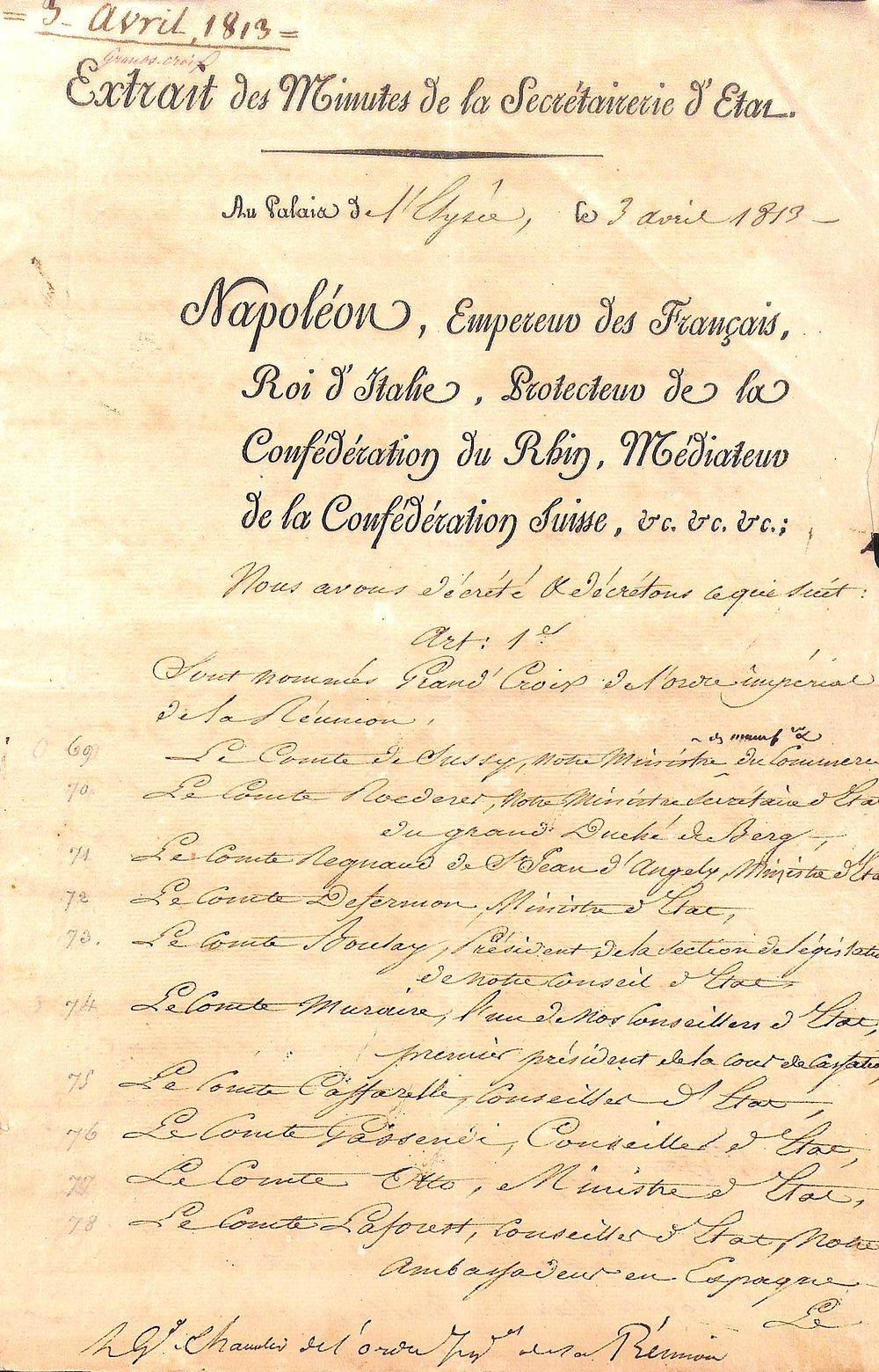
[HISTORICAL LETTERS & DOCUMENTS] - NAPOLEON I (1769–1821) — FIRST FRENCH EMPIRE - Official Manuscript - NAPOLEON I (1769–1821) — FIRST FRENCH EMPIRE - Official Manuscript Decree appointing leading statesmen, generals, scientists and churchmen to the rank of Grand Cross of the Imperial Order of the Reunion. Élysée Palace, 3 April 1813. Extrait des Minutes de la Secrétairerie d’État. Substantial official manuscript document on watermarked paper, four continuous pages, dated “Au Palais de l’Élysée, le 3 avril 1813”. Headed with Napoleon’s full imperial style: “Napoléon, Empereur des Français, Roi d’Italie, Protecteur de la Confédération du Rhin, Médiateur de la Confédération Suisse, etc. etc. etc.” Concluding “Signé: Napoléon” and countersigned with the autograph signature of Pierre Daru (1767–1829), Minister-Secretary of State. With the large embossed seal of the Secrétairerie d’État, incorporating the Imperial eagle, preserved in the left margin. In excellent condition. An impressive document of the First French Empire, appointing an extraordinary roll-call of Napoleonic statesmen, generals, scientists and churchmen to the highest rank of the Imperial Order of the Reunion at a crucial moment in the campaign of 1813. Established by Napoleon, the Ordre impérial de la Réunion served both as an imperial honour and as an instrument for binding the civil and military elites of territories incorporated into or associated with the Empire to the Napoleonic state. Article 1 of the present decree confers the rank of Grand-Croix de l’Ordre impérial de la Réunion upon a remarkable cross-section of the imperial establishment. Among the senior civil and diplomatic figures named are the Comte de Cussy, Minister of Commerce; the Comte Roederer, Minister-Secretary of State of the Grand Duchy of Berg; Regnaud de Saint-Jean d’Angély and Defermon, Ministers of State; Boulay, President of the Legislative Section of the Council of State; Muraire, First President of the Court of Cassation; Caffarelli and Jollivet, Councillors of State; the Comte Otto, Minister of State; and Laforest, Councillor of State and Napoleon’s ambassador to Spain. They are joined by a formidable succession of senior military commanders of the Empire and the Grande Armée, including Aldobrandini, Hullin, Belliard, Drouot, Latour-Maubourg, Lefebvre-Desnoëttes, Gérard, Compans, Molitor, Bonnet, Pernety, Dulauloy, Souham, Decaen, Roguet, Reille, Lobau, Rapp, the Duke of Padua Arrighi de Casanova, , Maurice Mathieu, Darricau, Foucher, Chasseloup and Morand, together with Vice-Admiral Missiessy. Several are identified by their current commands, placing the document firmly within the military organisation of the Empire at the opening of the 1813 campaign. Of particular interest is the presence of members of the Sénat conservateur and some of the most celebrated intellectual and scientific figures of Napoleonic France. The list includes Gaspard Monge, Pierre-Simon Laplace, Jean-Antoine Chaptal, Claude-Louis Berthollet and Joseph-Louis Lagrange, alongside Emmanuel-Joseph Sieyès and Roger Ducos. Lagrange’s inclusion is especially poignant: the great mathematician died in Paris on 10 April 1813, only one week after the date of the decree. The ecclesiastical establishment is represented by figures including Cardinal Jean-Sifrein Maury, Archbishop of Paris; Louis-Mathias de Barral, Archbishop of Tours; and Jean-Baptiste Duvoisin, Bishop of Nantes, further illustrating the extraordinary breadth of the imperial elite assembled in the document. Article 2 entrusts execution of the decree to the Grand Chancellor of the Order: “Notre Ministre d’État Grand Chancelier de l’Ordre Impérial de la Réunion est chargé de l’exécution du présent décret.” (“Our Minister of State, Grand Chancellor of the Imperial Order of the Reunion, is charged with the execution of the present decree.”) The document closes with “Signé: Napoléon”, followed by the formula “Par l’Empereur: Le Ministre Secrétaire d’État” and the autograph signature of Pierre Daru, one of Napoleon’s most important military administrators and Minister-Secretary of State from 1811 to 1813. The large embossed seal of the Secrétairerie d’État, bearing the Imperial eagle, gives the document its formal authentication. A remarkable collective portrait of the Napoleonic establishment in the spring of 1813. Bringing together ministers, diplomats, generals, admirals, prelates and some of the greatest scientific minds of the age, the decree offers an unusually concentrated record of the civil, military and intellectual elite upon which Napoleon’s Empire rested. Issued as the Emperor was rebuilding his forces following the catastrophe of the Russian campaign and preparing for renewed war in Germany, it is also a compelling document of the administrative and ceremonial machinery of the Empire at a decisive moment in its history.