Bidspirit auction | [HISTORICAL LETTERS & DOCUMENTS] -
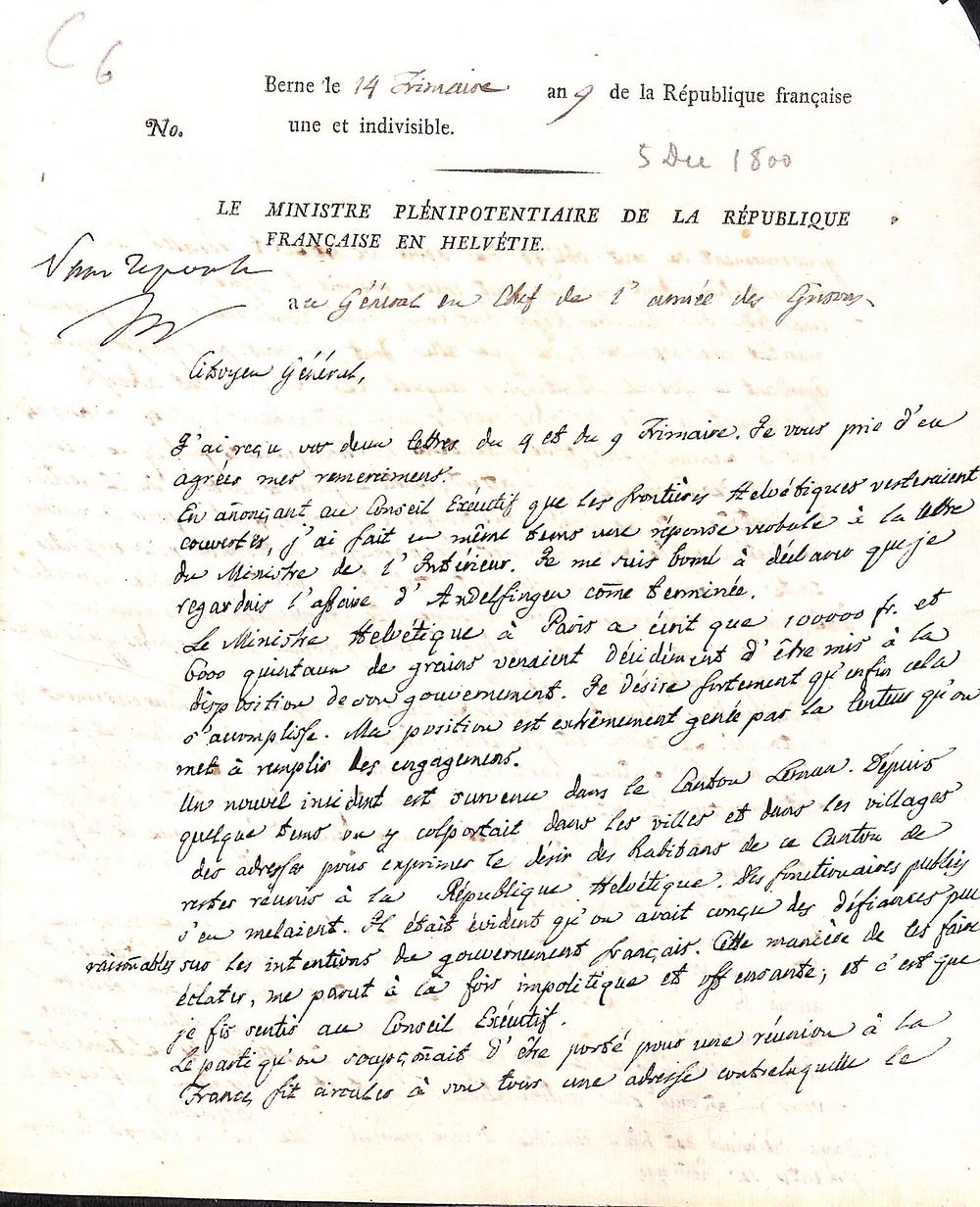
[HISTORICAL LETTERS & DOCUMENTS] - CHARLES-FREDERIC REINHARD (1761–1837) - Important Autograph Letter Signed to General Étienne Macdonald - CHARLES-FRÉDÉRIC REINHARD (1761–1837) - Important Autograph Letter Signed to General Étienne Macdonald, reporting political unrest in the Canton of Léman and congratulating him on the successful winter crossing of the Splügen Pass by the Armée des Grisons. Bern, 14 Frimaire, Year IX [5 December 1800]. Autograph letter signed “Reinhard”, in French, two pages in iron-gall ink on watermarked official stationery headed “Le Ministre Plénipotentiaire de la République Française en Helvétie”, addressed to Étienne-Jacques-Joseph-Alexandre Macdonald (1765–1840), General-in-Chief of the Armée des Grisons and future Marshal of the Empire. An important diplomatic and military letter from the French Minister Plenipotentiary in Switzerland to General Macdonald, written immediately after the latter’s celebrated winter crossing of the Splügen Pass, and combining first-hand intelligence on the political instability of the Helvetic Republic with an exceptionally immediate reference to one of the most hazardous Alpine operations of the Revolutionary Wars. An experienced diplomat who would hold a succession of important posts under the Directory, Consulate and Empire, Reinhard writes from Bern during one of the most unstable periods in the short history of the Helvetic Republic. Established under French influence in 1798, the new state remained divided by profound tensions between centralising and federalist forces, while the presence of French troops made Swiss internal politics inseparable from the wider European conflict. The first part of the letter concerns a new political disturbance in the Canton of Léman. Reinhard reports the circulation through its towns and villages of addresses intended to demonstrate the inhabitants’ desire to remain united with the Helvetic Republic: “Un nouvel incident est survenu dans le Canton Léman. Depuis quelque temps on y colportait dans les villes et dans les villages des adresses pour exprimer le désir des habitants de ce Canton de rester réunis à la République Helvétique.” (“A new incident has arisen in the Canton of Léman. For some time, petitions have been circulated through the towns and villages expressing the desire of the inhabitants of this Canton to remain united with the Helvetic Republic.”) The situation had become sufficiently serious to require military measures. Reinhard explains that General Montchoisy, directly approached by the Helvetic Executive Council, had issued strict orders to the French and Swiss local commanders to maintain public order: “Cependant le Général Montchoisy auquel le C.E. s’est adressé directement, a donné des ordres sévères aux commandants de place français et suisses, pour faire maintenir la tranquillité publique.” (“General Montchoisy, however, to whom the Executive Council addressed itself directly, has issued strict orders to the French and Swiss local commanders to ensure the maintenance of public tranquillity.”) A cavalry regiment was to be sent into the canton and quartered there. Reinhard is sharply critical of the Helvetic government, which he reproaches for having imprudently contributed to the agitation. The passage provides direct evidence of the extent to which French diplomatic and military authorities intervened in the internal security of the nominally independent Helvetic Republic. The second part of the letter moves from political unrest to an event of much wider military significance: Macdonald’s winter crossing of the Splügen Pass by the Armée des Grisons. Between 27 November and 4 December 1800, Macdonald’s troops forced their way across the snowbound Alpine route in exceptionally severe conditions, overcoming storms, deep snow and the constant danger of avalanches in order to descend towards Italy and continue operations against Austria. Writing from Bern on 5 December, immediately after the completion of the crossing, Reinhard expresses his relief at the news that Macdonald had successfully overcome the mountains and explicitly acknowledges the dangers of the season: “Je goûte bien vivement d’apprendre que vous ayez passé heureusement les montagnes; la saison est périlleuse; votre courage en triomphera et je me confie dans la fortune française.” (“I am greatly pleased to learn that you have crossed the mountains successfully; the season is perilous; your courage will triumph over it, and I place my trust in French fortune.”) The date gives these words particular historical immediacy. Reinhard was writing on the day following the completion of the crossing of the Splügen, while Macdonald’s Alpine campaign was still unfolding. His reference to the “saison périlleuse” therefore has a very concrete significance: the winter passage had exposed the Armée des Grisons to extreme conditions and serious losses,