Bidspirit auction | [HISTORICAL LETTERS & DOCUMENTS] -
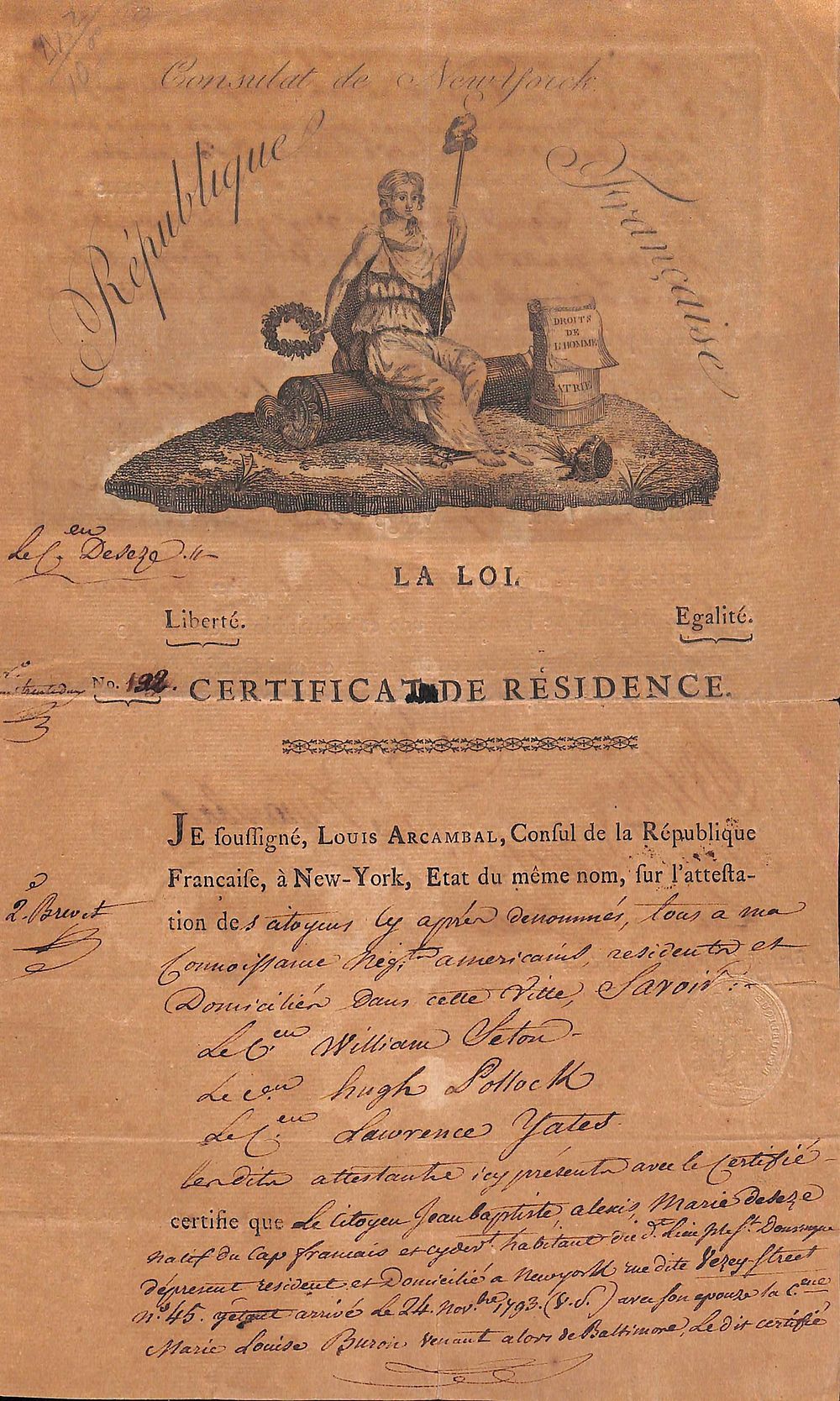
[HISTORICAL LETTERS & DOCUMENTS] - WILLIAM SETON (1746–1798), HUGH POLLOCK AND LAWRENCE YATES - Rare French Consular Certificate of Residence - WILLIAM SETON (1746–1798), HUGH POLLOCK AND LAWRENCE YATES - IMPORTANT MARRIAGE BETWEEN FRENCH EMIGRES IN NEW YORK Rare French Consular Certificate of Residence, signed by three prominent members of New York’s mercantile community as witnesses, including William Seton, a leading figure of the Bank of New York. New York, [late eighteenth century]. Original printed and manuscript certificate of residence issued by the Consulate of the French Republic in New York and signed by the French consul Louis Arcambal. With the autograph signatures of William Seton, Hugh Pollock and Lawrence Yates as witnesses. The upper portion of the document bears an elaborate engraved republican vignette depicting the personification of the French Republic seated upon a cannon, accompanied by printed revolutionary mottos. A rare document of the French émigré community in early New York, bringing together French consular administration and three representatives of the city’s mercantile elite in support of the French émigré Jean-Baptiste Alexis Marie de Seze. The certificate was issued to Jean-Baptiste Alexis Marie de Seze, husband of Marie Louise Buron of Baltimore, a French émigré who had sought refuge in the United States amid the upheavals of the Revolutionary period. The document formally establishes his residence through the testimony of three New York merchants whose signatures authenticate his declaration. Most prominent among them is William Seton (1746–1798), a major figure in the commercial and financial life of early New York and closely associated with the establishment and management of the Bank of New York. His signature appears alongside those of the merchants Hugh Pollock and Lawrence Yates, giving the certificate an unusually distinguished group of witnesses and placing de Seze within the networks of the city’s mercantile community. The document is also of particular interest for the later career of its recipient. Jean-Baptiste Alexis Marie de Seze became associated with French-language teaching in the United States and was the author of The English and French Interpreter, published in New York in 1813. His presence in America belongs to the wider movement of French émigrés who crossed the Atlantic during the revolutionary upheavals and established new intellectual, commercial and social connections in the young United States. De Seze also belonged to the same family as Raymond de Sèze (1748–1828), the celebrated French advocate who defended Louis XVI before the National Convention. The association lends an additional resonance to a document issued under the authority of the very French Republic whose creation had transformed the fortunes of the de Sèze family. The certificate itself is an attractive example of French Revolutionary consular documentation abroad. Its engraved allegorical heading, revolutionary formulas and signature of Consul Louis Arcambal combine the visual language of the new Republic with the practical requirements of French administration overseas. The signatures of the three American witnesses, meanwhile, demonstrate the interaction between the French consular establishment and New York’s established commercial community.