Bidspirit auction | [HISTORICAL LETTERS & DOCUMENTS] -
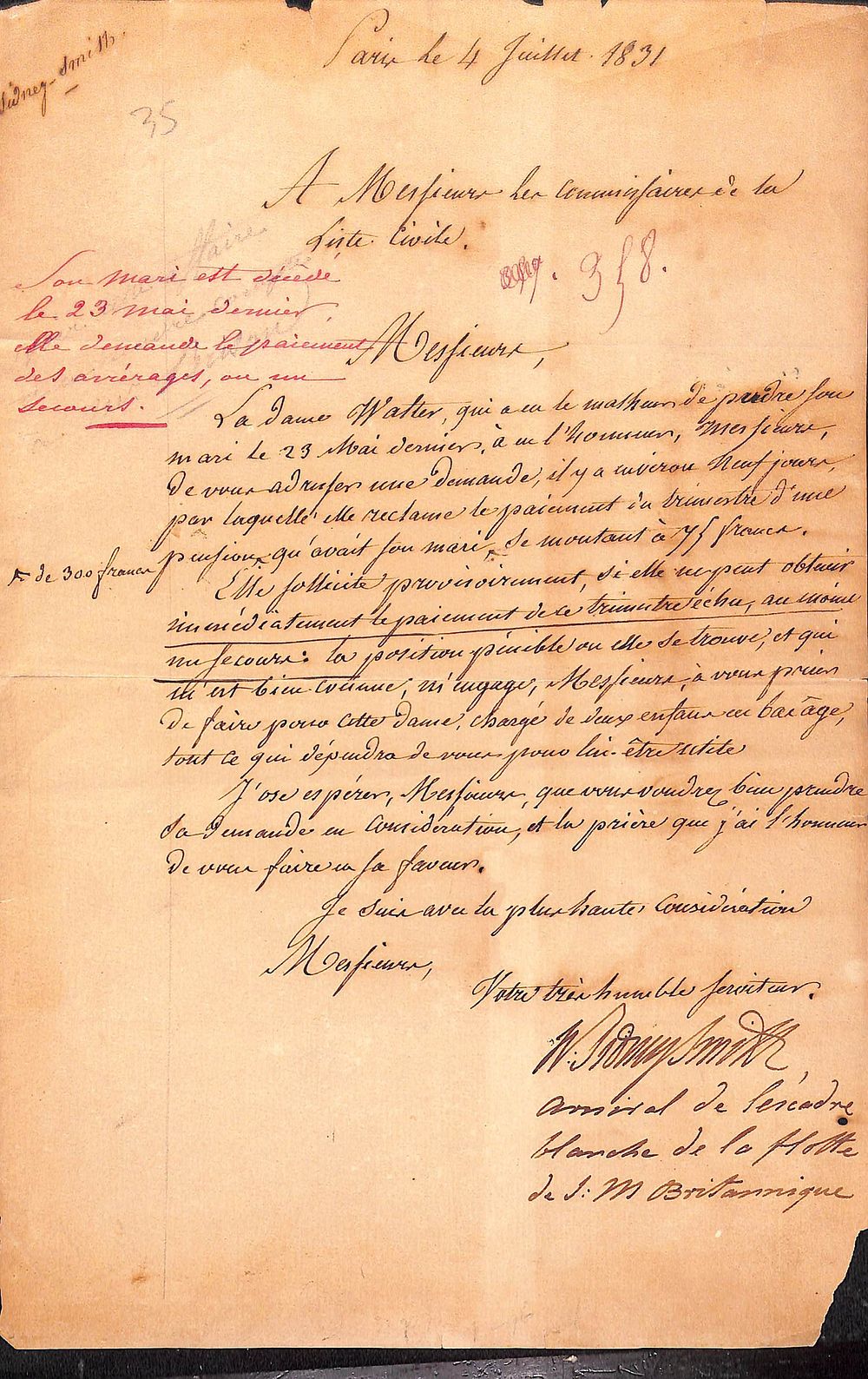
[HISTORICAL LETTERS & DOCUMENTS] - WILLIAM SIDNEY SMITH (1764–1840) - Letter Signed to the Civil List of the Kingdom of France - WILLIAM SIDNEY SMITH (1764–1840) - THE PARISIAN EXILE OF A GREAT BRITISH ADMIRAL Letter Signed to the Civil List of the Kingdom of France, interceding on behalf of an impoverished widow and her two young children. Paris, 4 July 1831. Letter signed by Sir William Sidney Smith, in French, on watermarked paper, dated Paris, 4 July 1831, and addressed to the administration of the French Civil List. With contemporary administrative and archival annotations in the left margin summarising the petition and its processing. Signed by Smith with his naval rank, “Amiral de l’Escadre Blanche de la Flotte de S.M. Britannique”. An appealing document from the later life of the celebrated British naval commander who had played a decisive role in the defence of Acre against Napoleon in 1799, revealing Smith acting as an influential intermediary on behalf of a widow in financial distress. Writing from Paris, Smith lends his name and considerable social standing to a petition on behalf of Madame Walter, whose husband had died on the preceding 23 May. He asks the authorities responsible for the Civil List to grant her financial assistance without delay, emphasising the precarious circumstances in which her husband’s death had left the family. Smith draws particular attention to the widow’s responsibility for two young children, appealing to the commissioners to consider her request favourably on grounds of both equity and urgent need. The letter thus offers a more private perspective on a figure principally remembered for his conspicuous military career, showing him using his position and connections in support of an individual seeking charitable relief. The signature is followed by Smith’s full naval designation: “Amiral de l’Escadre Blanche de la Flotte de S.M. Britannique.” (“Admiral of the White Squadron of the Fleet of His Britannic Majesty.”) The title reflects the traditional division of the Royal Navy into the Red, White and Blue squadrons, a system that also structured the hierarchy of flag-officer ranks. Smith had risen through this hierarchy during a career spanning the Revolutionary and Napoleonic Wars. By 1831 he was one of the most recognisable surviving naval figures of that generation. His reputation rested above all on the Siege of Acre in 1799, when his intervention in support of the Ottoman defenders helped frustrate Napoleon Bonaparte’s attempt to capture the city and contributed to the abandonment of the French campaign in Syria. His subsequent career encompassed further naval and diplomatic activity during the wars against Napoleonic France. In his later years Smith lived for extended periods in Paris, where he remained active in philanthropic and humanitarian causes. The present letter belongs naturally to this less familiar aspect of his career: rather than recording naval operations or high diplomacy, it shows the veteran admiral deploying the prestige attached to his name in a practical act of personal intercession. The contemporary annotations in the margin add to the documentary character of the piece, showing that Smith’s recommendation entered the administrative machinery of the French Civil List and was treated as part of an official request for assistance. An attractive document from the later years of one of the most celebrated British naval officers of the Revolutionary and Napoleonic era.