Bidspirit auction | [HISTORICAL LETTERS & DOCUMENTS] -
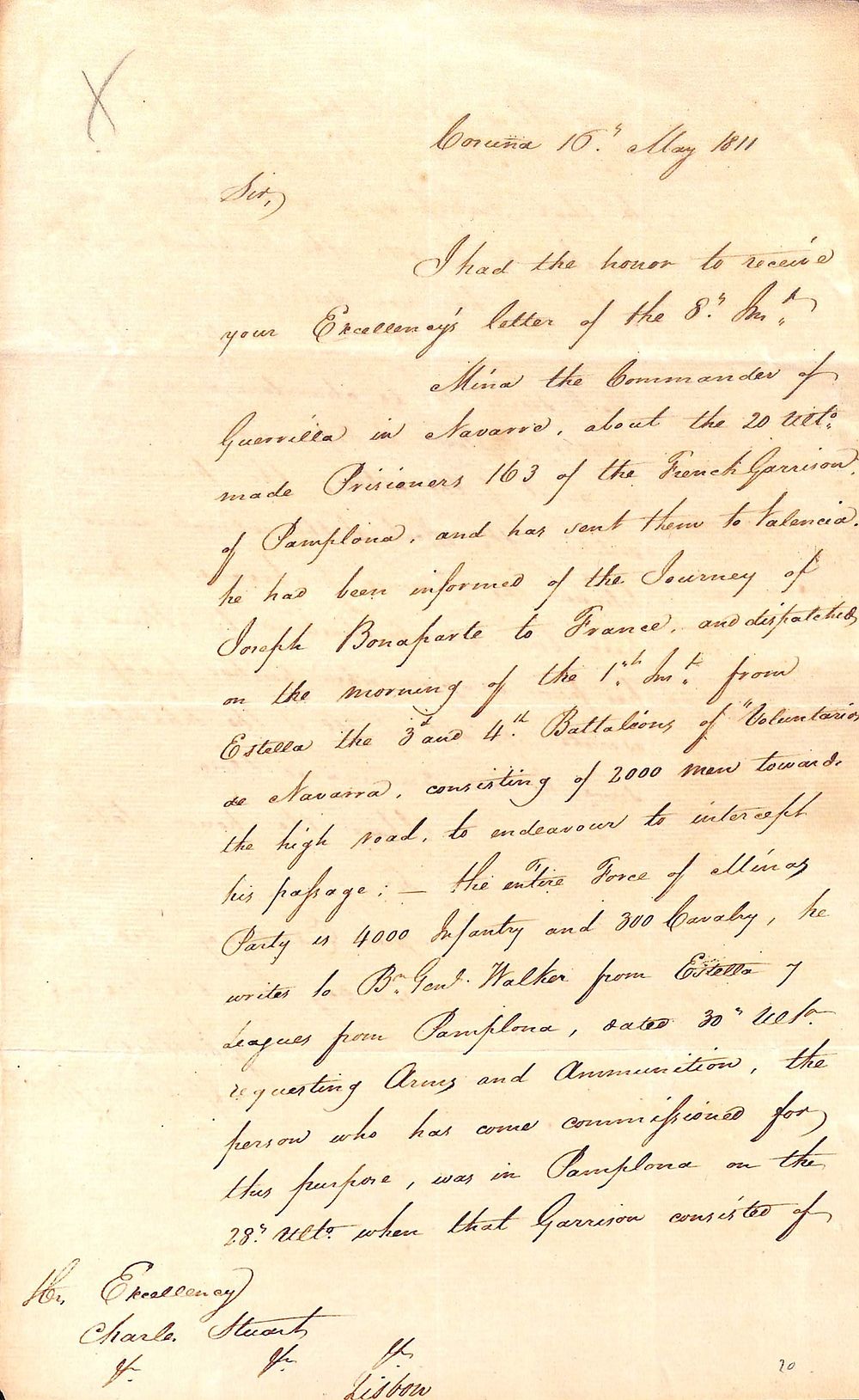
[HISTORICAL LETTERS & DOCUMENTS] - GEORGE WHITE (1775–1811) - Important Autograph Letter Signed to Sir Charles Stuart - GEORGE WHITE (1775–1811) - mportant Autograph Letter Signed to Sir Charles Stuart, reporting Francisco Espoz y Mina’s attempt to intercept King Joseph Bonaparte and describing the organisation and severe discipline of the Navarrese guerrillas. Corunna, 16 May 1811. Autograph letter signed “Geo. White”, with his rank “Ass.t Comm.y Gen.l” [Assistant Commissary General], in English, two pages on a folio bifolium, dated Corunna, 16 May 1811, and addressed to His Excellency Charles Stuart at Lisbon. Brown ink; light contemporary folds. An exceptional intelligence report from the Peninsular War, recording an attempt by Francisco Espoz y Mina’s forces to intercept Joseph Bonaparte and providing remarkably candid information on the strength, organisation and ruthless internal discipline of the Navarrese guerrillas. White, a British commissariat officer operating in Spain, writes to Sir Charles Stuart, the British minister in Lisbon and a central figure in the diplomatic, financial and logistical support of the Allied war effort in the Peninsula. His report provides Stuart with detailed intelligence concerning Francisco Espoz y Mina, already emerging as one of the most formidable guerrilla commanders of the Spanish resistance to French occupation. Of particular importance is White’s report of an operation directed against Joseph Bonaparte, Napoleon’s brother and King of Spain. Having received intelligence concerning the King’s movements, Mina dispatched his Navarrese volunteers at daybreak on 1 May towards the principal road in an attempt to intercept him. The episode places the letter directly within the intelligence networks through which irregular Spanish forces sought to exploit information about French movements and communications. White proceeds to assess Mina’s military strength, estimating his entire force at approximately 4,000 infantry and 300 cavalry, while reporting the guerrilla commander’s pressing need for arms and ammunition. His account is particularly valuable for presenting Mina’s forces not simply as an informal band of insurgents but as an increasingly organised military body, operating according to a recognisable system of command and discipline. The most striking passage concerns Mina’s efforts to suppress disaffection and collaboration within Navarre. White attributes the danger of sedition partly to the province’s close geographical and social connections with France, but reports that Mina had responded with extraordinary severity. According to the intelligence transmitted in the letter, more than two hundred inhabitants had been executed on what Mina regarded as satisfactory evidence since he had assumed command. The passage provides a stark contemporary testimony to the coercive dimension of guerrilla warfare in northern Spain. Mina’s campaign was directed not only against French troops and communications but also against those among the local population believed to have collaborated with the occupying regime or threatened the cohesion of the resistance. White’s matter-of-fact report to Stuart gives unusual immediacy to this aspect of the Peninsular conflict. A vivid intelligence document from the guerrilla war against Napoleonic occupation. White’s report brings together the attempted interception of Joseph Bonaparte, the numerical strength and material requirements of Mina’s forces, and a disturbing account of the executions used to suppress collaboration and disaffection in Navarre. Addressed directly to Sir Charles Stuart, it provides unusually immediate evidence of how intelligence concerning Spanish irregular warfare was gathered and transmitted through the British diplomatic and military apparatus during the Peninsular War.