Bidspirit auction | [HISTORICAL LETTERS & DOCUMENTS] -
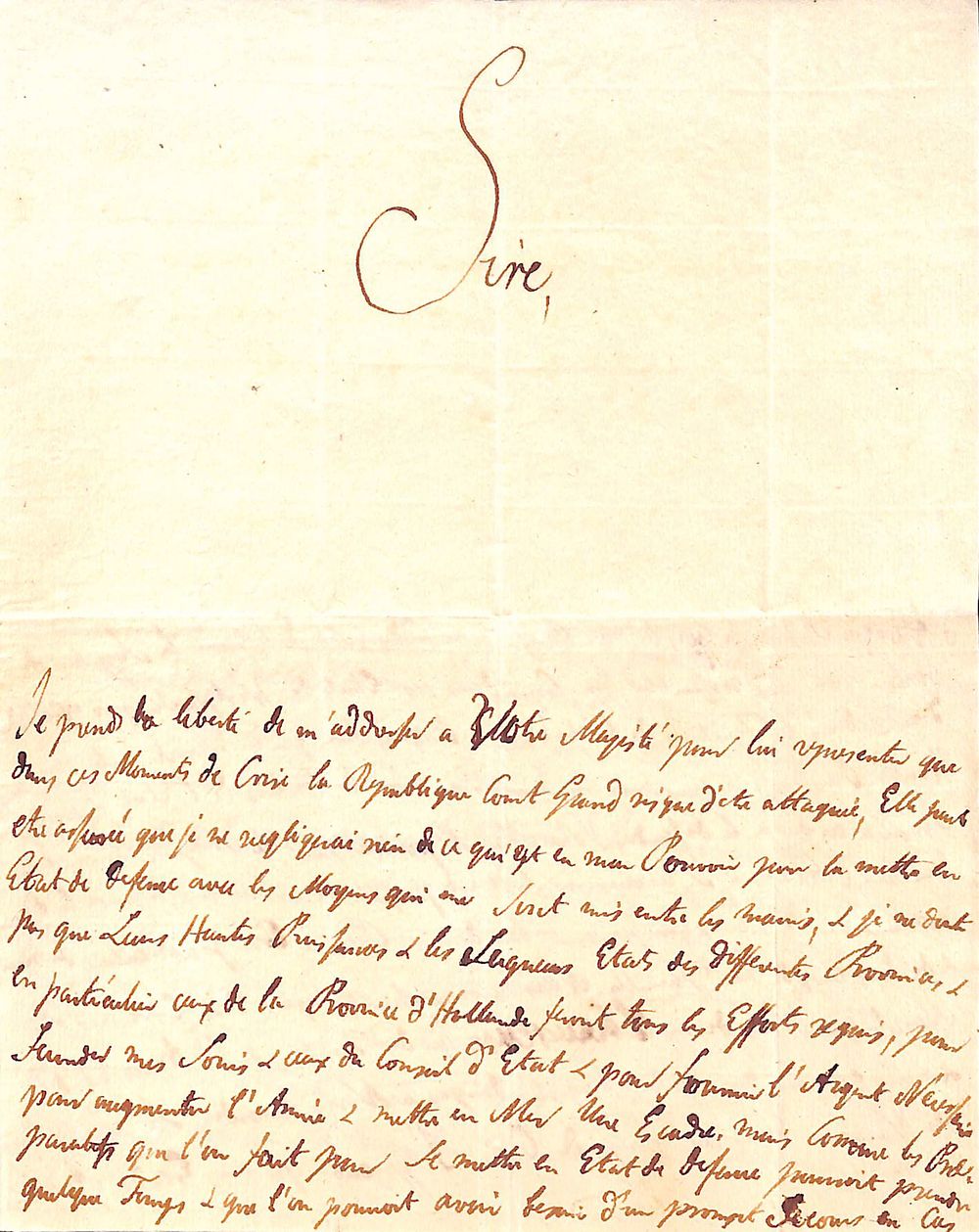
[HISTORICAL LETTERS & DOCUMENTS] - WILLIAM V, PRINCE OF ORANGE (1748–1806) - Important Autograph Letter Signed to Frederick William II, King of Prussia - WILLIAM V, PRINCE OF ORANGE (1748–1806) - Important Autograph Letter Signed to Frederick William II, King of Prussia, urgently requesting the positioning of Prussian troops for the defence of the Dutch Republic against a threatened French invasion. The Hague, 31 December 1792. Autograph letter signed “Guill. P. d’Orange”, in French, addressed to Frederick William II, King of Prussia (1744–1797). 4 pp., folio, written in brown ink, opening with the formal address “Sire” and concluding “de Votre Majesté le très humble et très obéissant Serviteur et Frère” (“Your Majesty’s most humble and obedient servant and brother”). A highly significant diplomatic and military letter written at a critical moment in the French Revolutionary Wars, in which William V warns the King of Prussia that the Dutch Republic is in imminent danger of attack and urgently seeks Prussian military assistance. William assures Frederick William II that he will neglect nothing within his own power to place the Republic in a state of defence. In particular, he refers to the considerable efforts required to obtain the necessary funds: “pour augmenter l’Armée et mettre en Mer une Escadre” (“to increase the Army and put a squadron to sea”). His principal concern, however, is that these defensive preparations will inevitably take time, whereas the Republic might suddenly require “un prompt Secours” (“immediate assistance”). He therefore appeals directly to the Prussian king to move troops stationed in his Westphalian territories towards the Dutch frontier, placing them in a position to intervene rapidly in the event of a French attack. William presents such assistance not merely as a military precaution but as a guarantee of the Republic’s security at a potentially disastrous moment, appealing personally to Frederick William II’s concern for the preservation of the Dutch state and to the ties between the two rulers. The date gives the letter particular historical immediacy. It was written on 31 December 1792, less than two months after the French victory at Jemappes on 6 November had opened the Austrian Netherlands to the armies of Revolutionary France. With French forces advancing through the region, William warns explicitly that: “la République court grand risque d’être attaquée” (“the Republic runs a great risk of being attacked”). His appeal was therefore not a general expression of diplomatic anxiety but a request for a practical military contingency plan: Prussian troops were to be brought sufficiently close to the frontier to provide rapid assistance before the Republic could complete its own mobilisation. Events would vindicate his fears almost immediately. On 1 February 1793, exactly one month and one day after the letter was written, the French National Convention declared war on Great Britain and the Dutch Republic, and French forces shortly afterwards launched their offensive against the Netherlands. A compelling document from the very threshold of war, capturing William V’s attempt to secure Prussian military protection while strengthening the Dutch army and preparing a naval squadron for the expected French offensive. Written only thirty-two days before Revolutionary France formally declared war on the Dutch Republic, the letter gives remarkable immediacy to the rapidly escalating crisis that would draw the Netherlands into the War of the First Coalition.